Informe Trimestral Portugal – 4T 2020

Volume de Fusões e Aquisições sofre queda de 22% em 2020

Volume de transações no sector Imobiliário sofre redução 16%

Estados Unidos reduziram suas aquisições em Portugal em 67% 

Volume de investimentos de Venture Capital sofre queda de 33%


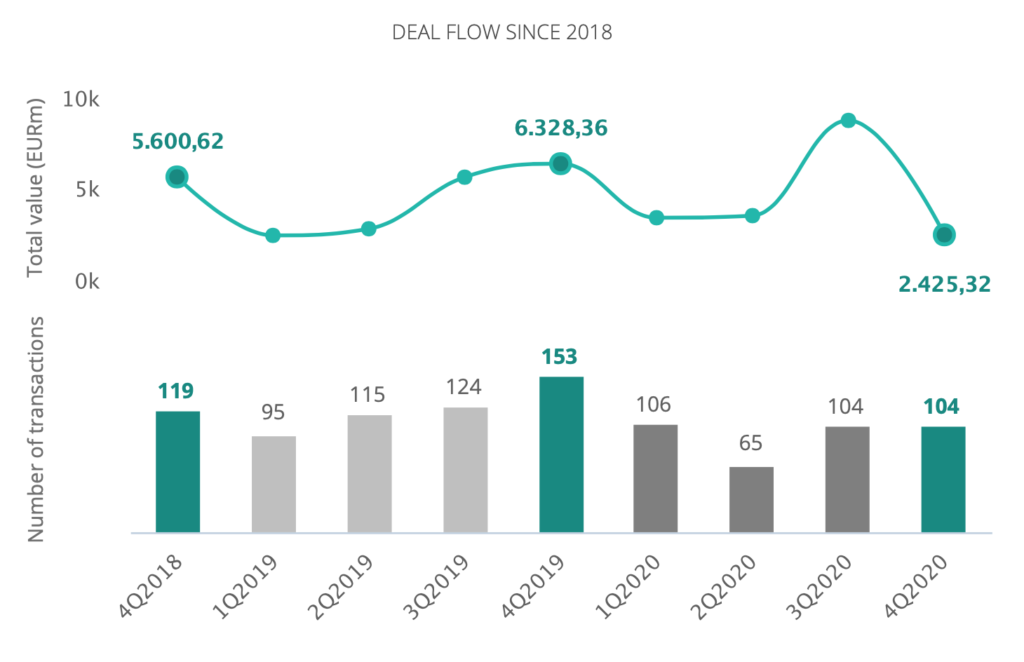
O mercado transacional português registou em 2020, 379 fusões e aquisições, das quais 182 tiveram valore divulgados que somaram EUR 18bi, segundo dados do TTR. Isto representa um aumento de 5% do valor movimentado e uma diminuição de 22% no volume  de transações em relação ao ano de 2019.  

No quarto trimestre do ano se registaram 104 transações, que apesar de representar uma redução de 32% em em relação ao 4T19, mantêm a tendência de alta observada no terceiro trimestre. 

Âmbito Cross-Border 

No que se refere às transações cross-border, houve uma redução generalizada na atividade em 2020, os Estados Unidos reduziram suas aquisições em Portugal em 67%, enquanto os Fundos de Private Equity e Venture Capital estrangeiros reduziram seus investimentos em Portugal em 33%, e até mesmo o sector historicamente mais atrativo para empresas estrangeiras, Tecnologia, sofreu queda de 13%. 

A Espanha continua sendo o principal investidor em Portugal e esteve envolvida em 34 operações até o fim de dezembro, o segundo país que mais investiu em Portugal em 2020 foi a França com 22 transações, e o terceiro mais ativo foi o Reino Unido que esteve envolvido em 21 operações. 

Em relação à atuação portuguesa no exterior, Espanha é o destino favorito na hora de realizar investimentos, com 16 transações registadas até o fim de dezembro. O segundo lugar onde Portugal investiu mais em 2020 é o Brasil com seis transações. 

Private Equity 

Em 2020, os fundos de Private Equity estiveram envolvidos em 29 transações, das quais 12 tiveram valores divulgados que somam EUR 4,2bi.  Estes números representam uma queda de 41% no número de negócios e um modesto aumento de 3% no valor total.  

Venture Capital 

Os fundos de Venture Capital movimentaram um total de EUR 881m em 2020, aumento de 117% em relação a 2019. Foram 56 transações representando uma redução anual de 33%. O setor mais ativo foi o de Tecnologia com 27 transações, redução de 40% na comparação anual. 

Transação do trimestre 

A transação destacada pelo TTR no 4T20 foi a aquisição de 81,1% da Brisa, por parte do consórcio formado por APG, NPS – National Pension Service e Swiss Life Asset Managers. A operação do setor de infraestrutura movimentou EUR 2,4bi. 

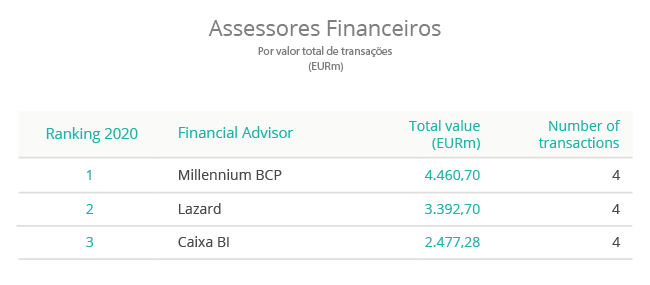
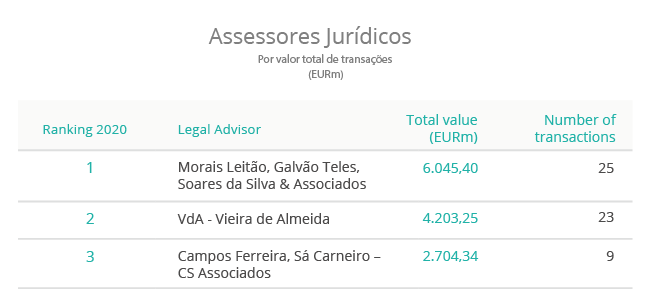
A transação contou com a assessoria legal em lei portuguesa dos escritórios Morais Leitão, Galvão Teles, Soares da Silva & Associados, VdA – Vieira de Almeida, Abreu Advogados e Campos Ferreira, Sá Carneiro – CS Associados ; A assessoria financeira ficou por conta da Caixa BI, Rothschild, Millennium BCP, EY Portugal e DC Advisory Partners. 

League Tables 

O informe publica os rankings de assessores financeiros e jurídicos até dezembro de 2020 en M&A, Private Equity, Venture Capital e Mercado de Capitais, onde se informa a atividade das firmas destacadas pelo valor total das mesmas. 

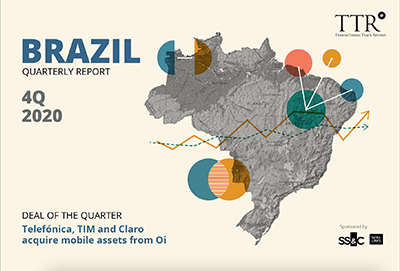
Informe Trimestral Brasil – 4T 2020

Mercado brasileiro registra 1.549 fusões e aquisições em 2020 

Volume de investimentos em Startups brasileiras aumenta 31% 

Os Estados Unidos reduziram suas aquisições no Brasil em 18% em 2020


Patrocinado por:

Intralinks

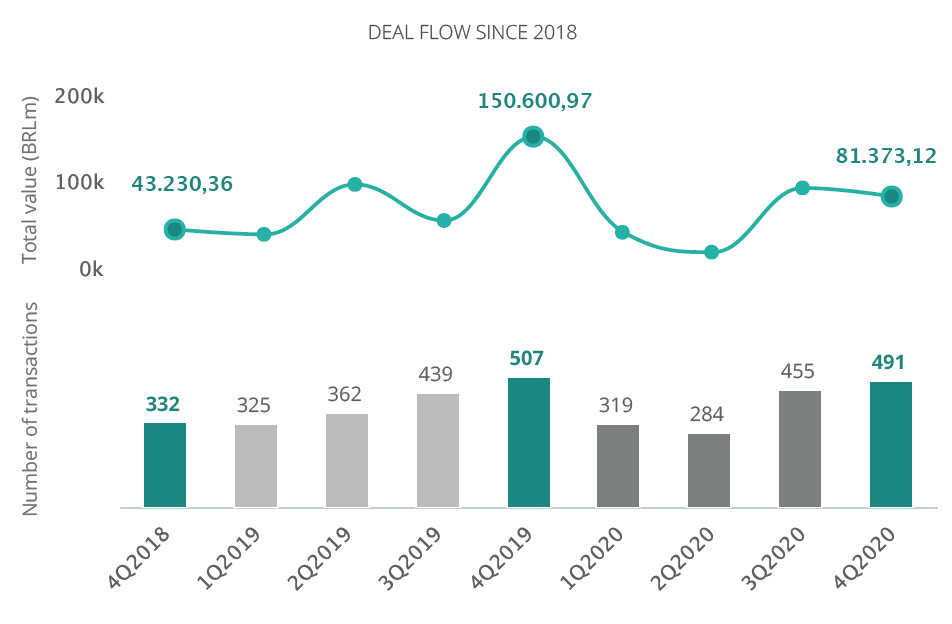
O mercado transacional brasileiro registrou em 2020,     1.549 transações e um valor total de BRL 229,5bi, segundo dados do TTR . Isto representa uma redução de 32% do valor movimentado e uma diminuição de 5% no número de transações em relação ao mesmo período de 2019.  

Por sua vez, o número de transações manteve a tendência de crescimento iniciada no segundo trimestre e atingiu um volume de 491 negócios no quarto trimestre do ano e um valor total de BRL 81,4bi.  Na comparação anual houve uma redução de 3% no número de transações em relação ao 4T 2019.  

Ao longo de todo o ano de 2020, o setor Tecnológico foi o mais ativo e registrou 504 transações , o que representa um aumento de 19% em comparação com 2019. No segundo lugar, o setor Financeiro e Seguros aumentou em 4%, com  um total de 222 operações. Já o setor de Higiene e Saúde foi o terceiro mais ativo que com 175 transações teve um aumento de 22% na comparação anual. 

Âmbito Cross-Border 

Em 2020, os Estados Unidos reduziram suas aquisições no Brasil em 18%. Da mesma forma, Fundos de Private Equity e Venture Capital estrangeiros também reduziram seus investimentos no Brasil em 42%. Já em relação a aquisição de empresas de Tecnologia por investidores estrangeiros não houve variação na comparação anual. 

Os Estados Unidos continuam sendo o principal investidor no Brasil e estiveram envolvidos em 119 aquisições em 2020, o segundo país que mais investiu no Brasil esse ano foi a Alemanha com 22 transações, e os terceiros más ativos foram a Espanha, o Reino Unido e o Canadá, que estiveram envolvidos em 15 aquisições no Brasil cada um deles.  

Em relação à atuação brasileira no exterior, Estados Unidos é o destino favorito na hora de realizar investimentos, com 24 transações registadas em 2020. O segundo lugar onde o Brasil investiu mais esse ano é a Colômbia com nove transações. 

Private Equity

Em 2020, foram registrados 124 investimentos realizados por os fundos de Private Equity, dos quais 42 tiveram valor divulgados que somaram BRL 11,5bi, o que representa uma redução de 55% na comparação anual.  

Venture Capital 

Os fundos de Venture Capital movimentaram um total de BRL 18,6bi em 2020, aumento de 71% em relação a 2019. Foram 421 rodadas de investimento, o que representa um crescimento anual de 35%. O setor mais ativo foi o de Tecnologia com 269 transações, aumento de 32% na comparação anual. O setor de Financeiro e Seguros apresentou 84 transações, crescimento de 29% e o terceiro setor mais ativo foi o de Higiene e Saúde com um salto de 132% em relação a 2019, com 44 investimentos. 

Transação do trimestre 

A transação destacada pelo TTR no 4T20 foi a aquisição de ativos móveis e licenças da Oi, por parte do consórcio formado pelas operadoras Telefônica Brasil, Tim e Claro. A operação do setor de telecomunicações móveis movimentou BRL 16,5bi. 

A transação contou com a assessoria legal em lei brasileira dos escritórios BMA – Barbosa Müssnich Aragão, Machado, Meyer, Sendacz e Opice Advogados, Pinheiro Neto Advogados e Veirano Advogados. A assessoria financeira ficou por conta do Banco Merrill Lynch Brasil, Banco BTG Pactual, Banco Itaú BBA e Deloitte. 

Ranking de assessores Jurídicos e Financeiros

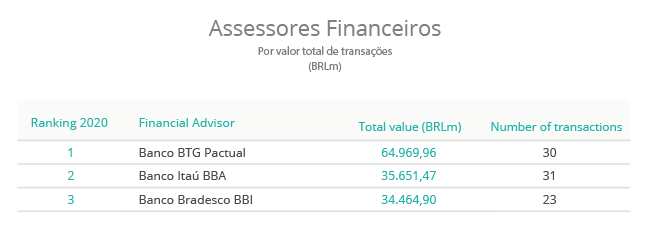
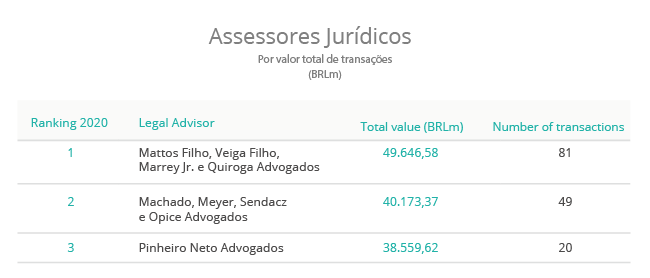
O informe publica os rankings de assessores financeiros e jurídicos em  2020 en M&A, Private Equity, Venture Capital e Mercado de Capitais, onde se informa a atividade das firmas destacadas pelo número de transações e pelo valor total das mesmas.

Dealmaker Q&A

Content available in English and Spanish (scroll down)

TTR DealMaker Q&A with Brigard & Urrutia Partner Darío Laguado

Darío LaguadoBrigard & Urrutia

Mr. Laguado joined the firm in 2010 and is currently the chairman of the Corporate/M&A practice.  Mr. Laguado focuses his practice in advising clients in cross-border transactions across multiple industries and in advising private equity funds in their investments and divestments in the country, currently having counseled on transactions exceeding an aggregate amount of US$10 billion.
Key representations include the merger of BVC and Deceval, the merger of ACE and Chubb, the merger of Colombia Telecomunicaciones and Movistar, the merger of Bank Itaú and Corpbanca, the acquisition by the Japanese company Itochu Corp. of an interest in Drummond, and the acquisition by Éxito of several companies in the region, among others. 
Some of the private equity funds that Mr. Laguado advises include Catterton Partners, MAS Equity Partners, Carlyle, Tribeca Capital Partners and Brookfield Asset Management, among others.


TTR: What are your main takeaways from 2020 in the Colombian M&A market?

D. L.: There are three main takeaways from 2020 in the Colombian M&A market: (i) even though there was a slowdown in the M&A activity in the country, the market rebounded quickly, which demonstrates that the long-term fundamentals, such as market appetite, liquidity and growth perspectives, seem to be largely unaffected; (ii) as history teaches us, there were winning and losing industries, and it is possible that the former outweigh the latter; and (iii) the pandemic accelerated trends that are inevitably transforming the legal industry, such as digitalization, technological improvements, remote work, etc.  

TTR: Brigard & Urrutia has advised on important deals in health and technology in Colombia this year. What op drive consolidation in each of these sectors in 2021 and in the op la-to-long term? 

D. L.: Indeed, this year we have had the opportunity to participate in interesting transactions. On the one hand, in the health sector, we have participated in the acquisition of assets related to the renal care unit of Clinica Medilaser, the acquisition by Clever Leaves Holdings Inc. of SAMA and its possible entry into NASDAQ; and the sale of National Clinics’ Hospitals; Clínicas Nacional Centenario and Clínicas Nacionales los Nevados, located in Bogotá and Pereira, as well as the contractual assignment of a collaboration agreement through which National Clinics exercised control of the San Rafael Clinic and the sale of the properties in which these clinics operate. On the other hand, in the technology sector, we have participated in the acquisition by MD Cloud Practice Solutions of a majority stake in Wiedii S.A.S. (company specialized in software development and web or mobile applications), the acquisition by Greensill PTY of Omni Intermediate Holdings, LLC and the acquisition by Will Hill Ltd of Alfabet S.A.S. in the online gambling sector.

In 2021, we believe that health and technology operations in Colombia will continue to be driven especially as a consequence of the strength that these sectors have acquired with the arrival of the pandemic in Colombia.

TTR: Technology and Internet were the most dynamics sectors in 2020 in Colombia. What op be the next driver of consolidation in these sectors once the digital transformation wave has played out?

D. L.: The pandemic has created a need to digitize a large part of company processes today has generated an evident growth in the technology and internet sector. This will possibly lead to growth of the different startups and enterprises in the sector, which before Covid-19 we would not have believed would happen so quickly. Examples of this will surely be consolidated in the education, in cybersecurity, telecommunications, delivery, online shopping sectors, among others. These sectors will continue to grow due to regional consolidation, population growth, and new trends that were accentuated by the pandemic.

TTR: What do you expect to be the main challenges for law firms advising on M&A transactions in Colombia and Latin America during 2021?

D. L.: We see several challenges in the year 2021:

In first place, the practice of M&A will surely be influenced by the “aftermath” of the crisis generated by the pandemic. As in any crisis, there are those who have benefited from the pandemic and this can make them active players in the practice of mergers and acquisitions, but certainly there are others who have been greatly affected and we can find them as targets in mergers and acquisitions transactions. For example, companies that have traditionally been reluctant to invest in third parties may have a greater appetite to consider such operations with a view to diversifying their assets or accessing fresh capital. Some private equity funds may see investment options that were previously unavailable. Likewise, we think that the operations of sale or investment of companies in crisis situations will possibly increase.

Second, the government’s fiscal situation, accentuated by the pandemic, will possibly fuel a wave of privatizations, which are highly challenging as they must be implemented through a demanding legal process. These are very relevant operations for the country.

Third, law firms will have to continue operating in a virtual environment for some time. The rituals of closing a transaction can involve formalities and deliverables that require physical presence. The pandemic has forced us to make the transition from these activities to a virtual environment. Except in very rare cases, this transition is perfectly achievable thanks to communication platforms, specialized software, and a little more coordination and discipline. Since they save time and money; Some of the new dynamics may come to stay and it will be a challenge in 2021 to learn and continue to improve in the virtual M&A activity. In terms of due diligence, although for many years most of it has already been done virtually, there are still some aspects that require presence, such as presentation of the administration, field visits, etc.


Spanish version


Darío LaguadoBrigard & Urrutia

Es miembro de la firma desde 2010 y actualmente es socio de la práctica de Corporativo/M&A. Enfoca su práctica en la asesoría a clientes en transacciones transfronterizas en múltiples industrias y en la representación de fondos de capital privado en sus inversiones y desinversiones en el país. El valor de las transacciones en las que ha participado excede de US$10 billones.  
Algunas de las transacciones en las que ha participado incluyen la fusión entre la BVC y Deceval; la fusión de ACE y Chubb; la fusión de Colombia Telecomunicaciones y Movistar; la fusión del Banco Itaú con Corpbanca; la adquisición por parte de la compañía japonesa Itochu de una participación en Drummond; la adquisición por parte del grupo Éxito de varias compañías en la Región, entre otros. 
Entre los fondos de capital privado que asesora se encuentran Catterton Partners, MAS Equity Partners, Carlyle, Tribeca Capital Partners y Brookfield Asset Management, entre otros.


TTR: ¿Cuáles son sus principales conclusiones de 2020 en el mercado de fusiones y adquisiciones colombiano?

D. L.: Hay tres conclusiones principales de 2020 en el mercado colombiano de fusiones y adquisiciones: (i) a pesar de que hubo una desaceleración en la actividad de fusiones y adquisiciones en el país, el mercado se recuperó rápidamente, lo que demuestra que los fundamentos de largo plazo, como el apetito del mercado, las perspectivas de liquidez y crecimiento no parecen verse afectadas en gran medida; (ii) como nos enseña la historia, hubo industrias ganadoras y perdedoras, y es posible que las primeras superen a las segundas; y (iii) la pandemia aceleró tendencias que inevitablemente están transformando la industria legal, como la digitalización, las mejoras tecnológicas, el trabajo a distancia, entre otros.

TTR: Brigard Urrutia ha asesorado este año importantes operaciones de salud y tecnología en Colombia. ¿Qué impulsará la consolidación en cada uno de estos sectores en 2021 en el mediano y largo plazo?

D. L.: Así es, este año hemos tenido la oportunidad de participar en interesantes transacciones. Por un lado, en el sector salud, hemos participado en la adquisición de activos relacionados a la unidad de cuidados renales de Clinica Medilaser, la adquisición por parte de Clever Leaves Holdings Inc. de SAMA y su posible entrada a NASDAQ; y, la venta de los hospitales de National Clinics; Clínicas Nacional Centenario y Clínicas Nacionales los Nevados, ubicadas en Bogotá y Pereira así como la cesión contractual de un contrato de colaboración mediante el cual ejercía el control de la Clínica San Rafael y la venta de los inmuebles en los que operan dichas clínicas. Por otro lado, en el sector tecnológico, hemos participado en la adquisición por parte de MD Cloud Practice Solutions de una participación mayoritaria en Wiedii S.A.S. (empresa especializada en desarrollo de software y aplicaciones web o móviles), la adquisición por parte de Greensill PTY de Omni Intermediate Holdings, LLC y la adquisición por parte de Will Hill Ltd de Alfabet S.A.S. en el sector de los juegos de azar online.

En el 2021, creemos que las operaciones de salud y tecnología en Colombia seguirán siendo impulsadas especialmente como consecuencia de la fuerza que estos sectores han adquirido con la llegada de la pandemia a Colombia. 

TTR: El sector tecnológico e internet han sido los más dinámicos en 2020 en Colombia. ¿Cuál será el próximo motor de consolidación en estos sectores una vez que se haya desarrollado la ola de transformación digital? 

D. L.: La necesidad que ha dejado la pandemia de digitalizar una gran parte de los procesos de las empresas, hoy en día, ha generado un evidente crecimiento en el sector tecnológico y de internet. Esto posiblemente conllevará crecimientos de los diferentes startups y emprendimientos del sector, que antes del Covid-19 no hubiéramos creído sucederían tan rápido. Ejemplos de esto seguramente se consolidarán en el sector educativo, en el sector de ciberseguridad, telefonía, delivery, compra online, entre otros.  Estos sectores seguirán creciendo debido a la consolidación regional, el crecimiento demográfico y las nuevas tendencias que fueron acentuadas por la pandemia.

TTR: ¿Cuáles espera que sean los principales retos para los despachos de abogados que asesoran en operaciones de M&A en Colombia y América Latina durante 2021?

D. L.: Vemos varios retos en el año 2021:

En primer lugar, la práctica de M&A seguramente se verá influenciada por el “aftermath” de la crisis generada por la pandemia.  Como en toda crisis, hay quienes se han beneficiado de la pandemia y esto puede convertirlos en actores activos en la práctica de fusiones y adquisiciones, pero ciertamente hay otros que se han visto muy afectados y podemos encontrarlos como objetivos en transacciones de fusiones y adquisiciones.  Por ejemplo, es posible que empresas que tradicionalmente han sido reticentes a la inversión de terceros tengan mayor apetito para considerar ese tipo de operaciones con miras a diversificar su patrimonio o a acceder a capital fresco.  Es posible que algunos fondos de capital privado vean opciones de inversión que antes no estaban disponibles.  Así mismo, Pensamos que las operaciones de compraventa o de inversión de empresas en situaciones de crisis posiblemente incrementarán.

En segundo lugar, la situación fiscal del gobierno, acentuada por la pandemia, posiblemente fomentará una ola de privatizaciones, las cuales son altamente retadoras pues deben implementarse mediante un proceso legal exigente.  Estas son operaciones muy relevantes para el país.   

En tercer lugar, las firmas de abogados tendrán que seguir operando en un ambiente virtual por algún tiempo.  Los rituales de cierre de una transacción pueden involucrar formalidades y entregables que requieren presencia física. La pandemia nos ha obligado a realizar la transición de estas actividades a un entorno virtual. Excepto en casos muy raros, dicha transición es perfectamente alcanzable gracias a plataformas de comunicación, software especializado y un poco más de coordinación y disciplina. Ya que ahorran tiempo y dinero; algunas de las nuevas dinámicas pueden llegar para quedarse y será un reto en el 2021 aprender y continuar mejorando en la actividad de M&A virtual.  En materia de debida diligencia, si bien por muchos años la mayor parte ya se hace de manera virtual, todavía hay algunos aspectos que requieren presencialidad, como presentación de la administración, visitas de campo, etc.

Dealmaker Q&A

Content available in English and Spanish (scroll down)

TTR DealMaker Q&A with Allen & Overy Partner Fernando Torrente

Fernando TorrenteAllen & Overy

Fernando Torrente with more than 30 years of experience is specialized in Spain in M&A and Equity Capital Markets, including takeovers, IPOs, flotations, securities issue and placement, secondary offerings and follow-on capital offerings. Additionally he is an expert in corporate governance and formed part of the group of lawyers that advised the Comisión Nacional del Mercado de Valores (CNMV) in preparing the Code of Good Governance of Listed Companies approved in February 2015


TTR: How do you see the M&A market after the current crisis and what are your main conclusions for 2020?

F. T.: Unfortunately, the crisis is not over and many of its worst effects, the most damaging affecting employment and a dramatic destruction of the business network, will be aggravated in 2021. However, the positive results obtained in the research and development processes of different vaccines have produced a very relevant change in the perception that companies and investors have about the development of the crisis and the recovery. This has led them to take decisions to search for investment opportunities, initiate consolidation processes, restructure their balance sheets, segregate areas of activity to open them to the participation by investors, put non-strategic assets up for sale or request a rescue of public funds. If the vaccine protection provides the expected response, this is going to be a determining factor in making 2021 a very active year, in which the market is going to offer a significant variety and number of transactions.

TTR: Many Spanish companies have taken on large debts or depend on government support to stay in business. How do you think this situation will crumble and how will this affect the M&A market?

It will depend a lot on market behaviour and the evolution of consumption and business recovery. There will be very difficult situations in which it will not be possible to repay the debt, which will involve restructuring and conversion processes and it will be necessary to take measures from the political, monetary and fiscal points of view. It is inevitable, unfortunately, that many companies will not be able to pay their debts, and this will cause divestments of assets or corporate spin-offs, rescue operations, consolidation processes, restructuring and insolvency proceedings, and distressed M&A transactions.

TTR: Up to November, the total value of transactions in Spain rose by 37%, according to TTR data, while the number of transactions decreased by 23%. How do you understand this divergence?

It is probably explained by the extraordinary situation that the world went through in 2020 due to the pandemic and the serious crisis caused by that, in which we are still immersed. The year 2020, without Covid-19, seemed uncertain after previous years with high growth in the M&A market. However, the total standstill of the economic activity, resulting from the general lockdown, had a pertinent impact on this market. Only a few transactions continued during this period, those that made strategic and business sense and which were led by very strong players in the financial field. The end of the first wave meant that the transactions, which had been paralysed, continued because it still made sense, as they were led by companies or investors with the capacity to deal with them, because of their strength, and because they took place in sectors that had proved resistant to the crisis. After the summer, we also saw consolidation transactions in the banking sector and the reactivation of the M&A market for smaller companies, which had been more affected. Logically, in such a difficult environment, opportunities are taken by those who are stronger and have a higher investment capacity. Besides, due to the huge liquidity existing in the market, particularly in private equity funds, there are fewer transactions but these have a higher volume.

TTR: Technology was the only sector that had more agreements this year than in 2019. What will be the next engine of consolidation in this sector once the wave of digital transformation has developed?

I think that the process of digital transformation, which started before the pandemic and which was accelerated by Covid-19 in a very intense way, still has a long way to go and I do not dare to predict when it might end.

The strongest companies have made very important investments in order to boost their development and will continue to do so, combining that with other investment and development elements, which are going to be a priority, such as sustainability. Those companies that have not had that financial strength but will survive the crisis, will continue with the digitalisation processes. I believe that the dynamism of this sector and its key role in the economy and society will continue to give it an enormous role.

TTR: Allen & Overy Spain has advised on renewable energy and technology transactions in Spain this year. What will drive consolidation in each of these sectors in 2021 and in the medium to long term?

Energy and technology are sectors in which there has been a lot of activity for a long time. Oil and electricity companies have long been undertaking a process to adapt their business to the energy transition, which has intensified in recent years, especially in 2020, for those who had not faced it decisively. These are sectors in continuous evolution, in which management teams have high capacity and the investors have great interest in their different aspects, infrastructures, core and secondary business, and so it is logical that consolidation processes take place through acquisitions or mergers, as well as through the appearance of new players.

TTR: What role do you expect Spanish telecommunications companies to play in mergers and acquisitions, nationally and internationally, in the next year?

Telecommunications companies have an extraordinarily important role, due to their business relevance, because they are providers of essential services, the very high qualification of their teams, their technological nature, and the fact that they are a driving force in innovation and development. During the last year we have seen very relevant transactions, such as the merger/combination of Liberty and Telefónica UK, and the takeover bid for Masmovil and Cellnex’s transactions. We will probably continue to see important transactions of very different types this year, for these reasons and the great interest they rouse among private equity funds searching for investment opportunities.

TTR: What do you expect to be the main challenges for law firms advising on M&A transactions in Spain over the next 12 to 18 months?

The market is moving very fast facing the opportunities that arise and there is going to be a very wide variety of transactions for which the law firms’ teams have to be ready to give advice of extraordinary quality and speed.

We are going to see distressed transactions, restructuring, processes of segregation of business units or branches of activity in which total or partial disinvestments will be sought, public to private transactions, mergers responding to sector consolidation processes, shareholder activism, dual tracks in which shareholders will seek to maximise the profitability of their investment through an IPO or a private M&A transactions. The international component will be very relevant and, until the Covid-19 pandemic stabilises, the environment will be very volatile. All this will demand the best from our teams and we have to be able to give our clients the best of us.  


Spanish version


Fernando TorrenteAllen&Overy

Fernando Torrente, con 30 años de experiencia, es uno de los abogados más reconocidos de España en fusiones y adquisiciones y en mercado de capitales tales como OPAs, salidas a bolsa, emisión y colocación de valores, OPV y OPS. Además Fernando tiene amplia experiencia en gobierno corporativo y formó parte del Grupo de abogados que asesoró a la CNMV en la elaboración del Código de Buen Gobierno de las Sociedades Cotizadas aprobado en febrero de 2015.


TTR: ¿Cómo ve el mercado de fusiones y adquisiciones después de la crisis actual? ¿Cuáles son sus principales conclusiones de 2020?

Desgraciadamente la crisis no ha terminado y muchos de sus peores efectos, los más lesivos porque afectan al empleo y a una dramática destrucción de tejido empresarial, se van a agudizar en este año 2021. No obstante, los buenos resultados obtenidos en los procesos de investigación y elaboración de las distintas vacunas – a pesar de la incapacidad que están evidenciando muchos dirigentes políticos en el diseño e implementación de los procesos de vacunación de la población que esperemos se corrija – han producido un cambio muy relevante en la percepción por empresas e inversores sobre el desarrollo de la crisis y la recuperación, que les ha llevado a tomar decisiones para buscar oportunidades de inversión, iniciar procesos de consolidación, reestructurar sus balances, segregar áreas de actividad para abrirlo a la participación de inversores, poner en venta activos no estratégicos o solicitar un salvamento de fondos públicos. Ello va a ser determinante para que el año 2021 sea, si la protección de la vacuna da la repuesta esperada, un año muy activo en el que el mercado va a ofrecer una variedad y un número de operaciones importante.

TTR: Muchas empresas españolas han asumido grandes deudas o dependen del apoyo del gobierno para mantenerse en el negocio. ¿Cómo cree que se desmoronará esta situación y cómo afectará esto al mercado de fusiones y adquisiciones?

Dependerá mucho del comportamiento del mercado y de la evolución del consumo y la recuperación empresarial. Va a haber situaciones muy difíciles en las que no va a ser posible devolver la deuda, ello implicará procesos de reestructuración y reconversión y será necesario que se adopten las medidas adecuadas desde el punto de vista político, monetario  y fiscal. Va a ser inevitable, desgraciadamente, que muchas empresas no tengan capacidad para afrontar el pago de sus deudas, y ello provocará desinversiones de activos o divisiones de negocio, operaciones de salvamento, procesos de consolidación, reestructuraciones y concursos y operaciones de distressed M&A.

TTR: Hasta noviembre, el valor total de las transacciones en España subió un 37%, según datos de TTR, mientras que el número de transacciones disminuyó un 23%. ¿Cómo interpreta esta divergencia?

Probablemente se explica por la extraordinaria situación que el mundo ha vivido en el año 2020 como consecuencia de la pandemia y la gravísima crisis que ha provocado en la que seguimos inmersos. El año 2020, sin COVID, se presentaba con ciertas incertidumbres después de años previos de gran crecimiento del mercado de M&A. Sin embargo, la paralización total de la actividad económica que se derivó del confinamiento general, tuvo el correspondiente impacto en este mercado. Solo algunas operaciones continuaron en ese periodo, las que tenían sentido estratégico y empresarial y estaban protagonizadas por actores muy fuertes económicamente. El fin de la primera ola hizo que operaciones que se habían paralizado pero que seguían teniendo sentido continuaran, de nuevo por estar protagonizadas por empresas o inversores con capacidad para afrontarlas, por su fortaleza, y por tener lugar en sectores que se han mostrado resistentes a la crisis. A la vuelta del verano hemos asistido también a operaciones de consolidación del sector bancario y se reactivó el mercado de M&A de empresas de menor tamaño que se había visto más afectado. Es lógico que en un entorno tan difícil, las oportunidades sean aprovechadas por quienes son más fuertes y disponen de mayor capacidad de inversión y que, por la muy elevada liquidez que existe en el mercado, particularmente en fondos de private equity, haya menos operaciones pero estas sean de mayor volumen.

TTR: La tecnología fue el único sector que tuvo más acuerdos este año que en 2019. ¿Cuál será el próximo motor de consolidación en este sector una vez que se haya desarrollado la ola de transformación digital

Pienso que el proceso de transformación digital que había empezado antes de la pandemia y que el COVID 19 ha acelerado de forma muy intensa, tiene todavía mucho por hacer y no me atrevo a ponerle fin. Las empresas más fuertes han hecho inversiones muy importantes para potenciar su desarrollo y van a seguir haciéndolo, combinándolo con otros elementos de inversión y desarrolllo que van a ser prioritarios como es la sostenibilidad. Pero las empresas que no han dispuesto de esa fortaleza financiera pero sobrevivan a la crisis, seguirán con los procesos de digitalizacion. El dinamismo de este sector y su papel tan determinante en la economía y en la sociedad creo que van a seguir dándole un enorme protagonismo.

TTR: Allen & Overy España ha asesorado este año en operaciones de renovables y tecnología en España. ¿Qué impulsará la consolidación en cada uno de estos sectores en 2021 y en el mediano y largo plazo?

Energía y tecnología son sectores en los que se está produciendo desde hace tiempo mucha actividad. Petroleras y eléctricas llevan tiempo emprendiendo un proceso para adaptar su negocio a la transición energética, que se ha visto intensificado en los últimos años,  especialmente en el 2020 para aquellos que no lo habían afrontado con decisión. Son sectores en continuan evolucion, en los que existe una gran capacidad de los equipos gestores y un gran interés de los inversores en sus distintas vertientes, infraestructuras, negocio principal y accesorios en los que es lógico que se produzcan procesos de consolidación mediante adquisiciones o fusiones así como la aparición de nuevos actores. 

TTR: ¿Qué papel espera que desempeñen las empresas de telecomunicaciones españolas en las fusiones y adquisiciones, a nivel nacional e internacional, en el próximo año?

Las empresas de telecomunicaciones tienen un papel extraordinariamente relevante, por su relevancia empresarial, por ser proveedores de servicios esenciales, la altísima cualificación de sus equipos, por su carácter tecnológico y ser motor en el plano de innovación y desarrollo. Hemos visto este año pasado operaciones muy relevantes, como han sido la fusión/combinación de Liberty y Telefónica UK, la Opa sobre Masmovil y las operaciones de Cellnex. Seguramente este año seguiremos viendo operaciones importantes de muy distinto tipo, por estas razones y el gran interés que despiertan entre los fondos de private equity que buscan oportunidades de inversión.

TTR: ¿Cuáles espera que sean los principales retos para los despachos de abogados que asesoran en operaciones de M&A en España durante los próximos 12 a 18 meses?

El mercado se mueve con mucha rapidez ante las oportunidades que se presentan y va a existir una variedad muy amplia de operaciones para las que los equipos de los despachos de abogados debemos estar muy preparados para dar un asesoramiento de extraordinaria calidad y respuesta. Vamos a ver convivir operaciones distress, reestructuraciones, procesos de segregación de divisiones de negocio ó ramas de actividad en los que se buscarán desinversiones totales o parciales, operaciones Public to private, fusiones que responden a procesos de consolidación sectorial, activismo accionarial, dual tracks en el que los accionistas buscarán maximizar la rentabilidad de su inversión a través de un IPO o de una operación de M&A privado. El componente internacional será muy relevante y hasta que la pandemia COVID se estabilice, el entorno va a ser muy cambiante. Todo ello va a exigir lo mejor de nuestros equipos y deberemos ser capaces de dar a nuestros clientes lo mejor de nosotros.  
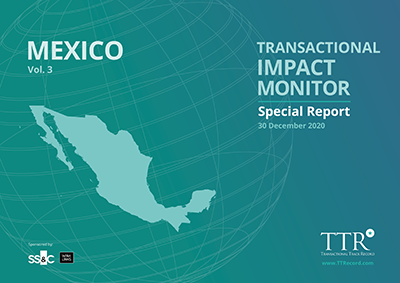
Transactional Impact Monitor: Mexico – Vol. 3


Transactional Impact Monitor: Mexico – Vol. 3

30 December 2020

TTR’s Transactional Impact Monitor (TIM) is a Special Report combining local knowledge and market visibility from top dealmakers developed to address extraordinary situations affecting the macroeconomic stability and M&A outlook in core markets


INDEX

– M&A Outlook
– Private Equity
– Capital Markets
– Handling the Crisis
– Dealmaker Profiles

There is no doubt that 2020 has been one of the most challenging years in Mexico for decades, made all the more difficult by the slow reaction and absence of mitigating measures provided by the government, in contrast to most other nations. 

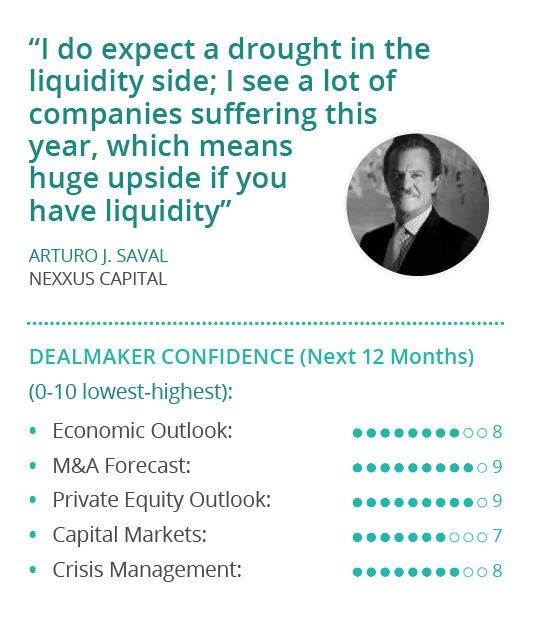
“Mexico has endured a deeper recession because we haven’t had the government support,” said Nexxus Capital Founder and Chairman of the Board Arturo Saval. “I’ve never lived through anything like this.” Several sectors have been put under enormous stress, he noted, none more so than the country’s normally booming hospitality industry. 

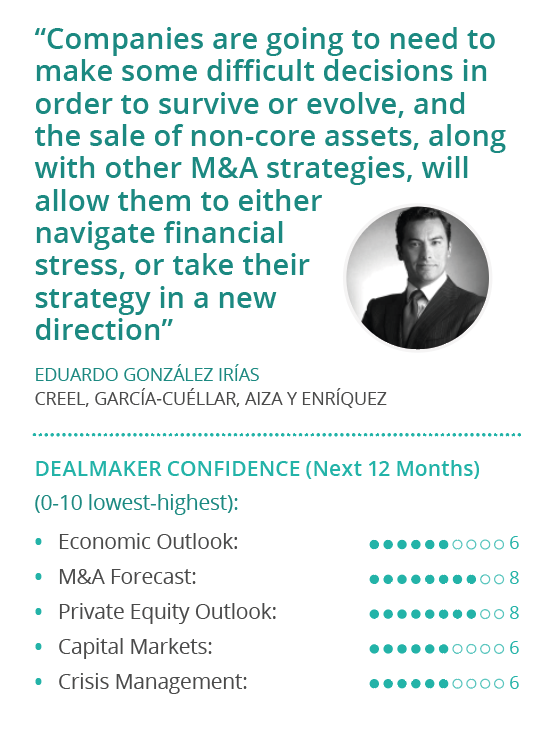
If there’s any optimism in Mexico’s business community as 2020 draws to a close, it’s relative to the dire pessimism that pervaded at the close of the first quarter, said Creel, García-Cuéllar, Aiza y Enríquez Partner Eduardo González.

There was great uncertainty over how the markets would react, González recalled, and many transactions that were on the cusp of closing were suspended as a result, some led by financial sponsors that relied on credit lines with local banks, others that depended on international financing. International lenders froze loan processing for several months, putting deals that relied on debt on ice, González said. 

Mexico’s private sector has been damaged, and the health of the country’s financial system remains precarious, said Saval. Of Mexico’s 51 banks, 25 will have a very hard time, and some will shut down for good, Saval predicted, which will put extra pressure on the large ones that remain, many of which are based overseas and are facing stress in their home markets as well. “There will be a lot of stress in the banking industry globally, which will make them reluctant to increase their exposure in Mexico,” he said.

The downturn has affected deals in a range of sectors, from construction to chemicals and consumer products, with some proving far more vulnerable than others, González said. “We saw up close people trying to get out of signed deals, invoking force majeure events or breach of contract,” he noted.

The uncertainty clouded financial projections, with no assurance that companies would be able to maintain their revenue and EBITDA margins in an unknown economic climate, he added. “Nobody thought they’d be able to maintain their sales volumes; nobody knew how the world economy would work with everybody being asked to stay at home.”

There are sectors that have been severely affected, but many continue operating and the fall in sales and profitability hasn’t been as devastating as anticipated, which has resulted in cautious optimism, González said.

Some industries have indeed been flourishing, Saval noted, with the surge in e-commerce bolstered by Mexico’s lag in this area pre-crisis. The country is underleveraged compared to many of its peers in Latin America and state finances are in good shape, with the exception of the country’s national oil company Pemex, “mostly because of the position the government has taken”, Saval added.

Investment in Mexico’s energy sector has been impacted by the policy position of the Andrés Manuel López Obrador (AMLO) administration, which eroded investor confidence in the renewable energy market and put a damper on reforms passed by his predecessor, González explained. 

Nonetheless, there are still investors out there for good assets, he said, and many, like China’s State Power Investment, which bought wind farm operator Zuma Energía in November, are accustomed to regulatory and political risks. The policy position of Mexico’s current government has made the energy sector less attractive, but renewable deals still command interest, he said. Similarly, appetite for Mexico’s road infrastructure among Canadian pension funds has also held up, González said, as evidenced by the recent sale of IDEAL.

Investment in conventional energy, on the other hand, faces tremendous hurdles, González said. “It’s difficult to understand the intentions of the government in areas that they themselves have politicized,” he said. “AMLO has consistently tried to make the petroleum industry a sacred cow for the people of Mexico for many years, and decisions governing the sector won’t likely be made based on any market intelligence, nor geopolitics, but rather for his own political benefit,” he added.

M&A Outlook
Click here to access the third issue of Transactional Impact Monitor: Mexico – Vol. 3.

Transactional Impact Monitor: Mexico – Vol. 3