Dealmaker Q&A

TTR DealMaker Q&A with Clifford Chance Partner Guillermo Guardia

Guillermo GuardiaClifford Chance (Barcelona office)

Law degree from Universidad de Barcelona (1996).
Guillermo joined Clifford Chance in January 2000 and has an extensive experience in international mergers and acquisitions, private-equity and joint-venture transactions.
He has also advised several national and international financial institutions and corporations on acquisition finance, corporate financing and project finance transactions both in the energy and in the infrastructure sector. In 2007 he was seconded to the Private Equity Group of the London office of Clifford Chance. 
Lecturer at the Law Faculty of the Universidad de Barcelona.
Ranked in Chambers & Partners.


TTR: M&A activity was very strong in Spain in early 2020, but things changed considerably by the close of 1Q20. How would you describe the current situation in the transactional market in Spain? 

G. G.: We are facing an unprecedented situation in all areas, and M&A is no exception. 

We cannot apply a market situation reading across all sectors, since many of them are facing very different situations. While certain sectors, such as renewables, telecoms and healthcare, are seeing a boom in transactions and are clearly in a phase of expansion, others are focusing on reordering or consolidating their activities in order to increase their profitability at medium and long term. There is also a third group, the most damaged by the health crisis, in which distress sales are becoming ever more frequent. 

This is probably one of the most striking aspects of the current situation, since in other times of changing circumstances, all sectors have generally experienced the same situation of crisis or expansion. 

TTR: What is the current situation in Spain and what are the prospects for the coming months where corporate restructurings are concerned? 

G. G.: The health crisis took many companies by surprise, and those most affected have had to obtain immediate liquidity facilities. As the year has gone on, more and more companies have had to restructure their debt at short and medium term and offer certain non-core business units for sale. 

We believe that this trend will continue into at least the first half of 2021. 

TTR: Clifford Chance has advised numerous renewable energy transactions in 2020. How do you explain the strong deal volume in this segment and what opportunities have you come across in recent months within this context? What factors will need to coincide for this trend to hold in the medium-to-long term? 

G. G.: The renewable energy sector has indeed demonstrated extraordinary resilience in the current circumstances, and Clifford Chance has advised on numerous transactions, both in relation to assets under development and the purchase and sale of consolidated projects on the secondary market. 

A fundamental factor in this situation is the enormous liquidity present in the market. There are other factors that have buoyed the sector, however, such as a regulatory framework that fosters legal certainty and contractual instruments that ensure a project’s credit quality. 

Renewable and efficient energy technologies will be one of the largest beneficiaries of the EU funds earmarked to alleviate the Covid-19 crisis. To the extent that the markets’ liquidity remains stable, this will continue to be a particularly active sector at medium and long term. 

TTR: Which three sectors do you expect to be most attractive to investors with firepower in 4Q20 and early 2021? 

G. G.: In addition to renewables, as mentioned above, we would highlight the healthcare and infrastructure sectors. 

We believe that there are various factors at work in the healthcare sector that will allow for significant transactional activity in the future. First of all, the consolidation of the trend towards specialisation and segmentation among the major Spanish pharma companies. This will lead to sales of non-core assets (typically the division of generics and manufacturing for third parties) as well as strategic acquisitions of product portfolios. To this must be added the greater interest in the healthcare sector among private equity funds. We believe that private capital will be an increasingly important player in the sector over the next few years. 

The infrastructure industry, meanwhile, which has been very active in 2020 despite the health crisis, is beginning to show signs of slowing down, which could have a 

decisive impact in 2021. While demand remains stable and funds continue to show interest in investing in this type of asset, the problem could come from the supply side. Tenders for new infrastructure projects have been decreasing substantially over the last few years, which will inevitably lead to fewer assets available to investors or to lower-quality assets. 

TTR: Which regulatory measures could help the Spanish M&A market recover more quickly? 

G. G.: One measure that would doubtless aid in the recovery of the M&A market would be the revision of legislation on foreign investment. The changes introduced in this area create a lot of doubt among international investors, and it would of course be helpful to devise a clear, effective and transparent system. We believe that certain areas for improvement have become clear since this legislation came into force. 

Second, the administration should take advantage of the EU’s Recovery and Resilience Facility to drive investment in new infrastructure projects in the sustainable mobility, water and environment and health areas.

DealMaker Q&A

Conteúdo disponível em Português e Inglês

TTR DealMaker Q&A com Marcelo G. Ricupero, sócio de Mattos Filho, Veiga Filho, Marrey Jr. e Quiroga Advogados

Marcelo G. RicuperoMattos Filho, Veiga Filho, Marrey Jr. e Quiroga Advogados

Marcelo G. Ricupero assessora clientes nacionais e estrangeiros em operações de fusões e aquisições e fundos de private equity. Sua atuação engloba, também, a representação de investidores, credores e devedores em operações complexas de reestruturação de dívidas. Foi advogado no escritório de Nova Iorque da Skadden, Arps, Slate, Meagher & Flom (EUA). Bacharel em Direito pela Universidade de São Paulo (USP), também possui especialização em Valores Mobiliários pela mesma universidade.


TTR: As fusões e aquisições em 2020 tiveram um primeiro trimestre “recorde” no Brasil, mas no início da crise de saúde COVID-19, a tendência mudou consideravelmente: como você descreveria a situação atual dos players no mercado transacional no Brasil nesta nova etapa?

M. G. R.: Acho que o mercado de fusões e aquisições no Brasil já deu algumas provas de que é um mercado maduro e sofisticado, ainda mais considerando as crises e dificuldades enfrentadas nos últimos anos. Embora seja verdade que, com a pandemia, as operações tiveram uma queda, acho que a maioria já voltou e novas operações também surgiram. Acho este um ponto importante. Há alguns anos, quando havia uma crise internacional, o mercado normalmente esperava a crise terminar para reaquecer. Agora, ele reaquece mesmo durante a crise. Nós estamos esperando um último trimestre bastante movimentado, embora existam fatores que podem comprometer essa expectativa.

TTR: Mattos Filho, Veiga Filho, Marrey Jr. e Quiroga Advogados é um dos principais assessores do mercado de capitais do Brasil de acordo com o ranking jurídico do TTR. Como você avalia o grande número de empresas que buscam abrir capital no Brasil em 2020 e quais oportunidades elas encontraram nos últimos meses pela situação atual do mercado local? Essa tendência de alta poderia prevalecer no médio e longo prazo?

M. G. R.: O grande catalisador das operações de abertura de capital no Brasil em 2020 me parece ser a taxa de juros, que atingiu seu ponto mais baixo na história. Com a redução das taxas de juros, houve uma migração muito grande de investidores que saíram de outros investimentos, atrelados à taxa de juros, para investimento em bolsa. Isso também explica a importância do mercado local nas ofertas recentes. Acho que essa tendência pode continuar para 2021, dependendo, claro, da taxa de juros permanecer baixa, que, por sua vez, depende de uma série de outros fatores, como fluxo de investimento estrangeiro, a discussão sobre o teto de gastos do governo, etc. Tudo está caminhando relativamente bem, e estamos esperando que as ofertas continuem em 2021. Depois de 2021, é difícil de dizer. Esse movimento é muito positivo, não só para o mercado de capitais, como também para operações de fusões e aquisições, pois as companhias que realizam as ofertas, normalmente, se capitalizam e procuram por oportunidades de consolidação.

TTR: Em relação à reestruturação societária, como está a situação atual e quais as perspectivas para os próximos meses no Brasil?

M. G. R.: Na minha visão, reestruturações societárias são instrumentais, ou seja, são feitas como parte de algum outro objetivo, seja vender um ativo, segregar negócios com perfis de risco diferentes, consolidar bases acionárias. Sendo assim, quanto maior o volume de operações, seja de M&A  ou de aberturas de capital, maior será o número de reorganizações societárias, especialmente no caso de aberturas de capital, em que uma reorganização societária prévia à operação é muito comum.

TTR: Quais as três mudanças mais importantes que o mercado de fusões e aquisições pode apresentar no Brasil para o quarto trimestre e início de 2021? Quais setores poderiam oferecer maiores oportunidades para investidores com potencial financeiro?

M. G. R.: Boa pergunta. Acho que uma tendência que vamos ver será justamente o incremento de operações de M&A envolvendo companhias que acessaram o mercado de capitais em 2020. Já estamos vendo um pouco disso, com aquisições menores, mas imaginamos que devem se intensificar. Acho que outra tendência é de operações de consolidação. Com a pandemia esperou-se que muitas companhias passariam por dificuldades, esperava-se até uma onda de pedidos de recuperação judicial, que ainda não se concretizou. Mas o fato é que, certamente, há grupos que foram afetados pela crise e isso deve representar oportunidades de consolidação. Outra tendência, já entrando na segunda questão, é de operações em mercados e indústrias que se mostraram resilientes a uma crise sem precedentes, como é esta que estamos passando. Eu destacaria alguns setores, como tecnologia, especialmente fintechs, biotechs e outras techs, life science (hospitais e farmas) e infraestrutura, especialmente energia (mercado que se mostrou quente o ano todo), saneamento (que parece ser uma das apostas da vez), e logística, incluindo ferrovias, portos, etc.

TTR: Como você descreveria as medidas tomadas pelo governo brasileiro para enfrentar a crise empresarial causada pelo impacto do combate à COVID-19? Que outras medidas são necessárias no curto prazo para garantir a recuperação econômica?

M. G. R.: Muito tímidas e de certa forma confusas, focadas nos aspectos errados. Sem entrar nas questões de saúde pública, do ponto de vista de ações para enfrentamento da crise empresarial, as medidas tomadas foram, em sua maioria, para lidar com questões emergenciais e, às vezes, até pontuais, sendo que várias MPs e projetos de lei se perderam no caminho (como o projeto de lei que mudava a Lei de Falências e Recuperação de Empresas em função da pandemia, que ficou conhecido como o projeto emergencial, pois surgiu quando já havia outro em tramitação mais avançada). Outras poucas acabaram virando lei e, de fato, lidando com temas importantes (como as que regularam assembleias virtuais, por exemplo). O que se esperava e, de certa forma, ainda se espera, é que o foco se volte para as medidas estruturais, como a questão do teto de gastos públicos, retomada da agenda de privatizações, além da aprovação de projetos de lei importantes, como a reforma – esta mais abrangente – da Lei de Falências e Recuperação de Empresas.


Versão em inglês


TTR: Brazil registered record M&A activity 1Q20, but the trend changed considerably with the onset of the COVID-19 health crisis,: how would you describe the current M&A situation and outlook in Brazil?

M. G. R.: I believe the M&A market in Brazil has already proved that it is mature and sophisticated, especially considering the crises and difficulties faced in recent years. While it is true that, with the pandemic, the number of transactions has dropped, most of them have returned to normal and new transactions have also emerged. I think this is an important point to notice. A few years ago, when there was an international crisis, the market normally waited for the crisis to end before warming up again. Now, it warms up even during a crisis. We are expecting a very busy last quarter, although there are factors that could affect this expectation.

TTR: Mattos Filho, Veiga Filho, Marrey Jr. e Quiroga Advogados is among the top capital markets advisory firms in Brazil, according to TTR’s legal ranking. How would you characterize the large number of companies that have been looking to pursue an IPO in Brazil in 2020 and what opportunities have they been seeing in local market in recent months? Will this upward trend persist in the medium and long term?

M. G. R.: The great trigger for the IPO and follow on transactions in Brazil in 2020 seems to be the drop in the interest rate, which has reached its lowest point in history. With the reduction in interest rates, investors have migrated from other investments, linked to the interest rate, to the stock market. This also explains the relevance of the local market in recent offers. I think this trend could continue for 2021, depending, of course, on the interest rate remaining low, which, in its turn, depends on several other factors, such as the flow of foreign investment into the country, the discussion about the government spending cap, etc. Everything going relatively well, we expect offers to continue in 2021. After 2021, it is difficult to say. This movement is very positive, not only for the capital market but also for M&As, as the companies are usually capitalized after the offering and look for consolidation opportunities.

TTR: What is the current situation where your restructuring practice is concerned and what are the prospects for the coming months in Brazil in this area?

M. G. R.: In my view, corporate restructurings are instrumental to other transactions, be it selling an asset, segregating businesses with different risk profiles, consolidating shareholder bases. Therefore, the greater the volume of transactions, whether M&A or IPOs, the greater the number of corporate reorganizations, especially in the case of IPOs, where corporate reorganizations before the transaction are very common.

TTR: What are the three most important changes that the M&A market will undergo in Brazil in 4Q20 and early 2021?, Which sectors should investors with ample firepower be focused on?

M. G. R.: Good question. I think that a trend that we will see is precisely the increase in M&A transactions involving companies that accessed the capital market in 2020. We already see some of this with smaller acquisitions, but we imagine that they should intensify. I think that another trend are consolidation transactions. With the pandemic it was expected that many companies would face difficulties, even a wave of requests for judicial reorganization was expected, which has not yet materialized. But the fact is that there are groups that have certainly been affected by the crisis more than others and this should represent opportunities for consolidation. Another trend, moving to the second question, is that of transactions in markets and industries that have proved to be resilient to an unprecedented crisis, such as this one that we are going through. I would highlight some sectors, such as technology, especially fintechs, biotechs, and other techs, life science (hospitals and pharma companies) and infrastructure, especially energy (a market that has been hot all year), sanitation (which seems to be promising at the moment), and logistics, including railways, ports, etc.

TTR: How would you describe the measures taken by the Brazilian Government to support the business community in the wake of the instability caused by the fight against COVID-19? What additional measures are needed in the short term to ensure economic recovery?

M. G. R.: Shy and somewhat confused, focused on the wrong aspects. Without going into public health issues, from the point of view of actions to deal with the business crisis, the measures taken were, for the most part, to deal with emergency issues and, at times, even punctual, with several provisional presidential decrees and bills getting lost along the way (like the bill to amend the Brazilian Bankruptcy Law due to the pandemic, which became known as the emergency bill, since it appeared when there was another one in progress and more advanced). A few others ended up becoming law and, in fact, dealing with important issues (such as those that regulated virtual shareholders meetings, for example). What was expected and, in a way, is still expected, is that the focus will turn to structural measures, such as the issue of the government spending cap, the privatization agenda, in addition to the approval of important bills, such as the reform – this more comprehensive – of the Brazilian Bankruptcy Law.


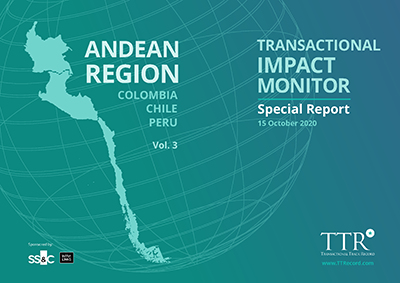
Transactional Impact Monitor: Andean Region – Vol. 3


Transactional Impact Monitor: Andean Region – Vol. 3

15 October 2020

TTR’s Transactional Impact Monitor (TIM) is a Special Report combining local knowledge and market visibility from top dealmakers developed to address extraordinary situations affecting the macroeconomic stability and M&A outlook in core markets


INDEX

CHILE
– M&A Outlook
– Handling the Crisis

COLOMBIA
– M&A Outlook
– Handling the Crisis

PERU
– M&A Outlook
– Handling the Crisis

– Dealmaker Profiles


CHILE

The mood among investors in Chile, and those looking on from abroad at what has long been considered the darling of Latin America for its political stability and liberal trade policies, is tenuous. The plebiscite on constitutional reform, originally scheduled for April, will be held on 25 October, a year after protesters filled the streets of Santiago following a public transit hike to voice their discontent on a range of matters. Among the grievances that led to widespread unrest were human rights abuses, the exclusion of a large swath of the population from the economic gains the country has enjoyed over the last three decades, and a generalized disenchantment with Chile’s form of pro-business, neoliberal democracy.

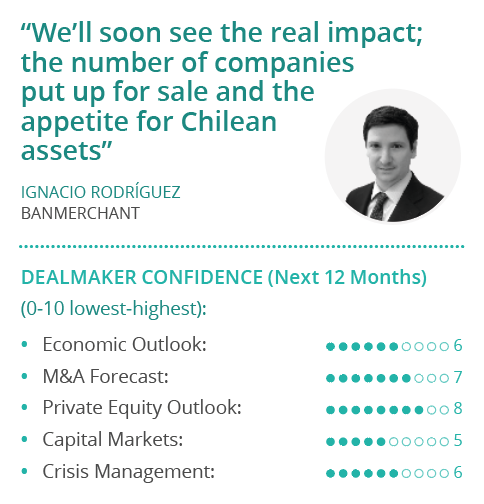
The economic crisis that gripped the world in 1Q20 caught Chile, and much of Latin America, mid-downward cycle, noted Banmerchant Deputy Manager of Corporate Finance Ignacio Rodríguez. Like other investment banks across the region, Banmerchant had several sale processes underway that were put on hold, Rodríguez said, noting that as the M&A work began to decline, restructuring became the firm’s core business.

“Many companies stopped generating revenues, but their liabilities still needed to be serviced,” he said. Chile’s banks stepped up to support the private sector, funneling low-interest loans with extended grace periods before borrowers had to begin repaying. In September, those grace periods began to expire, Rodríguez said, and if corporate revenues don’t normalize in October and November, a wave of insolvencies will hit Chilean shores. 

The uncertainty surrounding the economic recovery is complicated by the October plebiscite, which has investors, and Chileans in general, anxious. “Everybody wants to restructure their liabilities long-term, but many won’t be able to,” Rodríguez said. “They will either go under or seek fresh capital. That’s where M&A will reactivate, representing an opportunity for foreign investors to enter Chile at very low valuations.”

M&A Outlook
Click here to access the third issue of Transactional Impact Monitor: Andean Region – Vol. 3

COLOMBIA

Restrictions governing economic activity in Colombia are easing with all businesses except bars, nightclubs and gyms permitted to open daily as of 22 September, though opening hours continue to be limited for specific sectors. Business confidence has accordingly turned slightly positive for the first time since March, according to the local press. 

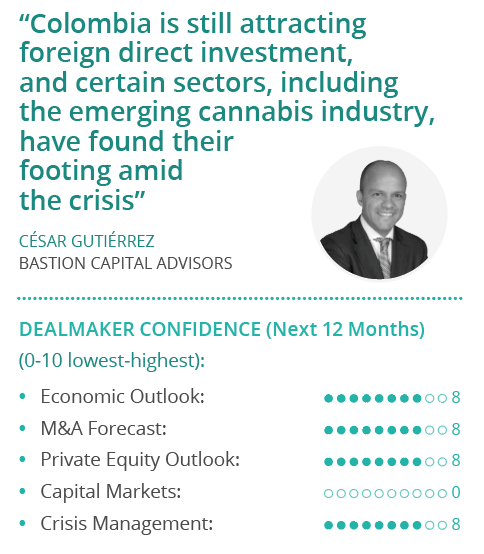
“We can now turn the page,” said César Gutiérrez, Managing Director of boutique investment bank Bastion Capital Advisors. After six months of near paralysis, the private sector is ready to get back to business, he said. Many Colombian companies in certain industries are entering restructuring processes, refinancing their debt, looking for capital or exploring sale options after six months of little-to-no business activity, however, he noted. 

Tourism and hospitality and related industries like aviation and catering, have been decimated, said Gutiérrez, and automotive sales are also down sharply. Bastion was recently approached by a company serving the aviation industry that could not continue to finance its overhead when revenue fell flat, Gutiérrez said. Though Colombia’s international airports reopened on 1 September, traffic remains lackluster as the fear of contracting COVID-19 while flying persists, and many corporate entities maintain work-from-home policies, limiting the company’s prospects for a rebound, he noted. 

There is no way to maintain fixed costs for five or six months when revenue evaporates overnight, Gutiérrez said, especially for companies that have relied on debt financing. Colombia’s banks have classified virtually every business segment as high-risk, meanwhile, making it difficult for companies to access bridge financing, Gutiérrez said. 

This looks to be the start of a wave of consolidation, where private equity funds with firepower can buy on the cheap, he noted, whether diversified domestic fund managers that have longstanding interests in Colombia, or those that have always had an interest in investing in the country. A long-awaited opportunity for private debt could finally find fertile ground in Colombia, Gutiérrez noted.

Despite the uncertainty about the timing and speed of the recovery, there will always be appetite for good assets, Gutiérrez said. “When some cry, others make handkerchiefs,” he noted, citing a popular saying. This is the moment for opportunistic investors, both strategic and financial, he added. “I’m very optimistic. This has been a moment to reflect, to analyze where industries are headed, and understand the new opportunities; companies need to get ready for what comes next.” 

M&A Outlook
Click here to access the third issue of Transactional Impact Monitor: Andean Region – Vol. 3

PERU

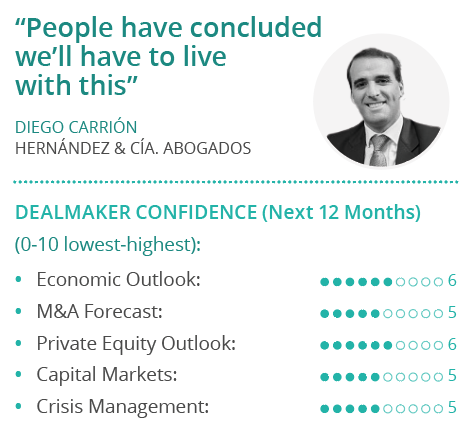
Following months of strict isolation, the Peruvian government announced it would permit air traffic between Peru and seven countries, namely Bolivia, Chile, Colombia, Ecuador, Panama, Paraguay and Uruguay, beginning the first week in October. The reopening of the country’s airspace comes despite an official death toll attributed to SARS-CoV-2 that puts Peru at the top of the list of nations globally by a significant margin, at over 1,000 per million inhabitants. Despite the health crisis, Peruvian companies are beginning to get back to business, and stalled transactions are getting back on track, according to Hernández & Cía. Abogados Partner Diego Carrión.

Peru was awash with M&A deals in 2015, when Carrión was appointed partner. That wave of transactions hit a bump when the “Lava Jato” scandal in Brazil spilled over into Peru, where Odebrecht and other large Brazilian and Spanish construction firms had large contracts underway in partnership with local entities, many of them, it turned out, won by corrupt means. 

The construction sector was paralyzed as a result of this, with project finance transactions arrested midstream. This was followed by some opportunistic M&A when Odebrecht and other large international construction firms needed to exit some projects, Carrión recalled, while M&A activity in other sectors of the economy continued at a good pace.

Hernández & Cía. Abogados was never involved with Odebrecht, which gave it a great upside, as many clients began to search the firm out for its clean record, said Carrión. Among the important new clients garnered as a result was Graña y Montero, Carrión noted. In 2017, the firm was retained by the company’s new board to guide it through a reorganization, and it has continued to work hand-in-hand with the board and the new management ever since to overcome one of the most dire corporate crises in the country’s history. “They sought us out for the strength of our team, and because we had no conflict of interest,” Carrión said, noting Hernández was part of the “big change” in the company.

The firm’s deal flow isn’t dependent on the construction industry, however, and it has worked on a slew of M&A deals in other sectors in recent years, including several led by private equity investors. Real estate is one sector in which it has invested heavily of late to enhance its expertise. In the midst of the crisis in mid-2020, it poached an entire real estate practice from another law firm to bolster its capabilities in this growing field. 

“This gives us an edge amid strong growth in what has become an increasingly sophisticated real estate market,” Carrión said. Real estate lawyers need to speak the language of the engineers and regulators, and Hernández was losing some business without a clear leader in the space, he said. The runway in the real estate market is tremendous, with construction projects that were shut down in 2Q20 now getting underway again and a pipeline of deals spanning the economy, from the development of agricultural lands to malls. “We now have the capacity to ride this wave,” Carrión said, noting the firm took advantage of its strong balance sheet and the lull in the market to make a strategic move that will position it with the right team. 

While construction projects in the private sector are underway again, the large infrastructure projects tendered by the Peruvian government, including Line 2 of Lima’s metro and the expansion of Jorge Chávez Airport, are progressing at a snail’s pace, Carrión said, amid bureaucracy that’s worse than ever, inducing skepticism, fear and a lack of confidence among participants and onlookers alike. 

M&A Outlook
Click here to access the third issue of Transactional Impact Monitor: Andean Region – Vol. 3

Transactional Impact Monitor: Andean Region – Vol. 3

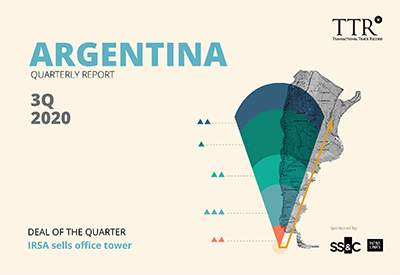
Informe Trimestral Argentina – 3T 2020

Las operaciones de M&A en Argentina disminuyen un 20% en el segundo trimestre de 2020

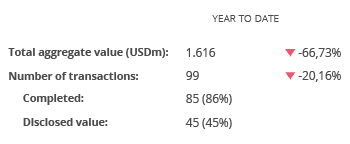
En 2020 se han registrado 99 transacciones en Argentina por USD 1.616m 

El sector Financiero y de Seguros es el más destacado del año con 18 operaciones


Patrocinado por:

This image has an empty alt attribute; its file name is SSNC-Intralinks-Logo-RGB-Blue-F-1024x321.png

El mercado transaccional argentino ha registrado en los nueve primeros meses del año un total de 99 fusiones y adquisiciones, entre anunciadas y cerradas, por un importe agregado de USD 1.616m, según el informe trimestral de Transactional Track Record en colaboración con Intralinks. Estas cifras suponen una disminución del 20,16% en el número de operaciones y un descenso del 66,73% en el importe de las mismas, con respecto al mismo periodo de 2019. 

Por su parte, en el tercer trimestre de 2020 se han contabilizado un total de 42 operaciones con un importe agregado de USD 757,84m. 

En términos sectoriales, el Financiero y de Seguros es el más activo del año, con un total de 18 transacciones, seguido por el sector de Tecnología, con 17 operaciones cada uno. En términos interanuales, el sector Financiero y de Seguros ha registrado un aumento del 100%, así como el sector de Tecnología ha registrado un alza del 13%.

Ámbito Cross-Border

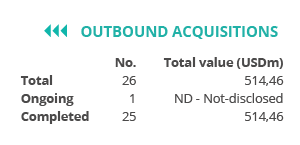
Por lo que respecta al mercado Cross-Border, en lo que va de año las empresas argentinas han apostado principalmente por invertir en Brasil, con 11 transacciones y con USD 399m. 

Por otro lado, Estados Unidos y México son los países que más han apostado por realizar adquisiciones en Argentina, con 11 y 6 deals, cada uno. Por importe, destaca Noruega, con USD 355m.

Venture Capital 

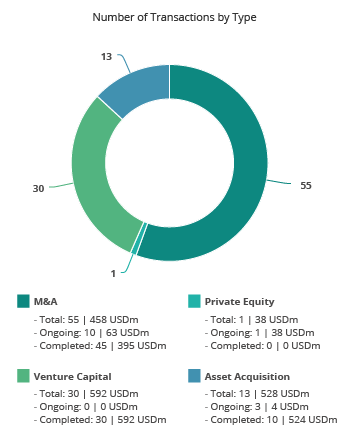
Hasta el tercer trimestre de 2020 Argentina ha registrado 30 operaciones de Venture Capital valoradas en USD 592m, lo que representa un aumento del 25% en el número de operaciones y un aumento del 18,11% en el capital movilizado con respecto al mismo periodo del año pasado.

Asset Acquisitions 

En el mercado de adquisición de activos, se han cerrado en el tercer trimestre del año 13 transacciones con un importe de USD 528m, lo cual implica un descenso del 53,57% en el número de operaciones y un descenso del 77,41% en su importe con respecto al mismo periodo de 2019.

Transacción Destacada

Para el tercer trimestre de 2020, Transactional Track Record ha seleccionado como operación destacada la adquisición la venta de una torre de oficinas, por parte de IRSA, valorada en USD 87,2m. 

La operación ha estado asesorada por la parte legal por Pérez Alati Grondona Benites & Arntsen, y por Zang, Bergel & Viñes Abogados.

Ranking de Asesores Legales y Financieros

Informe Trimestral Perú – 3T 2020

Las operaciones de M&A en Perú disminuyen un 43% en el tercer trimestre de 2020

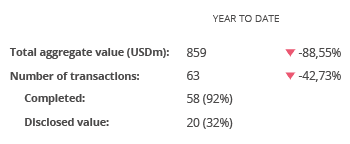
En los nueve primeros meses de 2020 se han registrado 63 transacciones por USD 859m 

El sector Inmobiliario es el más destacado del año, con 11 operaciones


Patrocinado por:

This image has an empty alt attribute; its file name is SSNC-Intralinks-Logo-RGB-Blue-F-1024x321.png

El mercado transaccional peruano ha registrado en los nueve primeros meses del año un total de 63 fusiones y adquisiciones, entre anunciadas y cerradas, por un importe agregado de USD 859m, según el informe trimestral de Transactional Track Record con la colaboración de Intralinks. Estas cifras suponen una disminución del 42,73% en el número de operaciones y un descenso del 88,55% en el importe de las mismas, con respecto al mismo periodo de 2019. 

Por su parte, en el tercer trimestre de 2020 se han contabilizado un total de 22 operaciones con un importe agregado de USD 268,30m. 

En términos sectoriales, el Inmobiliario es el más activo del año, con un total de 11 transacciones, seguido por el sector de Financiero y de Seguros, con 9 deals.

Ámbito Cross-Border

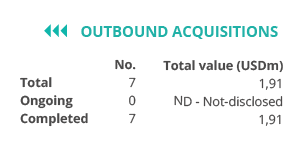
Por lo que respecta al mercado Cross-Border, en lo que va de año las empresas peruanas han apostado principalmente por invertir en Chile, con 2 transacciones y USD 1,50m. 

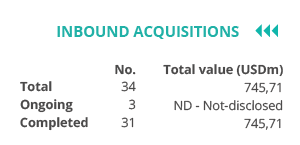
Por otro lado, Estados Unidos y Chile son los países que más han apostado por realizar adquisiciones en Perú, con 11 y 6 operaciones, respectivamente. Por importe, destaca Reino Unido, con USD 277,15m

Private Equity y Venture Capital 

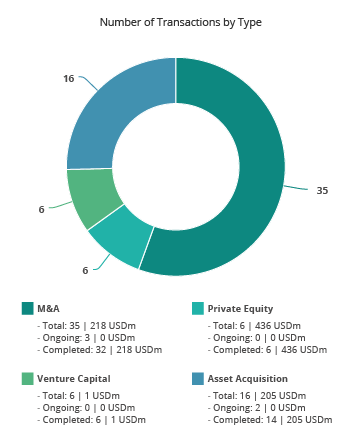
Hasta el tercer trimestre de 2020 se han producido un total de 6 transacciones de Private Equity, lo cual representa una disminución del 33% en el número de operaciones con respecto al tercer trimestre de 2019. 

Por su parte, en los nueve primeros meses de 2020, Perú ha registrado 6 operaciones de Venture Capital lo que representa una disminución del 14,29% en el número de operaciones con respecto al mismo periodo del año pasado. 

Asset Acquisitions 

En el mercado de adquisición de activos, se han cerrado en el tercer semestre del año 16 transacciones con un importe de USD 205m, lo cual implica un descenso del 38,46% en el número de operaciones y un descenso del 89,15% en su importe con respecto al mismo periodo de 2019.

Transacción Destacada

Para el tercer trimestre de 2020, Transactional Track Record ha seleccionado como operación destacada la adquisición de Orazul Energy Perú por parte de ISA

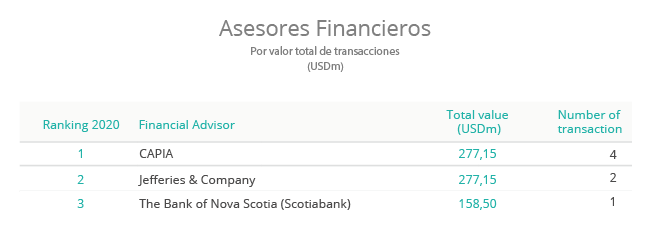
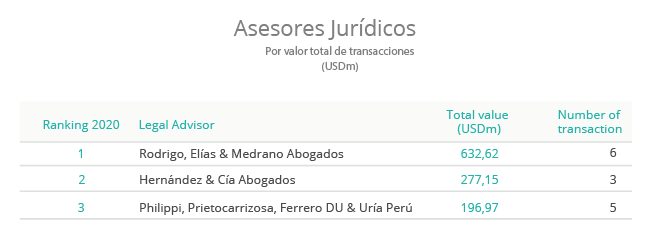
La operación, valorada en USD 158,50m, ha estado asesorada por la parte legal por Estudio Echecopar, Baker McKenzie US, Rodrigo, Elías & Medrano Abogados y White & Case US. Por la parte financiera, la operación ha sido asesorada por Scotiabank Perú.

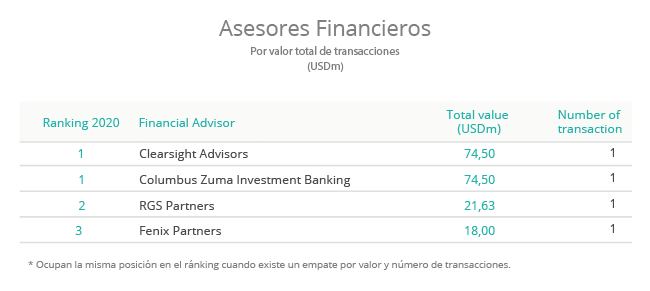
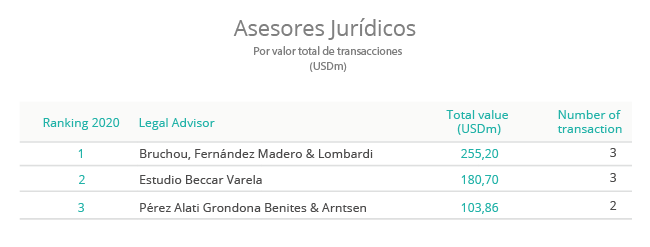
Ranking de Asesores Legales y Financieros