Dealmaker Q&A

Content available in English and Spanish (scroll down)

TTR DealMaker Q&A with Rebaza, Alcázar & De Las Casas Partner Alberto Rebaza


This image has an empty alt attribute; its file name is Alberto-Rebaza.jpg

Alberto RebazaRebaza, Alcázar & De Las Casas

Alberto Rebaza is founding partner and managing partner of Rebaza, Alcazar & De Las Casas law firm. Partner leads to mergers and acquisitions and corporate areas. In addition to his masters, he has studies at Georgetown University and England.

Alberto has been consistently considered by legal rankings as a leading lawyer in M&A, Banking and Finance. These publications include Chambers & Partners, IFRL 1000, Who’s Who Legal and LatinLawyer, among others. Also, Chambers & Partners called him “as the leading voice for large financial transactions and M&A”.

He has been a speaker at different conferences in Dublin, San Paulo, Bogota, Santiago, Panama City, Barcelona, NYC, Ciudad de Mexico, Bogota, Singapur, among others.

He has also been director in several companies and organizations such as Edegel (Energy), Rigel Peru (Insurance), Liderman (Services), Amrop (Services), IPAE, Pesquera Alexandra (Fishing), YPO, among others.

Very much involved in the arts world, Alberto is vicepresident of the Lima Museum of Art (MALI), member of the international patronage committee of the Museo Reina Sofia and member of the Latin American Circle at Guggenheim Museum in NYC.


TTR: In 4Q20, M&A volume returned to ‘prepandemic’ levels in Perú, with a total of 27 deals. How do you interpret this upward trend compared to 2Q20 and 3Q20? What can we expect in terms of transaction volume in 2021? 

A. R.: The increase of M&A transactions in 4Q2020 is the result of local economy reactivation, which was done in four phases and the last one began to be implemented in October 2020. The economic uncertainty decreased and allowed the resumption of M&A processes left on stand-by or processes that were slowed down in the previous quarters and the signing and/or closing of such transactions prior to the end of 2020. 

An additional incentive for the parties to close M&A transactions last year was to prevent their process from being subject to a merger control process under the Peruvian law of merger control, which will likely come into effect within the 1Q2021. 

Considering the new mandatory isolation imposed by the Peruvian Government and the uncertainty of its extension due to the health crisis, it is possible that M&A processes that began at the end of 2020 or this year, will slow down due to difficulties in providing information in connection with due diligence processes or to fulfill certain covenants for signing and/or closing. Also, the uncertainty regarding the beginning of the massive vaccination against COVID-19 and the Peruvian general elections that will take place in April may also slow down M&A transactions. However, it is possible that the large-scale transactions that have been negotiated, will be expedited despite the referred difficulties, in order to avoid the Peruvian merger control procedure and -maybe- being part of the first merger control procedure before INDECOPI, Peruvian public entity in charge of merger control review, in order to obtain authorization for closing. 

TTR: Although financial services led M&A transactions in Peru, deal volume in the sector fell 16% relative to 2019. What is the outlook for this sector in the medium term, given the bullish prospects for Fintech in Latin America? 

A. R.: The economy sector with the lowest negative variation compared to 2019 was the financial and insurance sector, followed by the real estate sector. Considering that approximately 70% of the Latin America population is unbanked or underbanked and also that fintechs have promoted the development of certain digital financial services for this target market, representing a significant challenge for financial institutions, it is possible that this sector will continue attracting interested parties for M&A or Venture Capital transactions. Regarding the latter, loans granted by fintech has gained a lot of momentum both in businesses funded by local investment funds, as well as large foreign banks. Also, new fintechs that give loans as an advance payment of salary are a very interesting alternative to bank loans of the same kind. 

Financial institutions have as strategy to vertically or horizontally integrate startups that have developed financial products and services that complement their services and products. We have also seen the interest of venture capital funds or corporate venture capitalists to acquire equity or finance fintechs. For example, in 2018 we advised Grupo Crédito on their first investment in Culqi, a 

Peruvian fintech and the following year we advised them on the second local investment of another Peruvian fintech, Wally. 

TTR: Deal volume related to online businesses grew by 80% in 2020, bucking the general downward trend across all other sectors. What will be the main drivers of consolidation in this segment in 2021? 

A. R.: The pandemic has raised awareness not only in large companies, but also in governments (for example, the Peruvian Tax Authority and Public Registries, among other Peruvian public entities, implemented automation and digitization of processes, among others) that there are deficiencies in the telecom sector and internal processes do not allow to provide services or offer products remotely. 

Companies that were unable to carry out their activities remotely suffered heavy losses and implemented severe measures to try to counter the negative effects of the pandemic. However, companies that integrated their operations with new technologies and that were able to fully or partially develop their activities remotely, were seen as attractive in the M&A market. Some of the economy sectors that have had to adapt more quickly to survive are commercial stores and restaurants, which have devolped or contracted platforms for delivery. In the financial industry, at the corporate and personal banking level, great advances have also been seen in this regard. 

The investment in equity of companies that provide digital services or that can contribute to the provision of B2C, B2B or B2B2C services is likely to continue growing this year and will be consolidated due to the need for other market agents to provide remote services in order to continue operating its business or integrate new lines of business that contribute to the development of its corporate purpose. 

TTR: What are the prospects for the M&A market in Latin America in 2021? Which three sectors and which three countries will undergo most consolidation? 

A. R.: The future of M&A transactions relies mainly, among other factors, on the massive vaccination against COVID-19. Some countries have already started the immunization process, while others -as Peru- are still awaiting the arrival of vaccines. This process will imply the beginning of resuming economic activities at pre-pandemic levels, which will lead to the recovery of the local, regional and global economy. 

The industries that will have the most consolidation in terms of M&A transactions are likely to be technology, consumer and industrial activity. Main industries involved in the largest number of Latam M&A transactions in 2020. 

The recovery of economic activities to pre-pandemic levels is vital in order to attract more activity in M&A. During 2020, in Peru, companies in the technology, financial and insurance, agribusiness and pharmaceutical sectors turned out to be the most resilient to the effects of the pandemic and companies in the distribution and retail sector, with adequate innovation, were interesting prospects for transactions of M&A. 

Considering that last year Brazil, Mexico and Chile were the countries with the highest transaction volume, it is possible that such countries will undergo most consolidation. This in view of the implementation of the immunization process against COVID-19, which is the main factor affecting the economy nowadays. Another factor that impacts the M&A market is the lack of agreement on the valuation of businesses or assets; however, some companies are including within their budget and projections for this year the effect of the pandemic, which allows buyer to measure the risk of its investment and to sincere its expectations and the target’s value. 

TTR: What will be the main challenges for Rebaza, Alcázar & De Las Casas in its M&A advisory work in Peru in 2021? 

A. R.: Despite the pandemic’s negative effects (which is undoubtedly a factor that will continue to be a challenge in M&A transactions this year) and the political uncertainty due to the upcoming general elections, one of the main challenges in 2021 will be to implement the merger control mechanism in transactions. This new procedure will imply an increase in the transaction costs of the parties, because prior to the authorization (and the time that this implies), an economic and legal analysis must be carried out in order to determine if an application should be submitted -in order to obtain the approval of the transaction- before the Technical Secretariat of the Commission for the Defense of Free Competition of INDECOPI (Peruvian public entity in charge of merger control review) in case (i) the threshold established in the Peruvian law of merger control and its regulations that will be published within 1Q2021; or (ii) the buyer decides to voluntarily notify the transaction. Likewise, with this new regulation, transactions must include standstill provisions considering the the aforementioned regulations, such as limitations on the exchange of sensitive information, covenants on the conduct of the business until authorization is obtained, among others. 

We are certain that our Competition – Antitrust team will provide legal advice with the standard of excellence inherent to our law firm- to all our clients interested in participating in M&A transactions that may be subject to merger control. We are very confident about succeeding in this new challenge due to our comprehensive preparation, which has resulted from analysis of regulations and doctrine of foreing jurisdictions with merger control systems, as well as meetings held with other regional actors with experience in merger control (i.e. Chile, Argentina and Colombia), and also the extrapolation -to this new regulation- of our know-how in matters of merger control applied to transactions in the electricity industry, in which we have provided legal advised advising to buyers.


Spanish version


Alberto RebazaRebaza, Alcázar & De Las Casas

Alberto Rebaza es socio fundador y managing partner de Rebaza, Alcázar & De Las Casas. Es co-líder del área de fusiones y adquisiciones. En adición a su maestría en  la Universidad de Virginia, cuenta con estudios en Georgetown University y en Inglaterra.

Alberto ha sido permanentemente considerado por los principales rankings legales como abogado líder en M&A y Banca y Financiamiento. 

Ha sido expositor en conferencias en diferentes ciudades tales como Dublin, San Paulo, Bogotá, Panamá, Barcelona, NYC, Ciudad de México, Bogotá, Singapur, etc.

Asimismo, ha sido director en diversas empresas y organizaciones como Edegel (Energía), Rigel Perú (Seguros), Liderman (Servicios), Amrop (Servicios), IPAE, Pesquera Alexandra (Pesquería), YPO, etc.

Muy involucrado en el mundo de las artes; Alberto es vicepresidente del Museo de Arte de Lima, miembro del comité de mecenazgo del Museo Reina de Sofía y miembro del Latin American Circle del Guggenheim Museum en Nueva York.


TTR: En el cuarto trimestre de 2020, el número de transacciones de M&A en Perú ha vuelto a los valores ‘prepandemia’, con un total de 27 deals. ¿Cómo interpreta esta tendencia al alza con respecto al segundo y tercer trimestre del año?, ¿qué perspectiva podríamos tener para 2021? 

A. R.: El incremento de operaciones en el cuarto trimestre del 2020 es el resultado de la reactivación de la economía local, la cual estuvo segmentada en cuatro fases y la última empezó a implementarse en octubre de 2020. La incertidumbre económica disminuyó y permitió que procesos de M&A que fueron dejados en stand-by en los trimestres anteriores se retomaran o procesos que estaban ralentizados, se cierren antes del término del ejercicio. 

Un incentivo adicional de las partes para cerrar transacciones de M&A el año pasado fue prevenir que su proceso se encuentre sujeto a control previo en el marco de la Ley de Control Previo de Concentraciones Empresariales que, probablemente, entre en vigencia dentro del primer trimestre del 2021. 

Tomando en cuenta la nueva cuarentena impuesta por el Gobierno Peruano y la incertidumbre de su extensión ante la crisis sanitaria, es posible que los procesos de M&A que se iniciaron a finales del año pasado o este año, se ralenticen debido a dificultades para proporcionar información en el marco del due diligence o para cumplir determinadas condiciones para la firma y/o cierre de la transacción. La incertidumbre sobre el inicio del proceso de vacunación masiva para inmunizar a los peruanos contra el COVID-19 y las elecciones generales que se llevarán a cabo en abril, también puede ralentizar las operaciones de M&A. No obstante, es posible que las transacciones de gran envergadura que se vienen negociado se agilicen a pesar de estas dificultades, a fin de evitar entrar al procedimiento de control previo de concentraciones empresariales y -quizás- ser parte del primer procedimiento frente a INDECOPI a fin de obtener la autorización para el cierre de la transacción. 

TTR: Si bien el sector financiero y de seguros lideró la actividad de operaciones M&A en Perú, se reflejó una caída del 16% con respecto a las cifras de 2019 ¿Cuál es el futuro de este sector en el mediano plazo, teniendo en cuenta las perspectivas optimistas en el sector Fintech en América Latina? 

A. R.: El sector con menor variación porcentual negativa respecto al 2019 fue el sector financiero y de seguros, seguido por el de real estate. Considerando que aproximadamente el 70% de la población de América Latina carece de una no tiene acceso o tiene acceso deficiente a servicios financieros, que las fintechs han impulsado el desarrollo de ciertos servicios financieros digitales para ese mercado objetivo y que ello representa un desafío importante para las instituciones financieras, considero que este sector seguirá atrayendo interesados para transacciones de M&A o Venture Capital. Con relación a esto último, el otorgamiento de préstamos por fintech ha tomado mucho impulso tanto en negocio fondeados por fondos de inversión locales, como grandes bancos de exterior. Otro punto interesante es la aparición de fintech que dan créditos en la modalidad de adelanto de sueldos, y que son una alternativa muy interesante frente a los créditos bancarios del mismo tipo. 

Esto se suma a la estrategia de entidades financieras para integrar vertical u horizontalmente a startups que han desarrollado productos y servicios financieros que complementan los servicios y productos ofrecidos por las grandes entidades financieras. También hemos visto el interés de fondos de venture capital o corporate venture capitalists de adquirir equity o financiar fintechs. Por ejemplo, en el 2018 asesoramos a Grupo Crédito en su primera inversión en Culqi, una fintech peruana y al año siguiente los asesoramos en la segunda inversión local de otra fintech peruana, Wally. 

TTR: Transacciones relacionadas a empresas cuya actividad se lleva a cabo por Internet crecieron en 80%, siendo el único segmento con un comportamiento al alza en Perú en 2020: ¿Cuáles serán los principales motores de consolidación en este segmento en 2021? 

A. R.: La pandemia ha generado conciencia no sólo en las grandes empresas, sino también en los gobiernos (por ejemplo, a nivel de la automatización y digitalización de los procesos en la Administración Tributaria, Registros Públicos, entre otras entidades públicas) de que existen deficiencias en el sector de telecomunicaciones y procesos internos que no permiten prestar servicios u ofrecer productos de manera remota. 

Las empresas que no pudieron llevar a cabo sus actividades de manera remota han sufrido grandes pérdidas y adoptaron medidas severas para tratar de contrarrestar los efectos negativos de la pandemia. No obstante, las empresas que integraron sus operaciones con nuevas tecnologías y que pudieron desarrollar total o parcialmente sus actividades de manera remota, fueron vistas como atractivas en el mercado. 

Alguno de los sectores que han tenido que adaptarse con mayor rapidez para sobrevivir son las tiendas comerciales y restaurantes, las cuales han adoptado por desarrollar o contratar plataformas para pedidos por delivery. En la industria financiera, a nivel de banca corporativa y personal, también se han visto grandes avances en este aspecto. 

La inversión en equity de empresas que provean servicios digitales o que puedan contribuir a la prestación de servicios B2C, B2B o B2B2C es probable que siga creciendo este año y se consolide debido a la necesidad de otros agentes del mercado de recurrir a servicios remotos para poder continuar con la prestación de servicios que es inherente a su negocio o integrar nuevas líneas de negocio que coadyuven con el desarrollo de su objeto social. 

TTR: ¿Cuáles son las perspectivas del mercado M&A en América Latina para 2021?, ¿Cuáles pueden ser los tres sectores y los tres países con mayor fortaleza en términos de consolidación? 

A. R.: El futuro de las transacciones de M&A depende principalmente, entre otros factores, de la vacunación masiva contra el COVID-19. Algunos países ya empezaron con el proceso de inmunización, mientras que otros -como Perú- aún están a la espera del arribo de vacunas. Este proceso implicará el inicio de retomar las actividades económicas a niveles pre-pandemia, lo cual conllevará a la recuperación de la economía local, regional y global. 

Es probable que los sectores que tendrán una mayor consolidación en términos de transacciones de M&A sean el de tecnología, consumo y actividad industrial. Principales sectores involucrados en el mayor número de transacciones de M&A en el 2020 en Latino América. 

La recuperación de las actividades económicas a niveles pre-pandemia es vital para efectos de atraer más actividad en M&A. Durante el 2020, en Perú las empresas del sector tecnológico, financiero y seguros, agroindustria y farmacéutico resultaron ser las más resilientes a los efectos de la pandemia y las empresas del sector distribución y retail, con una adecuada innovación, fueron prospectos interesantes para transacciones de M&A. 

Considerando que el año pasado Brasil, México y Chile fueron los países con mayor volumen de transacciones, podrían ser este año los países con mayor fortaleza en términos de consolidación. Ello considerando la implementación del proceso de inmunización contra el COVID-19, que es el principal factor que afecta a la economía actualmente. Otro factor que afecta al mercado de M&A es la falta de acuerdo en la valorización de negocios o activos; sin embargo, algunas empresas están incluyendo dentro de su presupuesto y proyecciones para este año el efecto de la pandemia, lo cual permite al comprador medir el riesgo de su inversión y sincerar el valor de la compañía y las expectativas del comprador. 

TTR: Para Rebaza, Alcázar & De Las Casas, ¿Cuáles podrían ser los principales retos en operaciones de M&A en Perú durante 2021? 

A. R.: Dejando de lado la pandemia y los efectos negativos que ha generado (lo cual sin duda es un factor que seguirá siendo un reto en las operaciones de M&A durante este año) y la incertidumbre política por las próximas elecciones generales, uno de los principales retos en el 2021 será implementar en las transacciones el mecanismo de control previo de fusiones y adquisiciones empresariales. Este nuevo procedimiento implicará un incremento en los costos de transacción de las partes, debido a que de manera previa a la autorización (y el tiempo que ello implica), se deberá efectuar un análisis económico y legal a efectos de determinar si se presenta una solicitud de aprobación de la transacción ante la Secretaría Técnica de la Comisión de Defensa de la Libre Competencia de INDECOPI (entidad competente en materia de control de fusiones y adquisiciones empresariales) en caso (i) se superen los umbrales establecidos en la Ley de Control Previo de Concentración Empresarial y el reglamento que se publique; o (ii) el comprador decida notificar voluntariamente la transacción. Asimismo, con esta nueva regulación, las transacciones deberán incluir obligaciones de “standstill” considerando lo previsto en la normativa antes referida, como por ejemplo limitaciones al intercambio de información sensible, regulaciones sobre la conducción del negocio hasta obtener la autorización, entre otros. 

Tenemos certeza de que nuestro equipo de Libre Competencia brindará asesoría legal -con el estándar de excelencia que es inherente a nuestra firma- a todos nuestros clientes que se encuentren interesados de participar en un M&A y se tenga que aplicar la nueva ley en materia de control previo a la transacción correspondiente. Confiamos plenamente en que nuestra preparación para afrontar este nuevo reto ha sido integral, lo cual ha resultado de análisis de regulaciones y doctrina de otras jurisdicciones con sistemas de control previo, reuniones con otros actores de la región con experiencia en control previo (i.e. Chile, Argentina y Colombia), así como la extrapolación -a esta nueva regulación- de nuestro know-how en materia de control previo de las transacciones en el sector eléctrico en las que hemos participado asesorando a partes compradoras. 

Dealmaker Q&A

Content available in English and Spanish (scroll down)

TTR DealMaker Q&A with Brigard & Urrutia Partner Darío Laguado

Darío LaguadoBrigard & Urrutia

Mr. Laguado joined the firm in 2010 and is currently the chairman of the Corporate/M&A practice.  Mr. Laguado focuses his practice in advising clients in cross-border transactions across multiple industries and in advising private equity funds in their investments and divestments in the country, currently having counseled on transactions exceeding an aggregate amount of US$10 billion.
Key representations include the merger of BVC and Deceval, the merger of ACE and Chubb, the merger of Colombia Telecomunicaciones and Movistar, the merger of Bank Itaú and Corpbanca, the acquisition by the Japanese company Itochu Corp. of an interest in Drummond, and the acquisition by Éxito of several companies in the region, among others. 
Some of the private equity funds that Mr. Laguado advises include Catterton Partners, MAS Equity Partners, Carlyle, Tribeca Capital Partners and Brookfield Asset Management, among others.


TTR: What are your main takeaways from 2020 in the Colombian M&A market?

D. L.: There are three main takeaways from 2020 in the Colombian M&A market: (i) even though there was a slowdown in the M&A activity in the country, the market rebounded quickly, which demonstrates that the long-term fundamentals, such as market appetite, liquidity and growth perspectives, seem to be largely unaffected; (ii) as history teaches us, there were winning and losing industries, and it is possible that the former outweigh the latter; and (iii) the pandemic accelerated trends that are inevitably transforming the legal industry, such as digitalization, technological improvements, remote work, etc.  

TTR: Brigard & Urrutia has advised on important deals in health and technology in Colombia this year. What op drive consolidation in each of these sectors in 2021 and in the op la-to-long term? 

D. L.: Indeed, this year we have had the opportunity to participate in interesting transactions. On the one hand, in the health sector, we have participated in the acquisition of assets related to the renal care unit of Clinica Medilaser, the acquisition by Clever Leaves Holdings Inc. of SAMA and its possible entry into NASDAQ; and the sale of National Clinics’ Hospitals; Clínicas Nacional Centenario and Clínicas Nacionales los Nevados, located in Bogotá and Pereira, as well as the contractual assignment of a collaboration agreement through which National Clinics exercised control of the San Rafael Clinic and the sale of the properties in which these clinics operate. On the other hand, in the technology sector, we have participated in the acquisition by MD Cloud Practice Solutions of a majority stake in Wiedii S.A.S. (company specialized in software development and web or mobile applications), the acquisition by Greensill PTY of Omni Intermediate Holdings, LLC and the acquisition by Will Hill Ltd of Alfabet S.A.S. in the online gambling sector.

In 2021, we believe that health and technology operations in Colombia will continue to be driven especially as a consequence of the strength that these sectors have acquired with the arrival of the pandemic in Colombia.

TTR: Technology and Internet were the most dynamics sectors in 2020 in Colombia. What op be the next driver of consolidation in these sectors once the digital transformation wave has played out?

D. L.: The pandemic has created a need to digitize a large part of company processes today has generated an evident growth in the technology and internet sector. This will possibly lead to growth of the different startups and enterprises in the sector, which before Covid-19 we would not have believed would happen so quickly. Examples of this will surely be consolidated in the education, in cybersecurity, telecommunications, delivery, online shopping sectors, among others. These sectors will continue to grow due to regional consolidation, population growth, and new trends that were accentuated by the pandemic.

TTR: What do you expect to be the main challenges for law firms advising on M&A transactions in Colombia and Latin America during 2021?

D. L.: We see several challenges in the year 2021:

In first place, the practice of M&A will surely be influenced by the “aftermath” of the crisis generated by the pandemic. As in any crisis, there are those who have benefited from the pandemic and this can make them active players in the practice of mergers and acquisitions, but certainly there are others who have been greatly affected and we can find them as targets in mergers and acquisitions transactions. For example, companies that have traditionally been reluctant to invest in third parties may have a greater appetite to consider such operations with a view to diversifying their assets or accessing fresh capital. Some private equity funds may see investment options that were previously unavailable. Likewise, we think that the operations of sale or investment of companies in crisis situations will possibly increase.

Second, the government’s fiscal situation, accentuated by the pandemic, will possibly fuel a wave of privatizations, which are highly challenging as they must be implemented through a demanding legal process. These are very relevant operations for the country.

Third, law firms will have to continue operating in a virtual environment for some time. The rituals of closing a transaction can involve formalities and deliverables that require physical presence. The pandemic has forced us to make the transition from these activities to a virtual environment. Except in very rare cases, this transition is perfectly achievable thanks to communication platforms, specialized software, and a little more coordination and discipline. Since they save time and money; Some of the new dynamics may come to stay and it will be a challenge in 2021 to learn and continue to improve in the virtual M&A activity. In terms of due diligence, although for many years most of it has already been done virtually, there are still some aspects that require presence, such as presentation of the administration, field visits, etc.


Spanish version


Darío LaguadoBrigard & Urrutia

Es miembro de la firma desde 2010 y actualmente es socio de la práctica de Corporativo/M&A. Enfoca su práctica en la asesoría a clientes en transacciones transfronterizas en múltiples industrias y en la representación de fondos de capital privado en sus inversiones y desinversiones en el país. El valor de las transacciones en las que ha participado excede de US$10 billones.  
Algunas de las transacciones en las que ha participado incluyen la fusión entre la BVC y Deceval; la fusión de ACE y Chubb; la fusión de Colombia Telecomunicaciones y Movistar; la fusión del Banco Itaú con Corpbanca; la adquisición por parte de la compañía japonesa Itochu de una participación en Drummond; la adquisición por parte del grupo Éxito de varias compañías en la Región, entre otros. 
Entre los fondos de capital privado que asesora se encuentran Catterton Partners, MAS Equity Partners, Carlyle, Tribeca Capital Partners y Brookfield Asset Management, entre otros.


TTR: ¿Cuáles son sus principales conclusiones de 2020 en el mercado de fusiones y adquisiciones colombiano?

D. L.: Hay tres conclusiones principales de 2020 en el mercado colombiano de fusiones y adquisiciones: (i) a pesar de que hubo una desaceleración en la actividad de fusiones y adquisiciones en el país, el mercado se recuperó rápidamente, lo que demuestra que los fundamentos de largo plazo, como el apetito del mercado, las perspectivas de liquidez y crecimiento no parecen verse afectadas en gran medida; (ii) como nos enseña la historia, hubo industrias ganadoras y perdedoras, y es posible que las primeras superen a las segundas; y (iii) la pandemia aceleró tendencias que inevitablemente están transformando la industria legal, como la digitalización, las mejoras tecnológicas, el trabajo a distancia, entre otros.

TTR: Brigard Urrutia ha asesorado este año importantes operaciones de salud y tecnología en Colombia. ¿Qué impulsará la consolidación en cada uno de estos sectores en 2021 en el mediano y largo plazo?

D. L.: Así es, este año hemos tenido la oportunidad de participar en interesantes transacciones. Por un lado, en el sector salud, hemos participado en la adquisición de activos relacionados a la unidad de cuidados renales de Clinica Medilaser, la adquisición por parte de Clever Leaves Holdings Inc. de SAMA y su posible entrada a NASDAQ; y, la venta de los hospitales de National Clinics; Clínicas Nacional Centenario y Clínicas Nacionales los Nevados, ubicadas en Bogotá y Pereira así como la cesión contractual de un contrato de colaboración mediante el cual ejercía el control de la Clínica San Rafael y la venta de los inmuebles en los que operan dichas clínicas. Por otro lado, en el sector tecnológico, hemos participado en la adquisición por parte de MD Cloud Practice Solutions de una participación mayoritaria en Wiedii S.A.S. (empresa especializada en desarrollo de software y aplicaciones web o móviles), la adquisición por parte de Greensill PTY de Omni Intermediate Holdings, LLC y la adquisición por parte de Will Hill Ltd de Alfabet S.A.S. en el sector de los juegos de azar online.

En el 2021, creemos que las operaciones de salud y tecnología en Colombia seguirán siendo impulsadas especialmente como consecuencia de la fuerza que estos sectores han adquirido con la llegada de la pandemia a Colombia. 

TTR: El sector tecnológico e internet han sido los más dinámicos en 2020 en Colombia. ¿Cuál será el próximo motor de consolidación en estos sectores una vez que se haya desarrollado la ola de transformación digital? 

D. L.: La necesidad que ha dejado la pandemia de digitalizar una gran parte de los procesos de las empresas, hoy en día, ha generado un evidente crecimiento en el sector tecnológico y de internet. Esto posiblemente conllevará crecimientos de los diferentes startups y emprendimientos del sector, que antes del Covid-19 no hubiéramos creído sucederían tan rápido. Ejemplos de esto seguramente se consolidarán en el sector educativo, en el sector de ciberseguridad, telefonía, delivery, compra online, entre otros.  Estos sectores seguirán creciendo debido a la consolidación regional, el crecimiento demográfico y las nuevas tendencias que fueron acentuadas por la pandemia.

TTR: ¿Cuáles espera que sean los principales retos para los despachos de abogados que asesoran en operaciones de M&A en Colombia y América Latina durante 2021?

D. L.: Vemos varios retos en el año 2021:

En primer lugar, la práctica de M&A seguramente se verá influenciada por el “aftermath” de la crisis generada por la pandemia.  Como en toda crisis, hay quienes se han beneficiado de la pandemia y esto puede convertirlos en actores activos en la práctica de fusiones y adquisiciones, pero ciertamente hay otros que se han visto muy afectados y podemos encontrarlos como objetivos en transacciones de fusiones y adquisiciones.  Por ejemplo, es posible que empresas que tradicionalmente han sido reticentes a la inversión de terceros tengan mayor apetito para considerar ese tipo de operaciones con miras a diversificar su patrimonio o a acceder a capital fresco.  Es posible que algunos fondos de capital privado vean opciones de inversión que antes no estaban disponibles.  Así mismo, Pensamos que las operaciones de compraventa o de inversión de empresas en situaciones de crisis posiblemente incrementarán.

En segundo lugar, la situación fiscal del gobierno, acentuada por la pandemia, posiblemente fomentará una ola de privatizaciones, las cuales son altamente retadoras pues deben implementarse mediante un proceso legal exigente.  Estas son operaciones muy relevantes para el país.   

En tercer lugar, las firmas de abogados tendrán que seguir operando en un ambiente virtual por algún tiempo.  Los rituales de cierre de una transacción pueden involucrar formalidades y entregables que requieren presencia física. La pandemia nos ha obligado a realizar la transición de estas actividades a un entorno virtual. Excepto en casos muy raros, dicha transición es perfectamente alcanzable gracias a plataformas de comunicación, software especializado y un poco más de coordinación y disciplina. Ya que ahorran tiempo y dinero; algunas de las nuevas dinámicas pueden llegar para quedarse y será un reto en el 2021 aprender y continuar mejorando en la actividad de M&A virtual.  En materia de debida diligencia, si bien por muchos años la mayor parte ya se hace de manera virtual, todavía hay algunos aspectos que requieren presencialidad, como presentación de la administración, visitas de campo, etc.

Dealmaker Q&A

Content available in English and Spanish (scroll down)

TTR DealMaker Q&A with Allen & Overy Partner Fernando Torrente

Fernando TorrenteAllen & Overy

Fernando Torrente with more than 30 years of experience is specialized in Spain in M&A and Equity Capital Markets, including takeovers, IPOs, flotations, securities issue and placement, secondary offerings and follow-on capital offerings. Additionally he is an expert in corporate governance and formed part of the group of lawyers that advised the Comisión Nacional del Mercado de Valores (CNMV) in preparing the Code of Good Governance of Listed Companies approved in February 2015


TTR: How do you see the M&A market after the current crisis and what are your main conclusions for 2020?

F. T.: Unfortunately, the crisis is not over and many of its worst effects, the most damaging affecting employment and a dramatic destruction of the business network, will be aggravated in 2021. However, the positive results obtained in the research and development processes of different vaccines have produced a very relevant change in the perception that companies and investors have about the development of the crisis and the recovery. This has led them to take decisions to search for investment opportunities, initiate consolidation processes, restructure their balance sheets, segregate areas of activity to open them to the participation by investors, put non-strategic assets up for sale or request a rescue of public funds. If the vaccine protection provides the expected response, this is going to be a determining factor in making 2021 a very active year, in which the market is going to offer a significant variety and number of transactions.

TTR: Many Spanish companies have taken on large debts or depend on government support to stay in business. How do you think this situation will crumble and how will this affect the M&A market?

It will depend a lot on market behaviour and the evolution of consumption and business recovery. There will be very difficult situations in which it will not be possible to repay the debt, which will involve restructuring and conversion processes and it will be necessary to take measures from the political, monetary and fiscal points of view. It is inevitable, unfortunately, that many companies will not be able to pay their debts, and this will cause divestments of assets or corporate spin-offs, rescue operations, consolidation processes, restructuring and insolvency proceedings, and distressed M&A transactions.

TTR: Up to November, the total value of transactions in Spain rose by 37%, according to TTR data, while the number of transactions decreased by 23%. How do you understand this divergence?

It is probably explained by the extraordinary situation that the world went through in 2020 due to the pandemic and the serious crisis caused by that, in which we are still immersed. The year 2020, without Covid-19, seemed uncertain after previous years with high growth in the M&A market. However, the total standstill of the economic activity, resulting from the general lockdown, had a pertinent impact on this market. Only a few transactions continued during this period, those that made strategic and business sense and which were led by very strong players in the financial field. The end of the first wave meant that the transactions, which had been paralysed, continued because it still made sense, as they were led by companies or investors with the capacity to deal with them, because of their strength, and because they took place in sectors that had proved resistant to the crisis. After the summer, we also saw consolidation transactions in the banking sector and the reactivation of the M&A market for smaller companies, which had been more affected. Logically, in such a difficult environment, opportunities are taken by those who are stronger and have a higher investment capacity. Besides, due to the huge liquidity existing in the market, particularly in private equity funds, there are fewer transactions but these have a higher volume.

TTR: Technology was the only sector that had more agreements this year than in 2019. What will be the next engine of consolidation in this sector once the wave of digital transformation has developed?

I think that the process of digital transformation, which started before the pandemic and which was accelerated by Covid-19 in a very intense way, still has a long way to go and I do not dare to predict when it might end.

The strongest companies have made very important investments in order to boost their development and will continue to do so, combining that with other investment and development elements, which are going to be a priority, such as sustainability. Those companies that have not had that financial strength but will survive the crisis, will continue with the digitalisation processes. I believe that the dynamism of this sector and its key role in the economy and society will continue to give it an enormous role.

TTR: Allen & Overy Spain has advised on renewable energy and technology transactions in Spain this year. What will drive consolidation in each of these sectors in 2021 and in the medium to long term?

Energy and technology are sectors in which there has been a lot of activity for a long time. Oil and electricity companies have long been undertaking a process to adapt their business to the energy transition, which has intensified in recent years, especially in 2020, for those who had not faced it decisively. These are sectors in continuous evolution, in which management teams have high capacity and the investors have great interest in their different aspects, infrastructures, core and secondary business, and so it is logical that consolidation processes take place through acquisitions or mergers, as well as through the appearance of new players.

TTR: What role do you expect Spanish telecommunications companies to play in mergers and acquisitions, nationally and internationally, in the next year?

Telecommunications companies have an extraordinarily important role, due to their business relevance, because they are providers of essential services, the very high qualification of their teams, their technological nature, and the fact that they are a driving force in innovation and development. During the last year we have seen very relevant transactions, such as the merger/combination of Liberty and Telefónica UK, and the takeover bid for Masmovil and Cellnex’s transactions. We will probably continue to see important transactions of very different types this year, for these reasons and the great interest they rouse among private equity funds searching for investment opportunities.

TTR: What do you expect to be the main challenges for law firms advising on M&A transactions in Spain over the next 12 to 18 months?

The market is moving very fast facing the opportunities that arise and there is going to be a very wide variety of transactions for which the law firms’ teams have to be ready to give advice of extraordinary quality and speed.

We are going to see distressed transactions, restructuring, processes of segregation of business units or branches of activity in which total or partial disinvestments will be sought, public to private transactions, mergers responding to sector consolidation processes, shareholder activism, dual tracks in which shareholders will seek to maximise the profitability of their investment through an IPO or a private M&A transactions. The international component will be very relevant and, until the Covid-19 pandemic stabilises, the environment will be very volatile. All this will demand the best from our teams and we have to be able to give our clients the best of us.  


Spanish version


Fernando TorrenteAllen&Overy

Fernando Torrente, con 30 años de experiencia, es uno de los abogados más reconocidos de España en fusiones y adquisiciones y en mercado de capitales tales como OPAs, salidas a bolsa, emisión y colocación de valores, OPV y OPS. Además Fernando tiene amplia experiencia en gobierno corporativo y formó parte del Grupo de abogados que asesoró a la CNMV en la elaboración del Código de Buen Gobierno de las Sociedades Cotizadas aprobado en febrero de 2015.


TTR: ¿Cómo ve el mercado de fusiones y adquisiciones después de la crisis actual? ¿Cuáles son sus principales conclusiones de 2020?

Desgraciadamente la crisis no ha terminado y muchos de sus peores efectos, los más lesivos porque afectan al empleo y a una dramática destrucción de tejido empresarial, se van a agudizar en este año 2021. No obstante, los buenos resultados obtenidos en los procesos de investigación y elaboración de las distintas vacunas – a pesar de la incapacidad que están evidenciando muchos dirigentes políticos en el diseño e implementación de los procesos de vacunación de la población que esperemos se corrija – han producido un cambio muy relevante en la percepción por empresas e inversores sobre el desarrollo de la crisis y la recuperación, que les ha llevado a tomar decisiones para buscar oportunidades de inversión, iniciar procesos de consolidación, reestructurar sus balances, segregar áreas de actividad para abrirlo a la participación de inversores, poner en venta activos no estratégicos o solicitar un salvamento de fondos públicos. Ello va a ser determinante para que el año 2021 sea, si la protección de la vacuna da la repuesta esperada, un año muy activo en el que el mercado va a ofrecer una variedad y un número de operaciones importante.

TTR: Muchas empresas españolas han asumido grandes deudas o dependen del apoyo del gobierno para mantenerse en el negocio. ¿Cómo cree que se desmoronará esta situación y cómo afectará esto al mercado de fusiones y adquisiciones?

Dependerá mucho del comportamiento del mercado y de la evolución del consumo y la recuperación empresarial. Va a haber situaciones muy difíciles en las que no va a ser posible devolver la deuda, ello implicará procesos de reestructuración y reconversión y será necesario que se adopten las medidas adecuadas desde el punto de vista político, monetario  y fiscal. Va a ser inevitable, desgraciadamente, que muchas empresas no tengan capacidad para afrontar el pago de sus deudas, y ello provocará desinversiones de activos o divisiones de negocio, operaciones de salvamento, procesos de consolidación, reestructuraciones y concursos y operaciones de distressed M&A.

TTR: Hasta noviembre, el valor total de las transacciones en España subió un 37%, según datos de TTR, mientras que el número de transacciones disminuyó un 23%. ¿Cómo interpreta esta divergencia?

Probablemente se explica por la extraordinaria situación que el mundo ha vivido en el año 2020 como consecuencia de la pandemia y la gravísima crisis que ha provocado en la que seguimos inmersos. El año 2020, sin COVID, se presentaba con ciertas incertidumbres después de años previos de gran crecimiento del mercado de M&A. Sin embargo, la paralización total de la actividad económica que se derivó del confinamiento general, tuvo el correspondiente impacto en este mercado. Solo algunas operaciones continuaron en ese periodo, las que tenían sentido estratégico y empresarial y estaban protagonizadas por actores muy fuertes económicamente. El fin de la primera ola hizo que operaciones que se habían paralizado pero que seguían teniendo sentido continuaran, de nuevo por estar protagonizadas por empresas o inversores con capacidad para afrontarlas, por su fortaleza, y por tener lugar en sectores que se han mostrado resistentes a la crisis. A la vuelta del verano hemos asistido también a operaciones de consolidación del sector bancario y se reactivó el mercado de M&A de empresas de menor tamaño que se había visto más afectado. Es lógico que en un entorno tan difícil, las oportunidades sean aprovechadas por quienes son más fuertes y disponen de mayor capacidad de inversión y que, por la muy elevada liquidez que existe en el mercado, particularmente en fondos de private equity, haya menos operaciones pero estas sean de mayor volumen.

TTR: La tecnología fue el único sector que tuvo más acuerdos este año que en 2019. ¿Cuál será el próximo motor de consolidación en este sector una vez que se haya desarrollado la ola de transformación digital

Pienso que el proceso de transformación digital que había empezado antes de la pandemia y que el COVID 19 ha acelerado de forma muy intensa, tiene todavía mucho por hacer y no me atrevo a ponerle fin. Las empresas más fuertes han hecho inversiones muy importantes para potenciar su desarrollo y van a seguir haciéndolo, combinándolo con otros elementos de inversión y desarrolllo que van a ser prioritarios como es la sostenibilidad. Pero las empresas que no han dispuesto de esa fortaleza financiera pero sobrevivan a la crisis, seguirán con los procesos de digitalizacion. El dinamismo de este sector y su papel tan determinante en la economía y en la sociedad creo que van a seguir dándole un enorme protagonismo.

TTR: Allen & Overy España ha asesorado este año en operaciones de renovables y tecnología en España. ¿Qué impulsará la consolidación en cada uno de estos sectores en 2021 y en el mediano y largo plazo?

Energía y tecnología son sectores en los que se está produciendo desde hace tiempo mucha actividad. Petroleras y eléctricas llevan tiempo emprendiendo un proceso para adaptar su negocio a la transición energética, que se ha visto intensificado en los últimos años,  especialmente en el 2020 para aquellos que no lo habían afrontado con decisión. Son sectores en continuan evolucion, en los que existe una gran capacidad de los equipos gestores y un gran interés de los inversores en sus distintas vertientes, infraestructuras, negocio principal y accesorios en los que es lógico que se produzcan procesos de consolidación mediante adquisiciones o fusiones así como la aparición de nuevos actores. 

TTR: ¿Qué papel espera que desempeñen las empresas de telecomunicaciones españolas en las fusiones y adquisiciones, a nivel nacional e internacional, en el próximo año?

Las empresas de telecomunicaciones tienen un papel extraordinariamente relevante, por su relevancia empresarial, por ser proveedores de servicios esenciales, la altísima cualificación de sus equipos, por su carácter tecnológico y ser motor en el plano de innovación y desarrollo. Hemos visto este año pasado operaciones muy relevantes, como han sido la fusión/combinación de Liberty y Telefónica UK, la Opa sobre Masmovil y las operaciones de Cellnex. Seguramente este año seguiremos viendo operaciones importantes de muy distinto tipo, por estas razones y el gran interés que despiertan entre los fondos de private equity que buscan oportunidades de inversión.

TTR: ¿Cuáles espera que sean los principales retos para los despachos de abogados que asesoran en operaciones de M&A en España durante los próximos 12 a 18 meses?

El mercado se mueve con mucha rapidez ante las oportunidades que se presentan y va a existir una variedad muy amplia de operaciones para las que los equipos de los despachos de abogados debemos estar muy preparados para dar un asesoramiento de extraordinaria calidad y respuesta. Vamos a ver convivir operaciones distress, reestructuraciones, procesos de segregación de divisiones de negocio ó ramas de actividad en los que se buscarán desinversiones totales o parciales, operaciones Public to private, fusiones que responden a procesos de consolidación sectorial, activismo accionarial, dual tracks en el que los accionistas buscarán maximizar la rentabilidad de su inversión a través de un IPO o de una operación de M&A privado. El componente internacional será muy relevante y hasta que la pandemia COVID se estabilice, el entorno va a ser muy cambiante. Todo ello va a exigir lo mejor de nuestros equipos y deberemos ser capaces de dar a nuestros clientes lo mejor de nosotros.  

Transactional Impact Monitor: Spain & Portugal – Vol. 5


Transactional Impact Monitor: Spain & Portugal – Vol. 5

1 December 2020

TTR’s Transactional Impact Monitor (TIM) is a Special Report combining local knowledge and market visibility from top dealmakers developed to address extraordinary situations affecting the macroeconomic stability and M&A outlook in core markets


INDEX

SPAIN
– M&A Outlook
– Private Equity
– Capital Markets
– Handling the Crisis

PORTUGAL
– M&A Outlook
– Private Equity
– Capital Markets
– Handling the Crisis

– Dealmaker Profiles

SPAIN

The Spanish economy will be among the most severely affected by the global crisis that upended life across the world in 2020. Despite a moderate rebound in 3Q20, Spain’s GDP was down 8.7% compared to the same nine-month period ending a year prior, according to the International Monetary Fund (IMF). IMF economists project a 12.8% slide by year-end as federal and regional governments impose new restrictions on movement and business activities.

Spanish companies have contracted government guaranteed debt amounting to 7% of GDP to shore-up their finances, but the country’s small and medium-size enterprises (SMEs), which account for 70% of overall economic activity, remain highly vulnerable and dependent on fiscal measures to remain solvent. About 37% of the debt contracted by Spanish companies is estimated to be at risk, according to the IMF, foreshadowing impending insolvencies for many in 2021. 

“The wave of restructurings is coming,” said DLA Piper Spain Senior Partner Iñigo Gomez-Jordana. More troubling than the imminent onslaught of insolvencies, is the persistent lack of clarity where mitigation measures and their duration are concerned, however, Gomez-Jordana said. 

New restrictions should be accompanied by guidance on how long they will last so that everybody can set their expectations, he said, noting there was a broad divergence among countries of the EU on approach, with poor coordination between them. “All this just serves to foment uncertainty,” he said.

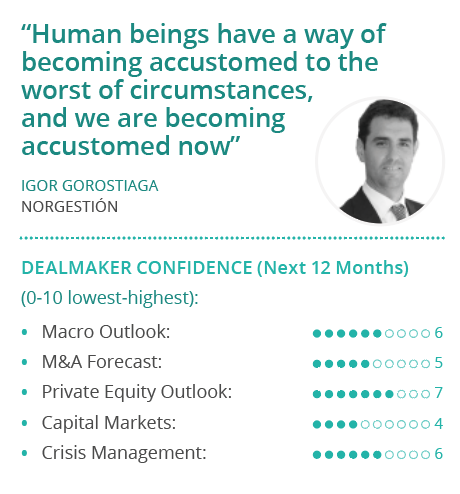
“There’s a more pessimistic climate in Spain than in neighboring markets, which is affecting the macro situation,” said Norgestión Managing Partner Igor Gorostiaga. The lack of coordination was understandable in March, but the fact that this continues almost nine months later is confounding, Gorostiaga said. 

Large companies and banks raised a lot of debt immediately after the lockdown to be solidly positioned in the face of uncertainty. The volume of senior and high yield issuances was very high, and there were plenty of investors ready to buy, Gomez-Jordana noted. Convertible debt issuances were down to a trickle, however, with few companies willing to risk equity at discounted rates amid the volatility, he said.

“I think there’s a general conviction that this situation is transitory,” said Gomez-Jordana. Of course, it’s important that the large companies that employ thousands don’t run into problems, and they need to maintain their cash reserves in an uncertain market, he added.

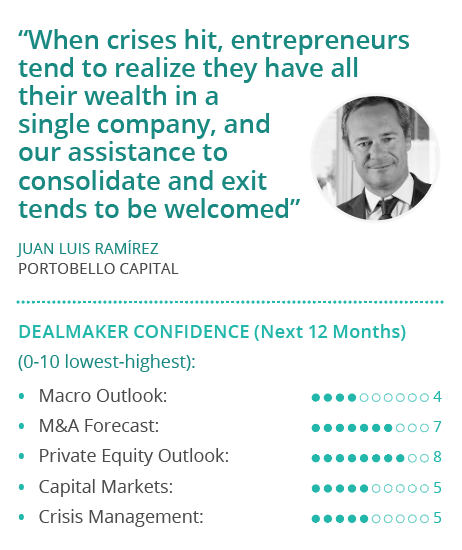
“Where the macro outlook is concerned, I tend to be an optimist,” said Portobello Capital Founding Partner Juan Luis Ramírez. “This crisis is better than the last, in that once it’s resolved, we’re going to return to normal more rapidly, as we have a healthy financial system,” he noted. Governments have injected historic sums into the economy, which should ultimately result in inflation to the benefit of debtors, he added.

Traditional retail, on the other hand, which was already suffering as e-commerce took at growing piece of the market, has been dealt a severe blow, Hernández noted. An acceleration of the migration online and away from brick and mortar among major retailers is a clear outcome of the current crisis, he said.

M&A Outlook
Click here to access the fourth issue of Transactional Impact Monitor: Spain & Portugal – Vol. 5.

PORTUGAL

The Portuguese economy is projected to contract by 10% in 2020, according to the IMF, with unemployment pushing 14%. A moderate recovery with 5% GDP growth is projected in 2021, with a drop in unemployment to 8.7%. The Portuguese government’s stimulus measures aimed at supporting income, preserving employment and ensuring liquidity will amount to nearly 3% of GPD in 2020, according to Banco de Portugal’s October Bulletin, not enough to stave off its economic contraction, which outpaced most other markets of the Eurozone in 1H20.

“Currently the economic outlook is negative, but the full extent of the contraction will depend on the severity of the second wave and the measures that might be needed to control it,” said Deloitte Partner João Diogo Pinto. “If we don’t have full lockdown, we’ll be living under constrained economic conditions for the foreseeable future, and we may be heading for a third wave in 2021 as well,” Pinto said. The leisure, hospitality and retail industries have been decimated, he noted, with weak prospects for recovery in the near term.  

Restaurants are open again, but new government measures in force since mid-October limit the number of people that can congregate to five, and with many working remotely or in rotation at the office, half the customers are completely missing, noted SRS Advogados Partner Paulo Bandeira. The Portuguese government’s 2021 budget being resolved in parliament has offered a value-added tax voucher, which will allow patrons to claim back a portion of what they spend in restaurants in 1Q21 the following quarter to encourage consumption and support the sector. Restaurants are happy with the measure, but the effective benefits will only accrue to consumers from April onwards, Bandeira noted. Meanwhile, the government upped its state of alarm and mandated mask wearing in public through the end of 2020 in a new law passed in late October.

M&A Outlook
Click here to access the fourth issue of Transactional Impact Monitor: Spain & Portugal – Vol. 5.

Transactional Impact Monitor: Spain & Portugal – Vol. 5

Dealmaker Q&A

Conteúdo disponível em português e inglês

TTR DealMaker Q&A con Carlos Lobo, sócio do Veirano Advogados

Carlos LoboVeirano Advogados

É sócio do Veirano Advogados e atua principalmente nas áreas de fusões e aquisições, private equity e mercado de capitais. Carlos atua predominantemente nas área de energia, infraestrutura e Telecom/Tecnologia. É formado em direito pela Universidade do Estado do Rio de Janeiro e possui mestrado pela Columbia University em Nova Iorque.


TTR: As fusões e aquisições em 2020 tiveram um primeiro trimestre “recorde” no Brasil, mas no início da crise de saúde COVID-19, a tendência mudou consideravelmente: como você descreveria a situação atual dos players no mercado transacional no Brasil nesta “Nova Realidade”?

C. L.: Passado um primeiro momento de incerteza no começo da pandemia, quando várias operações de Fusões e Aquisições foram suspensas, o mercado começou a reaquecer a partir de junho, principalmente liderado pelos fundos de Private Equity nacionais e estrangeiros. Este segundo semestre está bastante aquecido com um perfil variado de players e setores, mas observa-se uma predominancia dos fundos de Private Equity e companhias abertas como compradores. Setores como tecnologia e energia renovável foram menos afetados que os demais e mantiveram um volume considerável de operações ao longo de todo o ano.

TTR: Veirano Advogados é um dos principais assessores de M&A do setor de tecnologia do Brasil de acordo com o ranking jurídico do TTR. Como você avalia o crescimento do setor em 2020 e quais as perspectivas de médio e longo prazo?

C. L.: Este movimento não começou este ano. O setor de tecnologia vem sendo um dos mais ativos em termos de Fusões e Aquisições no Brasil nos últimos cinco anos e acredito que esta tendência deva continuar pelos próximos anos. Vários fatores explicam esse fenômeno. Em primeiro lugar, uma questão cultural, tendo em vista que brasileiros, quando comparados a outros países, passam bastante tempo na internet e são consumidores habituais por meio de e-commerce. Em segundo lugar, o uso disseminado de smartphones e o bom nível de banda larga nos grandes centros permite a realização de transações digitais. Esse ambiente é favorável ao surgimento de variadas empresas do setor de tecnologia. Além disso, o perfil empreendedor do brasileiro, que tem boa formação técnica, aliado a uma indústria de Venture Capital bastante ativa, tem contribuído para esse movimento. Por fim, o surgimento de diversas fintechs no Brasil tem impulsionado o processo de aquisições no setor tecnologia para o setor financeiro.       

TTR: Quais as três mudanças mais importantes que o mercado de fusões e aquisições pode apresentar no Brasil para o quarto trimestre e início de 2021? Quais setores poderiam oferecer maiores oportunidades para investidores com potencial financeiro?

C. L.: Não vejo grandes mudanças no setor até o final do ano e começo de 2021. Acho que setores como tecnologia, energia renovável, saúde e serviços financeiros devem continuar entre os mais ativos.

TTR: Considerando sua experiência em Private Equity, como você espera que esse tipo de investimento evolua em 2021?

C. L.: Acredito que os fundos de Private Equity devem continuar bastante ativos em 2021. Eles estão bem capitalizados e a atual conjuntura econômica, com empresas em situação financeira difícil combinada com a desvalorização da moeda, tem resultado em um número elevado de oportunidades para os fundos.

TTR: Como você descreveria as medidas tomadas pelo governo brasileiro para enfrentar a crise empresarial causada pelo impacto do combate à COVID-19? Que outras medidas são necessárias no curto prazo para garantir a recuperação econômica?

C. L.: Acho que faltou uma atuação mais coordenada do governo federal para evitar o elevado número de casos no Brasil e um apoio maior para as empresas que estão enfrentando dificuldades financeiras. Acho que o governo deveria impor maiores restrições para evitar a aglomeração de pessoas e reduzir o número de casos e criar um programa de apoio às empresas dos setores mais afetados, como hotelaria, restaurantes e companhias aéreas.


Versão em inglês


Carlos LoboVeirano Advogados

Carlos Lobo is a partner with the Firm and focuses his practice on mergers and acquisitions (M&A), private equity investments and capital markets. He is a specialist in the energy, infrastructure and Telecom/Technology sectors. He graduated from law school from the Rio de Janeiro State University and has an LLM from the Columbia University Law School.


TTR: Brazil registered record M&A activity 1Q20, but the trend changed considerably with the onset of the COVID-19 health crisis: how would you describe the current M&A situation and outlook in Brazil?

C. L.: After the first moment of uncertainty at the beginning of the pandemic, when several transactions of mergers and acquisitions were put on hold, the market has rebounded from June on, especially led by domestic and international private equity funds. This second semester is very busy with a different profile of players and sectors, but it is observed a predominance of private equity funds and public companies as buyers. Sectors like technology and renewable energy have been less affected and remained active throughout the year.

TTR: Veirano Advogados is one of the main advisors on M&A in the Brazilian technology sector, according to TTR’s legal ranking.  How do you evaluate the sector’s growth in 2020 and what are the medium and long-term perspectives?

C. L.: This trend has not began this year. The technology sector has been one of the most active in terms of Mergers and Acquisitions activity in the past five years and I believe that such trend shall continue for the coming years. Many factors explain such phenomenon. In first place, a cultural aspect, since Brazilians, when compared to other countries, spend a significant time  on the internet and are regular consumers through e-commerce. In second place, the ample use of smartphones  and the good availability of broadband in the main centers are beneficial for digital transactions. These factors create a favourable environment for the development of technology companies. Also, Brazilians are entrepreneurial and have good technical formation, which allied to an active venture capital industry have contributed for such trend. Finally, the emergence of fintechs in brazil have contributed to the increase of acquisitions in the technology sector related to financial services.

TTR: What are the three most important changes that the M&A market will undergo in Brazil in 4Q20 and early 2021?Which sectors should investors with ample firepower be focused on? 

C. L.: I do not anticipate any major changes in the m&a market until the end of this year and the beginning of 2021. I believe that technology, renewable energy, health care and financial services will remain among the most active sectors.

TTR: Considering your experience in Private Equity, how do you expect this type of investment to evolve in 2021?

C. L.: I believe that the Private Equity funds will continue to be very active in 2021. They are well capitalized and the current macroeconomic situation, with companies in financial distress combined with the devaluation of the currency, have resulted in a elevated number of opportunities for the funds.

TTR: How would you describe the measures taken by the Brazilian Government to support the business community in the wake of the instability caused by the fight against COVID-19? What additional measures are needed in the short term to ensure economic recovery?  

C. L.: I believe that the federal government should have better coordinated the efforts against the pandemic to reduce the number of cases and to offer better support to companies in financial distress. It should impose social distancing and other restrictions to reduce the numbers of cases and create a program of support to the companies of sectors greatly affected, like hotels, restaurants, and air carriers.