Transactional Impact Monitor: Andean Region

Transactional Impact Monitor: Andean Region – Vol. 1

15 April 2020

TTR’s Transactional Impact Monitor (TIM) is a Special Report combining local knowledge and market visibility from top dealmakers developed to address extraordinary situations affecting the macroeconomic stability and M&A outlook in core markets

INDEX

CHILE
– Private Equity
– Equity Capital Markets
– Handling the Crisis

COLOMBIA
– Private Equity
– Equity Capital Markets
– Handling the Crisis

PERU
– Private Equity
– Equity Capital Markets
– Handling the Crisis

– The View from Milan
– Dealmaker Profiles

CHILE

Summer vacation was just coming to an end in Chile when the government ordered the closing of non-essential businesses and told citizens to stay inside their homes for an indefinite period of self-isolation on Sunday 15 March. Schools remained closed the next day and Chileans remained homebound until the quarantine began lifting in certain areas on 13 April. Outings required citizens obtain a permit online wherever stay-at-home orders were in place.

Chile faced the business lockdown from the unique perspective of having hosted a destabilizing social upheaval in late 2019, which Carey Partner Francsico Guzmán likened to the “yellow vest” movement in France, in that it had no apparent leader or organized structure.

The social upheaval led to a plethora of tangible demands, including a review of Chile’s constitution, with labor and water rights among the politically sensitive issues surfacing, Guzmán said. 

Investors were cautious in the face of the economic and political uncertainty in 4Q19, he noted. Nonetheless, a strong dollar and cross-border prospects gave Carey a lot of work at the outset of 2020, he said. “That’s when coronavirus hit, and with it a global change.”

Chile was paralyzed by the social movement, and then by the threat of a pandemic, said Guzmán. “The political focus changed from addressing the demands of the social movement to surviving this as best we can,” he said. 

“Fortunately in our case, what we’ve seen is that there’s still work to be done, only the nature of the work is different; it’s more strategic,” Guzmán said. Clients are calling to consult on how best to proceed and to explore restructuring business units, he said.

Renewable energy transactions Carey was working on have continued and even closed in the midst of travel restrictions, Guzmán said, noting this segment had proved particularly resilient to the impacts the crisis was having on Chile.

Retail transactions were held up though, he said. “It’s not as if they’ve fallen apart, but if there was an MOU, the two parties have said, ‘let’s see what happens.’” Retail and infrastructure deals are still being negotiated, but the pace has slowed, he said. “Nobody wants to make a mistake by committing.” More attention is being paid to MAC and force majeure clauses to protect buyers, he noted.

Private Equity
Click here to access the first issue of Transactional Impact Monitor: Andean Region

COLOMBIA

In Colombia, 2019 was a strong year for M&A with growth in deal volume in all but the second quarter and significant growth in aggregate value in all but the fourth quarter. The first two months of 2020 began at a similar pace with several transactions underway and a strong pipeline, said Brigard Urrutia Partner Darío Laguado. The energy and health sectors were particularly active, he noted, and in mid-February, the outlook was still good, despite indications of a pandemic on the horizon. Now, there’s absolute uncertainty about the implications of the economic shutdown, and most of all, about the duration of the crisis it has produced, Laguado said. 

On 17 March, the government of Colombia declared a state of emergency and announced a countrywide quarantine beginning on 24 March and extended through 27 April. In Bogotá, the quarantine began on 20 March. “Companies aren’t thinking short-term, they’re thinking immediate-term,” Laguado said. 

Some sectors will take an especially hard hit; in others there will be opportunities, Laguado said. Everything that adapts everyday activities for the virtual world will do well, like food delivery app companies, he noted. On a whole, M&A transactions have been difficult to advance working remotely, however, he said.

There are already cases of airlines filing for bankruptcy protection, with entertainment, hospitality, and restaurants taking the brunt of the impact, and the suppliers to those sectors next in line, Laguado said. Textiles, consumer goods and manufacturing companies are also suffering, while the financial structure of major infrastructure projects has been thrown into question, he added. Roadway and airport infrastructure depends on traffic, and projects could be impacted by such a momentous slowdown, Laguado noted. Other segments haven’t felt such a significant impact yet, but everyone is concerned, he said.

“This caught everybody with their pants down. It’s a very new situation, very unique, and there were no protocols in place,” Laguado said, adding, “The major lesson here is to conserve liquidity.” 

A few of Brigard Urrutia’s deals that were at an advanced stage were signed, including the sale of Electricaribe assets on 30 March. Others have required finessing to protect buyers, Laguado said. A few other deals in industries that were not very affected have also closed, he said, noting transactions that are countercyclical are still moving forward.

The energy sector was hit simultaneously by the oil price war, Laguado noted, which has strained Colombia’s finances. This crisis hits Colombia at a precarious moment in terms of fiscal stability, he noted, which will limit the resources made available for emergency measures. “Everything is in the air with a lot of uncertainty. Clients are putting things on hold,” he said.

“We do see that there will be large M&A deals, but they will be more strategic,” he said, noting the firm was optimistic for a revitalization of the market in 2H20 if the downtime is limited.

Private Equity
Click here to access the first issue of Transactional Impact Monitor: Andean Region

PERU

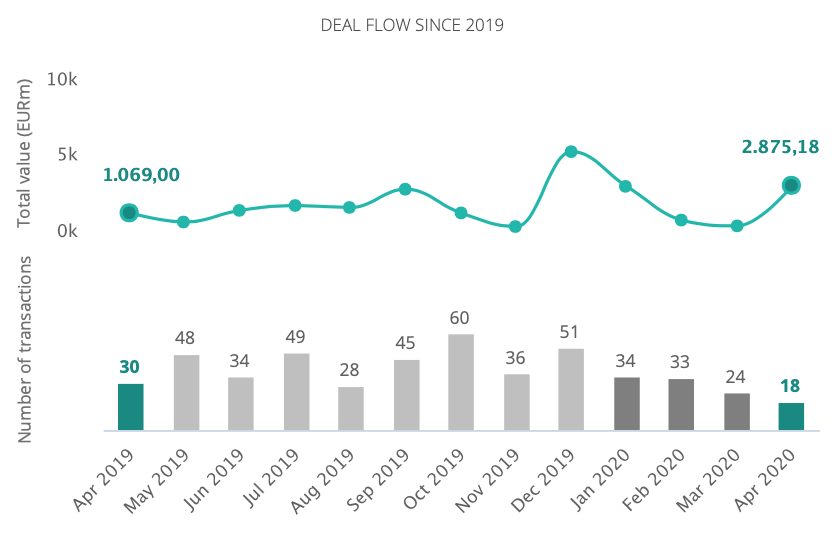
Peru had a very active M&A market over the past 12 months; deal volume grew by 8% in 2Q19 and by 20% in 4Q19 with some very large transactions contributing to a 417% increase in aggregate transaction value in 3Q19, according to TTR data. 

Rubio Leguía Normand was working on about six deals of various sizes in sectors ranging from construction to agribusiness to technology, some worth more than USD 100m, with prospective closings between May and August, Partner Carlos Arata told TTR. 

The measures imposed in the face of the public health threat have put all those deals on hold, he said. “I don’t expect to see any large deals wrapping up in the next six months, except those that were already very close to closing.”

Buyers are saying that the funds they had allocated for acquisitions need to be reserved for contingencies while sellers are saying that their numbers have fallen. People on both sides are taking a “wait-and-see” approach, Arata said. The agribusiness and health sectors will remain the most active in M&A, he noted. 

“The year started out very well; we had a really strong pipeline of deals built from last year,” said Ian Fry Cisneros, Founder and CEO of boutique investment bank UNE Asesores Financieros 

Antitrust regulation that was to go into effect in August 2020 was encouraging companies to get deals done beforehand, Fry said. This had accelerated deal flow, with many transactions being finalized in the first two months of the year and many more scheduled to conclude in 1H20 or early 2H20, he noted.

Like Chile and much of the world, Peru has been under mandatory lockdown since 15 March, with outings outside the home permitted only to restock essentials.

The quarantine interrupted the entire chain of payments throughout the economy, and whereas some companies may have sufficient capital to survive for a few months, many Peruvians live day-to-day, Arata pointed out. “The situation over the next six months is going to be complicated.”

Of the eight deals UNE had in its pipeline, one was a sell-side mandate for food and beverage retailer that operated in airports, Fry noted. It was in the eye of the storm and it came as no surprise when the bidder backed out, he said. “They’re still interested, but they’ll want to have another look once the storm has passed.” The firm has been fortunate to put its other deals on ice rather than have them called off, to be reactivated as soon as possible, Fry said.

Depending on the sector, negotiations are more or less impacted, he said. “It’s probable that there will be adjustments; it’s only natural that the buyer would say that the situation has changed, even if they are still interested,” he said.

Tourism, aviation and entertainment are suffering the greatest impact, he said, whereas agro exporters are still attracting interest. Suppliers to the food manufacturing and pharmaceutical industries need to be kept productive to ensure the supply of essential goods, he said, and these segments will continue to garner interest as they have been permitted to carry on with minimal interruption.

In general, M&A will slow down as buyers wait out the crisis, Arata said, unless they’re sitting on a large pile of cash. Deals could continue to close in the most resilient and stable sectors, like energy and construction, he said, but most sectors will face a sharp downturn.

The government of Peru is expected to invest heavily in public infrastructure to help the economy recover over the coming months, and many firms that were impacted by the scandals in the construction industry will be looking for strategic partners in the months ahead, Arata said.

Private Equity
Click here to access the first issue of Transactional Impact Monitor: Andean Region

Transactional Impact Monitor: Spain & Portugal

Transactional Impact Monitor: Spain & Portugal – Vol. 1

8 April 2020

TTR’s Transactional Impact Monitor (TIM) is a Special Report combining local knowledge and market visibility from top dealmakers developed to address extraordinary situations affecting the macroeconomic stability and M&A outlook in core markets

INDEX

SPAIN
– M&A Outlook
– Private Equity
– Equity Capital Markets
– Handling the Crisis

PORTUGAL
– M&A Outlook
– Private Equity
– Handling the Crisis

– The View from Milan
– Dealmaker Profiles

SPAIN

As alarm and panic make way for cautious optimism in Spain’s battle with SARS-CoV-2 amid a fall in the daily tally of deaths attributed to the virus, the country’s top dealmakers tell TTR of the unprecedented impact containment measures are having on the economy and the transactional market.

The year kicked off strong, private equity firms had a lot of dry powder, but there was a feeling that we were nearing the end of the cycle, said Latham & Watkins Managing Partner Ignacio Gómez-Sancha. “The situation has now changed dramatically from a growth market to a panorama of shock.”

After nearly a month of confinement, which tightened on 14 March with a royal decree that has since been extended through 25 April, countless companies in Spain are reeling, factories are shuttered, restaurants closed, and the bar culture the country is famous for, conspicuously absent.

Spaniards are demonstrating resolve, absolutely convinced of the prudence of adhering to the royal decree for the common good, despite a generalized lack of trust in government predating the crisis, and morale is improving as the number of reported cases reaching the country’s hospitals stabilizes. Just like the enhanced security screening at airports in place since 2001, measures imposed to safeguard public health have been accepted as the new normal, said Gómez-Sancha.

The Spanish government has approved some EUR 100bn to support corporates impacted by the shutdown, making EUR 20bn available to date, 50% allocated to loan guarantees and for small and medium-size enterprises. “What is still lacking are concrete measures to implement it,” said Gómez-Sancha. 

The funds allocated for businesses impacted by the shutdown form part of a broader pledged package of support worth more than EUR 200bn, or nearly 20% of Spain’s GDP. Measures include a moratorium on evictions and utility interruptions affecting those whose livelihoods have been interrupted, with corresponding subsidies to service providers. The government has also announced concessional micro financing for consumers and the postponement of social security contributions for the self-employed.

M&A Outlook
Click here to access the first issue of Transactional Impact Monitor: Spain & Portugal

PORTUGAL

The Portuguese government issued a stay at home plea to its citizens on 13 March, the same weekend the royal decree was issued in Spain. A week later, the government declared a state of emergency and ordered all non-essential businesses closed, a measure renewed 3 April for another fortnight. The monetary response to the crisis has been modest by comparison, however, with just EUR 3bn allocated in guarantee schemes for SMEs and midcaps and another EUR 7bn being sought from the European Commission.

SMEs in Portugal will essentially depend on state aid, which at the moment has not matched expectations, according to Vieira de Almeida (VdA) Group Senior Partner and Head of M&A Practice Jorge Bleck. All companies related to tourism in Portugal are having a very rough time, Bleck noted. “It is devastating because it has meant losing almost all revenue in 24 hours. Those activities were effectively providing jobs to many, many people in Portugal.” 

“For the most optimistic in the tourism and commercial aviation sectors, 2020 is a lost year,” said PLMJ Partner and co-head of Corporate M&A Duarte Schmidt. “Those who are most pessimistic are worried this might be the start of a very long recession.”

The timing of this crisis is unfortunate for Portugal, as it hits at a moment of fiscal vulnerability, Bleck said. “People are forgetful, because they were deluded with the increase in GDP and its mathematical effect of reducing the debt-to-GDP ratio,” Bleck said. The overall debt increased, however, he pointed out. “Now that GDP will fall, we will end up with debt levels in the region of 140%,” he said. 

The impacts of the SARS-CoV-2 response in Portugal are very different for industrial versus service companies, noted Atena Equity Partners Chairman João Rodrigo Santos. Most service providers are closed for business, whereas industrial companies, especially those that are export-oriented, are still open but probably experiencing a slowdown in new orders, he said. 

“Most companies are preparing for a very complicated period ahead by reducing costs and securing rescue financing from banks,” Santos said. “We were already late in the cycle, so the pandemic was just the trigger of a recession. As in all recessions, the majority of businesses will suffer one way or the other,” said Santos.

Santos is not optimistic about the prospects for a rapid recovery. The consumer discretionary segment is going to suffer more over the next couple of years, both at services and industrial levels, he said. 

“Besides being traditionally a very cyclical sector, I believe this time the ramp-up is going to be slower given the likely unprecedented drop in GDP, rising unemployment, and the anti-social trauma this pandemic will create,” he warned. 

M&A Outlook
Click here to access the first issue of Transactional Impact Monitor: Spain & Portugal

Informe Trimestral Argentina – 1T 2020

Mercado de Fusiones y Adquisiciones en Argentina disminuye un 34% en el primer trimestre de 2020 

En los tres primeros meses del año se han registrado 25 transacciones en el país 

9 operaciones registradas en el primer trimestre alcanzan un importe de USD 543,77m

El mercado de M&A en Argentina ha contabilizado en los tres primeros meses del año un total de 25 operaciones, de las cuales 9 suman un importe no confidencial de USD 543,77m, de acuerdo con el informe trimestral de Transactional Track Record. Estos datos reflejan un descenso del 34,21% en el número de operaciones y una baja del 58,85% en el importe de las mismas, respecto al primer trimestre de 2019.  

De las operaciones contabilizadas de enero a marzo, el 3,02% pertenece a operaciones entre USD 1m y USD 10m; el 20,87% pertenece a operaciones entre USD 10m a USD 50m; el 10,82% pertenece a operaciones entre USD 50m a USD 100m; y el 65,28% pertenece a operaciones entre USD 100m y USD 500m. 

En términos sectoriales, el de Petróleo y Gas es el que más transacciones ha contabilizado a lo largo de 2020, con un total de 6 operaciones. 

Ámbito Cross-Border  

Por lo que respecta al mercado Cross-Border, en lo que va de año las empresas argentinas han apostado principalmente por invertir en Brasil con 2 transacciones. Por importe, destaca Colombia, con USD 8,70m.  

Por otro lado, México y Estados Unidos, con 3 operaciones cada uno, son los países que más han apostado por realizar adquisiciones en Argentina. Por importe destacan Noruega y Países Bajos, con USD 355m por cada país. 

Private Equity y Venture Capital

En el primer trimestre de 2020 se ha producido un total de una transacción de Private Equity valorada en USD 38m, lo que representa una disminución del 75% en el número de operaciones y un descenso del 96,63% en el capital movilizado con respecto al primer trimestre de 2019.  

Por su parte, en los tres primeros meses de 2020, Argentina ha registrado seis operaciones de Venture Capital, con un capital movilizado de USD 13m, lo que representa una tendencia estable en el número de operaciones y un descenso del 81,70% en el importe con respecto al mismo periodo del año pasado.  

Asset Acquisitions 

En el mercado de adquisición de activos, se han cerrado en el primer trimestre 4 transacciones con un importe de USD 355m, lo cual implica un descenso del 42,86% en el número de operaciones y un aumento del 343,75% en su importe con respecto al mismo periodo de 2019.  

Transacción Destacada  

Para el primer trimestre de 2020, Transactional Track Record ha seleccionado como operación destacada la realizada por Equinor y Royal Dutch Shell, que adquieren un 49% del área Bandurria Sur a Schlumberger por USD 355m

La operación ha estado asesorada por la parte legal por Bruchou, Fernández Madero & Lombardi; Equinor; Martelli Abogados; Shell Oil Company; MHR Abogados; y Schlumberger.  

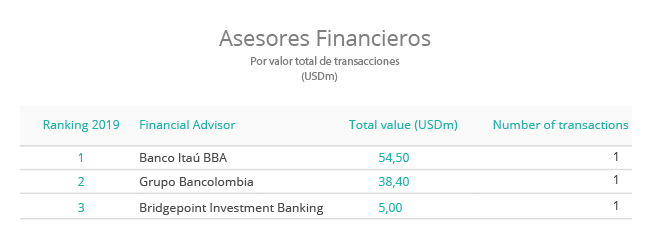
Ranking de Asesores Financieros y Legales
Informe Trimestral Perú – 1T 2020

Mercado de Fusiones y Adquisiciones en Perú disminuye un 58% en el primer trimestre de 2020

En los tres primeros meses del año se han registrado 16 transacciones en el país 

8 operaciones registradas en el primer trimestre alcanzan un importe de USD 519,05m

El mercado de M&A en Perú ha contabilizado en los tres primeros meses del año un total de 16 operaciones, de las cuales 8 suman un importe no confidencial de USD 519,05m, de acuerdo con el informe trimestral de Transactional Track Record. Estos datos reflejan un descenso del 57,89% en el número de operaciones y una baja del 63,99% en el importe de las mismas, con respecto al primer trimestre de 2019.  

De las operaciones contabilizadas de enero a marzo, el 2,45% pertenece a operaciones entre USD 1m y USD 10m; el 13,11% pertenece a operaciones entre USD 10m a USD 50m; y el 84,37% pertenece a operaciones entre USD 100m y USD 500m. 

En términos sectoriales, Transportes, Aviación y Logística, además de Financiero y de Seguros; Inmobiliario; e Internet, hacen parte de los más activos a lo largo de 2020, con un total de 2 operaciones en cada subsector. 

Ámbito Cross-Border  

Por lo que respecta al mercado Cross-Border, en el primer trimestre del año las empresas peruanas han apostado principalmente por invertir en Colombia y España, con 1 transacción en cada país.  

Por otro lado, Reino Unido y Chile (con 2 operaciones en cada uno), son los países que más han apostado por realizar adquisiciones en Perú. Por importe destaca Reino Unido, con USD 277,15m. 

Private Equity y Venture Capital  

En el primer trimestre de 2020 se han producido un total de 3 transacciones de Private Equity valoradas en USD 277m, las cuales representan una disminución del 25% en el número de operaciones y un descenso del 21,66% en el capital movilizado con respecto al primer trimestre de 2019.  

Por su parte, en los tres primeros meses de 2020, Perú ha registrado 1 operación de Venture Capital, lo que representa un descenso del 75% en el número de operaciones con respecto al mismo periodo del año pasado.

Asset Acquisitions 

En el mercado de adquisición de activos, se han cerrado en el primer trimestre 4 transacciones con un importe de USD 24m, lo cual implica un descenso del 55,56% en el número de operaciones y un descenso del 61,67% en su importe con respecto al mismo periodo de 2019.  

Transacción Destacada  

Para el primer trimestre de 2020, Transactional Track Record ha seleccionado como operación destacada la realizada por CVC Capital Partners, la cual ha adquirido el 83,93% de Hermes Transportes Blindados por USD 236,35m

La operación ha estado asesorada por la parte legal por Rodrigo, Elías & Medrano Abogado; Simpson Thacher & Bartlett UK; Hernández & Cía Abogados; y por Ropes & Gray UK. Por la parte financiera, la operación ha sido asesorada por Jefferies & Company y por CAPIA.

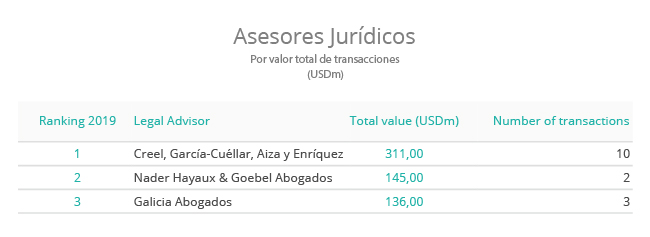
Ranking de Asesores Financieros y Legales
Informe Trimestral Chile – 1T 2020

Mercado de Fusiones y Adquisiciones en Chile disminuye un 46% en el primer trimestre de 2020

En el primer trimestre de 2020 se han registrado 38 operaciones 

16 operaciones registradas en el periodo alcanzan un importe de USD 969m 

Sector Inmobiliario es el más destacado del periodo, con 8 operaciones

El mercado de M&A en Chile ha contabilizado en los tres primeros meses del año un total de 38 operaciones, de las cuales 16 suman un importe no confidencial de USD 969m, de acuerdo con el informe trimestral de Transactional Track Record. Estos datos reflejan un descenso del 45,71% en el número de operaciones y una disminución del 60,32% en el importe de las mismas, respecto al primer trimestre de 2019. 

En términos sectoriales, el sector Inmobiliario es el que más transacciones ha contabilizado a lo largo de 2020 con un total de 8 operaciones, seguido por el sector de Consultoría, Auditoría e Ingeniería, además de Internet, con 5 operaciones en cada sector.

Ámbito Cross-Border  

Por lo que respecta al mercado Cross-Border, en lo que va de año las empresas chilenas han apostado principalmente por invertir en México, Colombia y Perú, con 3, 2 y 2 operaciones, respectivamente. Por importe, destaca Alemania con USD 330m. 

Por otro lado, Estados Unidos, con 5 operaciones, es el país que más ha apostado por realizar adquisiciones en Chile. Por importe destaca Japón, con USD 283m.

Venture Capital

En los tres primeros meses de 2020, Chile ha registrado 9 operaciones de Venture Capital valoradas en USD 14m, lo que representa un aumento del 125% en el número de operaciones y una disminución del 62,40% en el capital movilizado con respecto al mismo periodo del año pasado.

Asset Acquisitions 

En el mercado de adquisición de activos, se han cerrado en el primer trimestre 5 transacciones con un importe de USD 27m, lo cual implica un descenso del 68,75% en el número de operaciones y un descenso del 89,80% en su importe con respecto al mismo periodo de 2019.

Transacción Destacada  

Para el primer trimestre de 2020, Transactional Track Record ha seleccionado como operación destacada la realizada por DT Rigel, la cual ha cerrado la adquisición de BTG Pactual Chile Seguros de Vida

La operación, que ha registrado un importe USD 68,5m, ha estado asesorada por la parte legal por Philippi, Prietocarrizosa Ferrero DU & Uría Chile y por Barros & Errázuriz Abogados. 

Por la parte financiera, la operación ha estado asesorada por Banco BTG Pactual.

Ranking de Asesores Financieros y Legales