El mercado transaccional español registra 1.610 operaciones hasta octubre de 2020
En octubre se han registrado 154 operaciones y un capital movilizado de EUR 10.319m
El sector Inmobiliario es el más activo del año, con 346 transacciones
En el año se registran 131 operaciones de Private Equity y 399 de Venture Capital
Patrocinado por:
El mercado transaccional español ha registrado hasta el mes de octubre un total de 1.610 operaciones con un importe agregado de EUR 79,879m, según el informe mensual de TTR.
Estas cifras suponen una disminución del 23,95% en el número de operaciones con respecto al mismo periodo de 2019, así como un aumento del 18,59% en el capital movilizado, comparado con octubre de 2019.
Por su parte, en el mes de octubre se han registrado 154 fusiones y adquisiciones, entre anunciadas y cerradas, por un importe agregado de EUR 10.319,37m. En términos sectoriales, el sector Inmobiliario ha sido el más activo del año, con un total de 346 transacciones, seguido por el de Tecnología, con 306.
Ámbito Cross-Border
Por lo que respecta al mercado Cross-Border, hasta octubre de 2020 las empresas españolas han elegido como principales destinos de inversión a Portugal y a Estados Unidos, con 29 y 19 operaciones, respectivamente. En términos de importe, Reino Unido es el país más destacado, con un valor aproximado de EUR 25.021,61m.
Por otro lado, Estados Unidos y Reino Unido, con 109 y 87 operaciones, respectivamente, son los países que mayor número de inversiones han realizado en España. Por importe destaca Estados Unidos, con un importe de EUR 4.731,34m.
Private Equity,Venture Capital y Asset Acquisitions
En lo que va de año se ha contabilizado un total de 131 operaciones de Private Equity por EUR 12.267m, lo cual supone un descenso del 42,79% en el número de operaciones y del 51,54% en el importe de las mismas, respecto al mismo periodo del año anterior.
Por su parte, en el mercado de Venture Capital se han llevado a cabo 399 transacciones con un importe agregado de EUR 7.216m, lo que implica una reducción del 3,39% en el número de operaciones y un aumento del 302,99% en el importe de las mismas, en términos interanuales.
En el segmento de Asset Acquisitions, hasta octubre se han registrado 450 operaciones por un valor de EUR 11.447m, lo cual representa una disminución del 30,34% en el número de operaciones, y un descenso del 17,05% en el importe de éstas, en términos interanuales.
Transacción del mes
En octubre de 2020, TTR ha seleccionado como transacción destacada la adquisición por parte de Iberdrola Renewables Australia, filial de la española Iberdrola, del 98,25% de la australiana Infigen, mediante una Oferta Pública de Adquisición (OPA) lanzada sobre el 100% de la empresa.
La operación, que ha registrado un importe de aproximadamente EUR 526,25m, ha estado asesorada por la parte legal por DLA Piper. Por la parte financiera, la operación ha estado asesorada por Deloitte España.
Ranking de asesores financieros y jurídicos
Informe Mensual México – Octubre 2020
Posted on
Mercado transaccional mexicano registra descenso del 8% en 2020
En octubre se han registrado 26 transacciones en el país por USD 215,98m
A lo largo de 2020 se han registrado 236 transacciones por USD 11.280m
Operaciones de capital riesgo aumentan casi un 11% hasta octubre de 2020
Sector de Tecnología y Financiero y de Seguros, los sectores más destacados del año
Por su parte, en los diez primeros meses del año se han producido un total de 236 transacciones, de las cuales 113 registran un importe conjunto de USD 11.280m, lo que implica un descenso del 7,81% en el número de operaciones y una disminución del 16,56% en el importe de estas, con respecto al mismo período de 2019.
En términos sectoriales, el Tecnológico ha sido el más activo del año, con 45 operaciones, así como el Financiero y de Seguros, con un total de 43 transacciones, seguido por el de Internet, con 33.
Ámbito Cross-Border
Por lo que respecta al mercado cross-border, a lo largo de 2020 las empresas mexicanas han apostado principalmente por invertir en Estados Unidos, con 14 operaciones, seguido de España, con 10 transacciones. Por importe destaca España, con USD 1.038,73m.
Por otro lado, Estados Unidos, es el país que más ha apostado por realizar adquisiciones en México, con 57 operaciones, seguido de Canadá con 11 transacciones, respectivamente. Por importe, se destaca Estados Unidos, con USD 1.065,10m.
Private Equity,Venture Capital y Asset Acquisitions
Hasta octubre de 2020 se han contabilizado un total de 10 operaciones de Private Equity por USD 183m, lo cual supone un descenso del 37,50% en el número de operaciones y un aumento del 172,74% en el importe de éstas, con respecto al mismo periodo del año anterior.
Por su parte, en el segmento de Venture Capital se han contabilizado hasta octubre un total de 82 operaciones con un importe agregado de USD 1.030m, lo que implica un aumento del 10,81% en el número de operaciones y una disminución del 41,90% en el importe de las mismas en términos interanuales.
En el segmento de Asset Acquisitions, hasta el mes de octubre se han registrado 47 operaciones, por un valor de USD 1.064m, lo cual representa una disminución del 27,69% en el número de operaciones, y un descenso del 66,05% en el importe de estas, con respecto a octubre de 2019.
La operación, valorada en USD 136m ha estado asesorada por Creel, García-Cuéllar, Aiza y Enríquez; Simpson Thacher & Bartlett US; Galicia Abogados y Cleary Gottlieb Steen & Hamilton US.
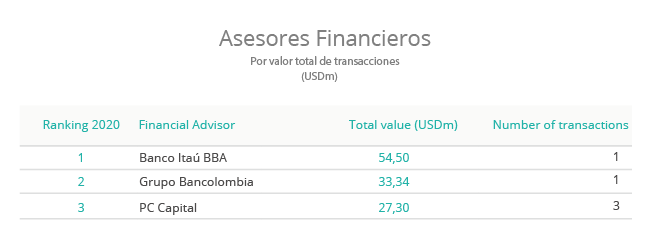
Ranking de asesores financieros y jurídicos
Informe Mensal Brasil – Outubro 2020
Posted on
Volume de Fusões e Aquisições têm redução de 8%, até outubro de 2020
Os Estados Unidos reduziram suas aquisições no Brasil em 14%
Startups de saúde e higiene movimentam 136% a mais em 2020
Em 2020, investimentos em startups de tecnologia aumentam 22%
Patrocinado pelos:
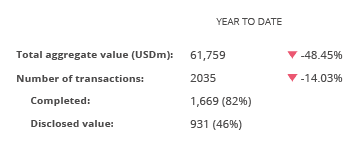
O mercado transacional brasileiro registrou até o mês de outubro 1.133 operações com um valor total de BRL 182,9bi, segundoo informe mensal do TTR. Isto representa uma diminuição de 8% do valor movimentado e uma redução de 11% no número de transações, em relação ao mesmo período de 2019.
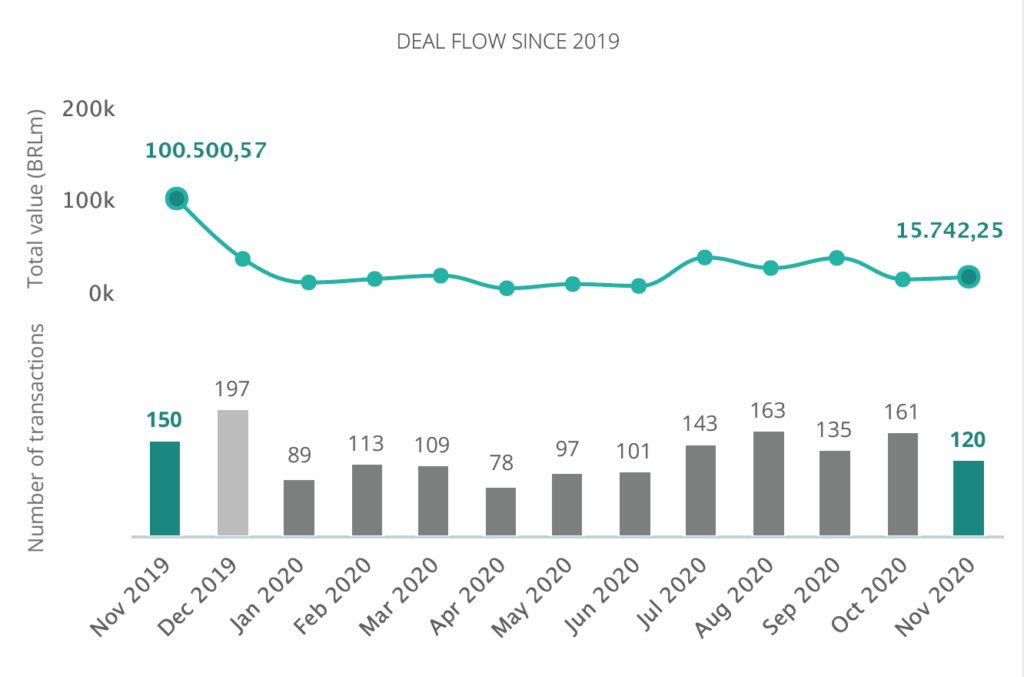
Por sua vez, no mês de outubro se registraram 128 transações de fusões e aquisições entre anunciadas e concluídas, por um valor total de BRL 15,1bi. Neste caso, houve uma redução de 20% no número de transações e um aumento de 3% no valor movimentado em relação ao mês de outubro de 2019. Em 2020, após atingir o volume mais baixo do ano em abril, 78 transações, iniciou-se uma recuperação da dinâmica transacional, que atingiu seu auge em agosto, com 156 operações.
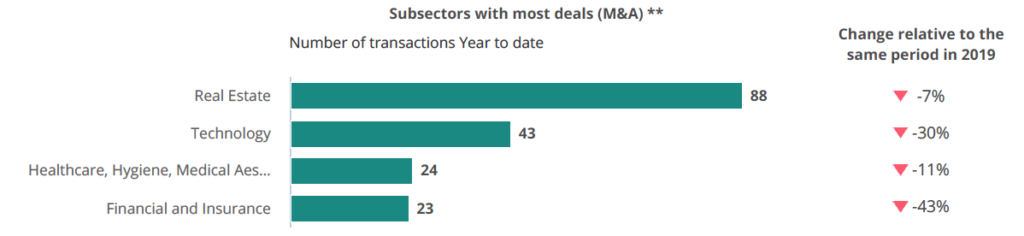
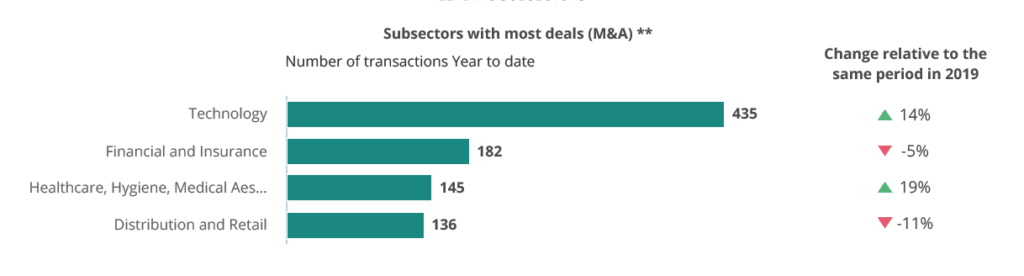
Os setor mais ativo do ano é o de Tecnologia com 375 transações até o fim de outubro. Seguido pelo setor Financeiro e de Seguros com 159 operações e em terceiro lugar, o setor de Saúde e Higiene com 119 transações, representando um crescimento anual de 10%.
Âmbito Cross-Border
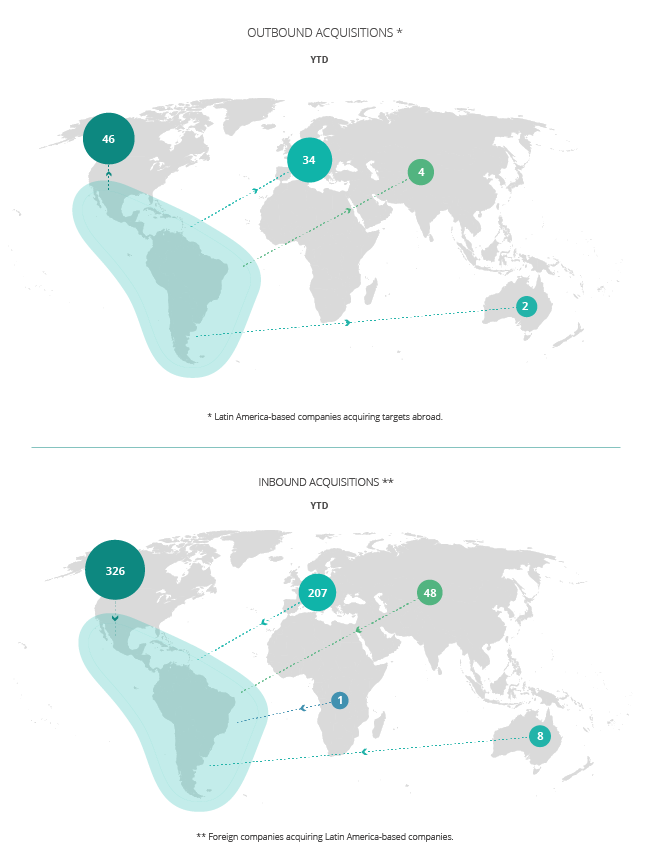
Os Estados Unidos reduziram suas aquisições no Brasil em 14%, mesmo assim, ainda são o investidor mais ativo com 95 transações até o fim de outubro. Fundos de Private Equity e Venture Capital estrangeiros também reduziram seus investimentos no Brasil em 32%. As empresas estrangeiras mantiveram seus investimentos no setor de Tecnologia e Internet no Brasil, com 85 transações, não houve variação em relação ao mesmo período do ano anterior.
Em relação a atuação brasileira no exterior, Estados Unidos é o destino favorito na hora de realizar aquisições, foram 20 transações até o fim de outubro.
Venture Capital
Os fundos de Venture Capital movimentaram um total de BRL 13,9bi até outubro, aumento de 53% em relação ao mesmo período de 2019. Foram 311 rodadas de investimento, representando um crescimento anual de 24%. O setor que mais recebeu investimentos foi o de Tecnologia, representando 67% do total, com 208 transações, aumento de 22% na comparação anual.
A transação contou com a assessoria em lei brasileira dos escritórios Lefosse Advogados e Mattos Filho, Veiga Filho, Marrey Jr. e Quiroga Advogados.
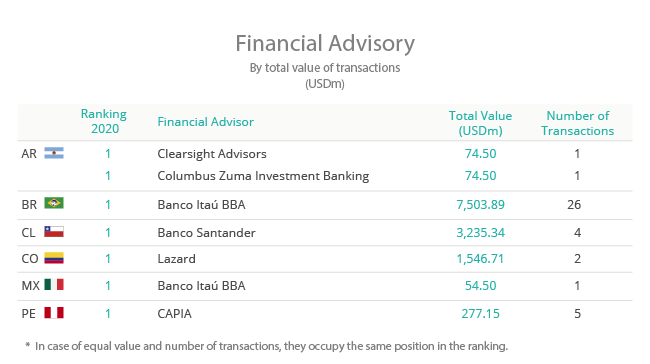
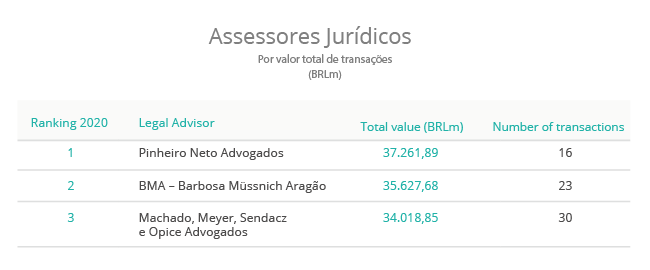
Ranking de assessores Jurídicos e Financeiros
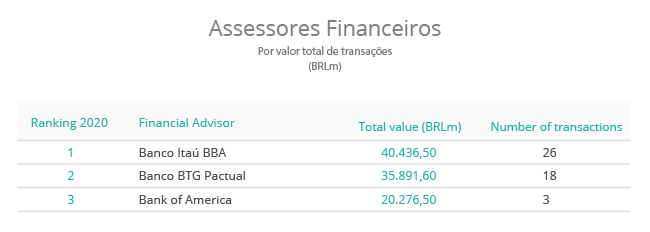
O relatório publica os rankings de assessores financeiros e jurídicos até setembro de 2020 en M&A, Private Equity, Venture Capital e Mercado de Capitais, onde se informa a atividade das firmas destacadas pelo número de transações e pelo valor total das mesmas.
Transactional Impact Monitor: Andean Region – Vol. 3
Posted on
Transactional Impact Monitor: Andean Region – Vol. 3
15 October 2020
TTR’s Transactional Impact Monitor (TIM) is a Special Report combining local knowledge and market visibility from top dealmakers developed to address extraordinary situations affecting the macroeconomic stability and M&A outlook in core markets
INDEX
CHILE – M&A Outlook – Handling the Crisis
COLOMBIA – M&A Outlook – Handling the Crisis
PERU – M&A Outlook – Handling the Crisis
– Dealmaker Profiles
CHILE
The mood among investors in Chile, and those looking on from abroad at what has long been considered the darling of Latin America for its political stability and liberal trade policies, is tenuous. The plebiscite on constitutional reform, originally scheduled for April, will be held on 25 October, a year after protesters filled the streets of Santiago following a public transit hike to voice their discontent on a range of matters. Among the grievances that led to widespread unrest were human rights abuses, the exclusion of a large swath of the population from the economic gains the country has enjoyed over the last three decades, and a generalized disenchantment with Chile’s form of pro-business, neoliberal democracy.
The economic crisis that gripped the world in 1Q20 caught Chile, and much of Latin America, mid-downward cycle, noted Banmerchant Deputy Manager of Corporate Finance Ignacio Rodríguez. Like other investment banks across the region, Banmerchant had several sale processes underway that were put on hold, Rodríguez said, noting that as the M&A work began to decline, restructuring became the firm’s core business.
“Many companies stopped generating revenues, but their liabilities still needed to be serviced,” he said. Chile’s banks stepped up to support the private sector, funneling low-interest loans with extended grace periods before borrowers had to begin repaying. In September, those grace periods began to expire, Rodríguez said, and if corporate revenues don’t normalize in October and November, a wave of insolvencies will hit Chilean shores.
The uncertainty surrounding the economic recovery is complicated by the October plebiscite, which has investors, and Chileans in general, anxious. “Everybody wants to restructure their liabilities long-term, but many won’t be able to,” Rodríguez said. “They will either go under or seek fresh capital. That’s where M&A will reactivate, representing an opportunity for foreign investors to enter Chile at very low valuations.”
Restrictions governing economic activity in Colombia are easing with all businesses except bars, nightclubs and gyms permitted to open daily as of 22 September, though opening hours continue to be limited for specific sectors. Business confidence has accordingly turned slightly positive for the first time since March, according to the local press.
“We can now turn the page,” said César Gutiérrez, Managing Director of boutique investment bank Bastion Capital Advisors. After six months of near paralysis, the private sector is ready to get back to business, he said. Many Colombian companies in certain industries are entering restructuring processes, refinancing their debt, looking for capital or exploring sale options after six months of little-to-no business activity, however, he noted.
Tourism and hospitality and related industries like aviation and catering, have been decimated, said Gutiérrez, and automotive sales are also down sharply. Bastion was recently approached by a company serving the aviation industry that could not continue to finance its overhead when revenue fell flat, Gutiérrez said. Though Colombia’s international airports reopened on 1 September, traffic remains lackluster as the fear of contracting COVID-19 while flying persists, and many corporate entities maintain work-from-home policies, limiting the company’s prospects for a rebound, he noted.
There is no way to maintain fixed costs for five or six months when revenue evaporates overnight, Gutiérrez said, especially for companies that have relied on debt financing. Colombia’s banks have classified virtually every business segment as high-risk, meanwhile, making it difficult for companies to access bridge financing, Gutiérrez said.
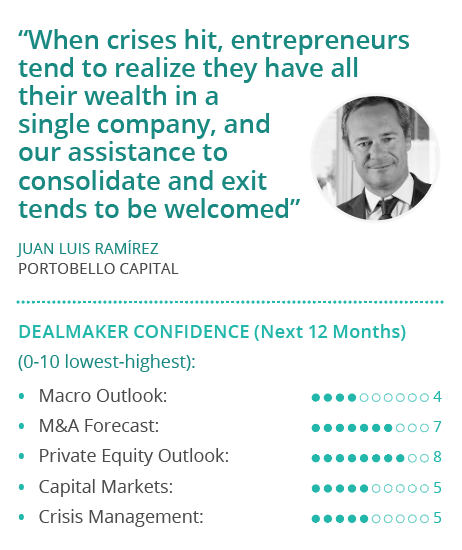
This looks to be the start of a wave of consolidation, where private equity funds with firepower can buy on the cheap, he noted, whether diversified domestic fund managers that have longstanding interests in Colombia, or those that have always had an interest in investing in the country. A long-awaited opportunity for private debt could finally find fertile ground in Colombia, Gutiérrez noted.
Despite the uncertainty about the timing and speed of the recovery, there will always be appetite for good assets, Gutiérrez said. “When some cry, others make handkerchiefs,” he noted, citing a popular saying. This is the moment for opportunistic investors, both strategic and financial, he added. “I’m very optimistic. This has been a moment to reflect, to analyze where industries are headed, and understand the new opportunities; companies need to get ready for what comes next.”
Following months of strict isolation, the Peruvian government announced it would permit air traffic between Peru and seven countries, namely Bolivia, Chile, Colombia, Ecuador, Panama, Paraguay and Uruguay, beginning the first week in October. The reopening of the country’s airspace comes despite an official death toll attributed to SARS-CoV-2 that puts Peru at the top of the list of nations globally by a significant margin, at over 1,000 per million inhabitants. Despite the health crisis, Peruvian companies are beginning to get back to business, and stalled transactions are getting back on track, according to Hernández & Cía. Abogados Partner Diego Carrión.
Peru was awash with M&A deals in 2015, when Carrión was appointed partner. That wave of transactions hit a bump when the “Lava Jato” scandal in Brazil spilled over into Peru, where Odebrecht and other large Brazilian and Spanish construction firms had large contracts underway in partnership with local entities, many of them, it turned out, won by corrupt means.
The construction sector was paralyzed as a result of this, with project finance transactions arrested midstream. This was followed by some opportunistic M&A when Odebrecht and other large international construction firms needed to exit some projects, Carrión recalled, while M&A activity in other sectors of the economy continued at a good pace.
Hernández & Cía. Abogados was never involved with Odebrecht, which gave it a great upside, as many clients began to search the firm out for its clean record, said Carrión. Among the important new clients garnered as a result was Graña y Montero, Carrión noted. In 2017, the firm was retained by the company’s new board to guide it through a reorganization, and it has continued to work hand-in-hand with the board and the new management ever since to overcome one of the most dire corporate crises in the country’s history. “They sought us out for the strength of our team, and because we had no conflict of interest,” Carrión said, noting Hernández was part of the “big change” in the company.
The firm’s deal flow isn’t dependent on the construction industry, however, and it has worked on a slew of M&A deals in other sectors in recent years, including several led by private equity investors. Real estate is one sector in which it has invested heavily of late to enhance its expertise. In the midst of the crisis in mid-2020, it poached an entire real estate practice from another law firm to bolster its capabilities in this growing field.
“This gives us an edge amid strong growth in what has become an increasingly sophisticated real estate market,” Carrión said. Real estate lawyers need to speak the language of the engineers and regulators, and Hernández was losing some business without a clear leader in the space, he said. The runway in the real estate market is tremendous, with construction projects that were shut down in 2Q20 now getting underway again and a pipeline of deals spanning the economy, from the development of agricultural lands to malls. “We now have the capacity to ride this wave,” Carrión said, noting the firm took advantage of its strong balance sheet and the lull in the market to make a strategic move that will position it with the right team.
While construction projects in the private sector are underway again, the large infrastructure projects tendered by the Peruvian government, including Line 2 of Lima’s metro and the expansion of Jorge Chávez Airport, are progressing at a snail’s pace, Carrión said, amid bureaucracy that’s worse than ever, inducing skepticism, fear and a lack of confidence among participants and onlookers alike.
Las operaciones de M&A en Argentina disminuyen un 20% en el segundo trimestre de 2020
En 2020 se han registrado 99 transacciones en Argentina por USD 1.616m
El sector Financiero y de Seguros es el más destacado del año con 18 operaciones
Patrocinado por:
El mercado transaccional argentino ha registrado en los nueve primeros meses del año un total de 99 fusiones y adquisiciones, entre anunciadas y cerradas, por un importe agregado de USD 1.616m, según el informe trimestral de Transactional Track Record en colaboración con Intralinks. Estas cifras suponen una disminución del 20,16% en el número de operaciones y un descenso del 66,73% en el importe de las mismas, con respecto al mismo periodo de 2019.
Por su parte, en el tercer trimestre de 2020 se han contabilizado un total de 42 operaciones con un importe agregado de USD 757,84m.
En términos sectoriales, el Financiero y de Seguros es el más activo del año, con un total de 18 transacciones, seguido por el sector de Tecnología, con 17 operaciones cada uno. En términos interanuales, el sector Financiero y de Seguros ha registrado un aumento del 100%, así como el sector de Tecnología ha registrado un alza del 13%.
Ámbito Cross-Border
Por lo que respecta al mercado Cross-Border, en lo que va de año las empresas argentinas han apostado principalmente por invertir en Brasil, con 11 transacciones y con USD 399m.
Por otro lado, Estados Unidos y México son los países que más han apostado por realizar adquisiciones en Argentina, con 11 y 6 deals, cada uno. Por importe, destaca Noruega, con USD 355m.
Venture Capital
Hasta el tercer trimestre de 2020 Argentina ha registrado 30 operaciones de Venture Capital valoradas en USD 592m, lo que representa un aumento del 25% en el número de operaciones y un aumento del 18,11% en el capital movilizado con respecto al mismo periodo del año pasado.
Asset Acquisitions
En el mercado de adquisición de activos, se han cerrado en el tercer trimestre del año 13 transacciones con un importe de USD 528m, lo cual implica un descenso del 53,57% en el número de operaciones y un descenso del 77,41% en su importe con respecto al mismo periodo de 2019.