DealMaker Q&A

TTR DealMaker Q&A with Dentons Cardenas & Cardenas Partner Mauricio Borrero

Mauricio BorreroDentos Cardenas & Cardenas: Co-head of M&A and Corporate groups, and is the head of the Latin American and Caribbean region Corporate practice group.

—————————————–

The M&A activity in 2020 is severely affected by the COVID-19 health crisis. How would you describe the situation of the M&A players in Colombia and LatAm at this time?

After coming nearly to a halt as a result of the Coronavirus, the M&A market is starting to recuperate. In general terms, traditional M&A players such as strategic buyers and private equity funds, are currently focusing on protecting the value of their own companies and assets rather than entering into new transactions. Nonetheless, those strategic buyers and funds that have available cash, are now starting to actively look for potential targets to acquire. This stems from the fact that the crisis has created a buyer’s market for M&A, with bargain prices and multiple investment opportunities. This is particularly evident for strong LatAm companies investing in other countries of the region, as well as acquisitions of companies with a strong reputation and global presence. With an increase in the negative financial effects of the crisis in local companies, especially in the leisure, transport, hospitality, and real estate sectors, it is likely that we will have a surge in distressed M&A transactions during the second semester of 2020 and Q1 and Q2 of 2021.

Which sectors would you say are more affected by this situation? Which ones do you think are most likely to recover more quickly?

Although this crisis has affected the entire economy, the most affected sectors are leisure, transportation, hospitality, and real estate. The oil and gas sector has also been affected by both COVID-19 and a reduction of the international prices of crude oil. We consider that the sectors that are more likely to recover quickly will be pharmaceutical, manufacturing, and technology.

What regulatory measures do you think could be deployed to unblock the current situation?

The most critical point is to re-open the economy, with a controlled opening of air travel. The Colombian government needs to increase the available funds for the different financial stimulus packages (i.e. Colombia Responde, Colombia Responde para Todos, etc.), to provide liquidity to local companies. The payment ecosystem needs to be enhanced by enabling new players and different options for the circulation of money and payment mechanisms different than traditional means such as cash. This will also serve to give access to credit and some level of formalization to more individuals and businesses. Defining what economic sectors are key in the “new dynamic” and promote them with subsidized funding and/or tax incentives.

What is the situation of the M&A market in Colombia compared to other nearby countries? Is this stagnation being lived in the same way in other countries in LatAm?

The current situation of the Colombian M&A Market is fairly similar to our peers in LatAm. We have been monitoring the situation with our M&A partners of the region and we have seen that they have all experienced a slowdown in the number and size of M&A deals. We have also evidenced that through the LatAm region there is an increased interest from strategic buyers and private equity sponsors to acquire companies and/or assets at a bargain price. Currently, Dentons Latin America and the Caribbean is participating in several intra-region transactions and international M&A deals involving more than three countries of the region.

What should we expect in the following months? Do you believe it is still possible to get back to normal in 2020?

We consider that the M&A market in Colombia will continue to grow during the following months, but it will not reach the number and size of deals of the previous years. These transactions will be more difficult and the entire process may take longer. All participants of the M&A market will face difficult times ahead when determining the fair market value of the asset/company being acquired, and securing financing at reasonable rates. Moreover, the social distancing rules will affect the negotiation process, as “all hands on deck” negotiations will be difficult to achieve. The time for performing a due diligence process will also be affected, as the collection of documents will become more difficult for the target company, given the limitations for their personnel to be physically present at their offices. We also consider that governmental approvals when required will take longer to be issued. An increase in distressed M&A deals is evident, and will probably be one of the drivers of the M&A market during the following 18 to 24 months. I believe we will only get back to normal during 2023.

———————————————

Versión en español

La actividad transaccional en 2020 está sin duda muy marcada por la crisis sanitaria del COVID-19, ¿cómo describiría la situación de los players del mercado transaccional en Colombia y de la región en estos momentos?

Después de casi detenerse como resultado del Coronavirus, el mercado de fusiones y adquisiciones está comenzando a recuperarse. En términos generales, los actores tradicionales de fusiones y adquisiciones, tales como compradores estratégicos y fondos de capital privado, se están centrando actualmente en proteger el valor de sus propias compañías y activos, en lugar de llevar a cabo nuevas transacciones. Sin embargo, los compradores estratégicos y fondos que tienen efectivo disponible, ahora están comenzando a buscar activamente posibles objetivos para adquirir. Esto se debe al hecho que la crisis ha creado un mercado de compradores para fusiones y adquisiciones, con precios reducidos y múltiples oportunidades de inversión. Esto es particularmente evidente para las compañías latinoamericanas que invierten en otros países de la región, así como para las adquisiciones de compañías con una sólida reputación y presencia global. Con un aumento en los efectos negativos financieros de la crisis en las empresas locales, especialmente en los sectores de entretenimiento, transporte, hotelería e inmobiliario, es probable que tengamos un aumento en las transacciones de “distressed M&A” durante el segundo semestre de 2020 y los dos primeros trimestres de 2021.

¿Qué sectores diría usted que se han visto más afectados por esta situación? ¿Cuáles experimentarán una recuperación más rápida?

Aunque esta crisis ha afectado a toda la economía, los sectores más afectados son el de entretenimiento, transporte, hotelero e inmobiliario. El sector del petróleo y el gas también se ha visto afectado tanto por COVID-19 como por la reducción de los precios internacionales del petróleo crudo.

¿Qué medidas cree que podrían tomarse a nivel regulatorio para desatascar esta paralización?

El punto más crítico es reabrir la economía, con una apertura controlada de los viajes aéreos. El gobierno colombiano necesita aumentar los fondos disponibles para los diferentes paquetes de estímulo financiero (es decir, Colombia Responde, Colombia Responde para Todos, etc.), para proporcionar liquidez a las empresas locales. El ecosistema de pagos debe mejorarse permitiendo nuevos jugadores y diferentes opciones para la circulación de dinero y mecanismos de pago diferentes a los medios tradicionales como el efectivo. Esto también servirá para dar acceso al crédito y cierto nivel de formalización a más individuos y empresas. Definir qué sectores económicos son clave en la “nueva dinámica” y promoverlos con financiamiento subsidiado y/o incentivos tributarios.

¿En qué situación se encuentra Colombia respecto a la actividad transaccional de otros países de su entorno? ¿Esta paralización que vivimos se traslada de igual manera a otros países de América Latina?

La situación actual del mercado colombiano de fusiones y adquisiciones es bastante similar a la de nuestros pares en LatAm. Hemos estado monitoreando la situación con nuestros socios de M&A de la región y hemos visto que todos han experimentado una desaceleración en el número y tamaño de las transacciones de M&A. También hemos evidenciado que en la región de LatAm hay un mayor interés de compradores estratégicos y sponsors de capital privado para adquirir empresas y/o activos a un precio reducido. Actualmente, Dentons Latinoamérica y el Caribe está participando en varias transacciones intrarregionales y acuerdos internacionales de fusiones y adquisiciones que involucran a más de tres países de la región.

¿Qué cabe esperar que suceda en los próximos meses? ¿cree usted que se podrá recuperar la normalidad en 2020?

Consideramos que el mercado de fusiones y adquisiciones en Colombia continuará creciendo durante los próximos meses, pero no alcanzará la cantidad y el tamaño de las transacciones de los años anteriores. Estas transacciones serán más difíciles y puede que todo el proceso dure más tiempo. Todos los participantes en el mercado de fusiones y adquisiciones enfrentarán tiempos difíciles al determinar el valor justo de mercado del activo/empresa que se adquiere y asegurar el financiamiento a tasas razonables. Además, las reglas de distanciamiento social afectarán el proceso de negociación, ya que las negociaciones de “todas las partes sentadas en la misma mesa” serán difíciles de lograr. El tiempo para realizar un proceso de debida diligencia también se verá afectado, ya que la recopilación de documentos será más difícil para el target, dadas las limitaciones para que su personal esté físicamente presente en sus oficinas. También consideramos que las aprobaciones gubernamentales demorarán más en emitirse cuando sean necesarias. Se evidencia un aumento en las transacciones de “distressed M&A”, y probablemente este será uno de los motores del mercado de M&A durante los próximos 18 a 24 meses. Creo que sólo volveremos a la normalidad durante 2023.
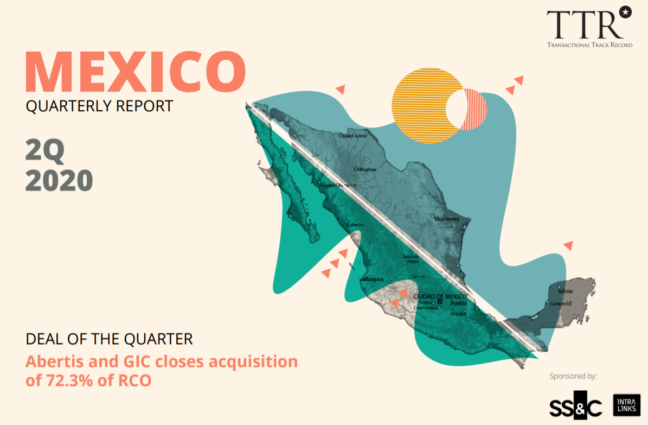
Informe Trimestral México – 2T 2020

Las operaciones de M&A en México disminuyen un 22% en el segundo trimestre de 2020

  • En los seis primeros meses de 2020 se han registrado 121 transacciones por USD 3.802m
  • El sector Internet es el más destacado del semestre, con 19 operaciones
  • Capital movilizado en operaciones de Private Equity aumenta un 8% en el semestre
  • Transacción destacada: Abertis y GIC cierra adquisición del 72.3% de RCO

Patrocinado por:

El mercado transaccional mexicano ha registrado en los seis primeros meses del año un total de 121 fusiones y adquisiciones, entre anunciadas y cerradas, por un importe agregado de USD 3.802m, según el informe trimestral de TTR –Transactional Track Record en colaboriación con Intralinks. Estas cifran suponen una disminución del 22,44% en el número de operaciones y un descenso del 52,67% en el importe de las mismas, con respecto al mismo periodo de 2019.

Por su parte, en el segundo trimestre de 2020 se han contabilizado un total de 43 operaciones con un importe agregado de USD 1.537,70m.

En términos sectoriales, Internet es el más activo del año, con un total de 19 transacciones, seguido por el sector Financiero y de Seguros, con 18, y el de Tecnología, con 10 operaciones. Sin embargo, en términos interanuales el sector Internet ha registrado una disminución del 24% y el sector de Tecnología ha reducido su actividad en un 58%, mientras que el sector Financiero ha aumentado un 6%.

Ámbito Cross-Border

Por lo que respecta al mercado Cross-Border, en lo que va de año las empresas mexicanas han apostado principalmente por invertir en Estados Unidos, con 11 transacciones, seguido por España, con 8 operaciones. Por importe, destaca España, con USD 1.025,85m.

Por otro lado, Estados Unidos y Canadá son los países que más han apostado por realizar adquisiciones en México, con 22 y 7 operaciones, respectivamente. Por importe, destaca Estados Unidos, con USD 222,32m.

Private Equity y Venture Capital

Hasta el segundo trimestre de 2020 se han producido un total de 5 transacciones de Private Equity valoradas en USD 73m, las cuales representan una disminución del 50% en el número de operaciones y un aumento del 7,98% en el capital movilizado con respecto al segundo trimestre de 2019.

Por su parte, en los tres primeros meses de 2020, México ha registrado 39 operaciones de Venture Capital valoradas en USD 344m, lo que representa una tendencia estable en el número de operaciones y una disminución del 23,47% en el capital movilizado con respecto al mismo periodo del año pasado.

Asset Acquisitions

En el mercado de adquisición de activos, se han cerrado en el primer semestre del año 30 transacciones con un importe de USD 875m, lo cual implica un descenso del 25% en el número de operaciones y un descenso del 68,81% en su importe con respecto al mismo periodo de 2019.

Transacción Destacada

Para el segundo trimestre de 2020, Transactional Track Record ha seleccionado como operación destacada la adquisición del 72,3% de RCO por parte de Abertis and GIC, valorada en USD 2.387,17m.

La operación ha estado asesorada por la parte legal por Fried Frank Harris; Shriver & Jacobson; Greenberg Traurig México; Creel, García-Cuéllar, Aiza y Enríquez y por Galicia Abogados. Por la parte financiera, la operación ha sido asesorada por Santander Corporate Investment Banking (SCIB); Goldman Sachs; Morgan Stanley y J.P. Morgan.

Ranking de Asesores Legales y Financieros

En el ranking TTR de asesores financieros, por importe, lideran hasta el segundo trimestre de 2020 Banco Itaú BBA, con USD 54,50m. Por número de operaciones lidera Landmark Alantra, con 2 transacciones.

En cuanto al ranking de asesores jurídicos, por importe y por número de operaciones, lidera Creel, García-Cuéllar, Aiza y Enríquez, con 12 operaciones y un importe de USD 311m.

Informe Trimestral España – 2T 2020

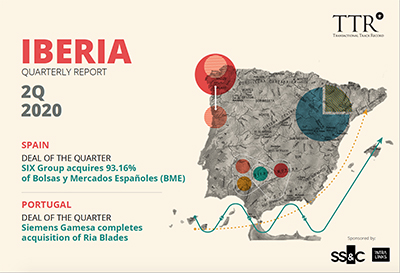
El número de operaciones de M&A en España disminuye un 30% en el primer semestre de 2020

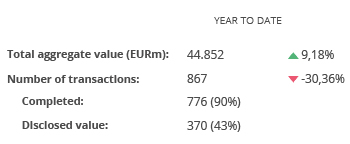
En lo que va de año se han registrado 867 operaciones de M&A por un importe de EUR 44.852m

El sector inmobiliario ha registrado el mayor número de operaciones, con 200, pese a experimentar una caída del 36% con respecto al primer semestre de 2019

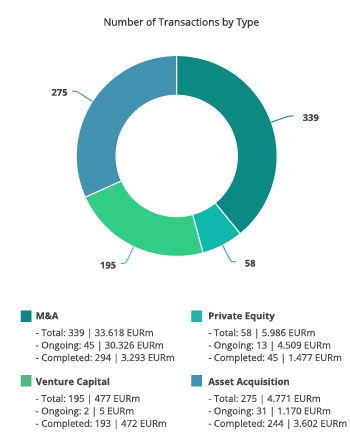
En el año se han registrado 58 operaciones de Private Equity y 195 de Venture Capital

En el segundo trimestre se han contabilizado 299 fusiones y adquisiciones por EUR 33.949m


Patrocinado por:

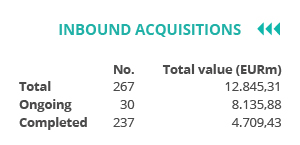
El mercado transaccional español ha registrado en los seis primeros meses del año un total de 867 fusiones y adquisiciones, entre anunciadas y cerradas, por un importe agregado de EUR 44.852m, según el informe trimestral de TTR en colaboración con Intralinks. Estas cifran suponen una disminución del 30,36% en el número de operaciones y un aumento del 9,18% en el importe de las mismas, con respecto al mismo periodo de 2019.

Por su parte, en el segundo trimestre de 2020 se han contabilizado un total de 299 operaciones con un importe agregado de EUR 33.949m.

En términos sectoriales, el Inmobiliario es el más activo del año, con un total de 200 transacciones, seguido por el sector Tecnológico, con 160, y el Financiero y de Seguros, con 64 operaciones. Sin embargo, en términos interanuales el sector Inmobiliario ha registrado una disminución del 36%, mientras que el sector de Tecnología ha reducido su actividad en un 9%, y el sector Financiero y de Seguros en un 18%.

Ámbito Cross-Border 

Por lo que respecta al mercado Cross-Border, en el primer semestre del año, las empresas españolas han elegido como principal destino de sus inversiones a Portugal con 20 operaciones. 

This image has an empty alt attribute; its file name is 02_FEB_ES_CrossBorder_map-.jpg

Por otro lado, Estados Unidos (56), Reino Unido (51) y Francia (39) son los países que mayor número de inversiones han realizado en España. Por importe destaca Estados Unidos, con un importe agregado de EUR 3.941,13m.

Private Equity y Venture Capital

En los seis primeros meses de 2020 se han contabilizado un total de 58 operaciones de Private Equity, de las cuales 17 tienen un importe no confidencial agregado de EUR 5.986m. Esto supone una disminución del 55,04% en el número de operaciones y un descenso del 70,67% en el importe de las mismas, con respecto al mismo periodo del año anterior.

 Por su parte, en el mercado de Venture Capital se han llevado a cabo 195 transacciones, de las cuales 158 tienen un importe no confidencial agregado de EUR 477m. En este caso, ha existido un descenso con respecto al mismo periodo de 2019 del 14,47% en el número de las operaciones, y una reducción del 52,26% en el capital movilizado.

Asset Acquisitions

En el mercado de adquisición de activos, se han contabilizado 275 transacciones con un importe de EUR 4.771m, lo cual implica un descenso del 27,06% en el número de operaciones y una disminución del 24,17% en su importe con respecto al mismo periodo de 2019. 

Transacción del trimestre 

En el segundo trimestre de 2020, TTR ha seleccionado como transacción destacada la adquisición del 93,16% de Bolsas y Mercados Españoles (BME) por parte de SIX Group.

La operación, valorada en EUR 2.648,60m, ha estado asesorada por la parte legal por Linklaters Spain, Latham & Watkins España, Garrigues España y Clifford Chance. Por la parte financiera han participado Credit Suisse Group, Alantra y Santander Corporate Investment Banking (SCIB). La operación ha sido asesorada en la parte de Comunicación por Kreab España. 

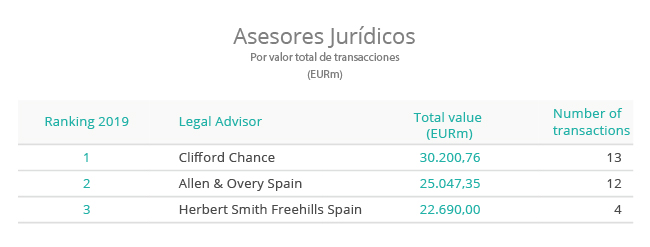
Ranking de asesores financieros y jurídicos 

Transactional Impact Monitor: Andean Region – Vol. 2

Transactional Impact Monitor: Andean Region – Vol. 2

9 June 2020

TTR’s Transactional Impact Monitor (TIM) is a Special Report combining local knowledge and market visibility from top dealmakers developed to address extraordinary situations affecting the macroeconomic stability and M&A outlook in core markets

INDEX

CHILE
– M&A Outlook
– Handling the Crisis

COLOMBIA
– M&A Outlook
– Handling the Crisis

PERU
– M&A Outlook
– Handling the Crisis

– The View from Milan
– Dealmaker Profiles

CHILE

Nearly a month after Chile tightened the initial restrictions on movement and business activities imposed in mid-March in Santiago, the minister of health announced on 2 June revised figures for the number of active cases under treatment for SARS-CoV-2, resulting in a decrease from 59,100 to 21,325 and an increase in reported recoveries from some 46,000 to just under 86,000. At the same time, health officials announced the deadliest day with 75 deaths attributed to the virus, bringing the total official death toll to just over 1,200 and 114,000 confirmed cases.

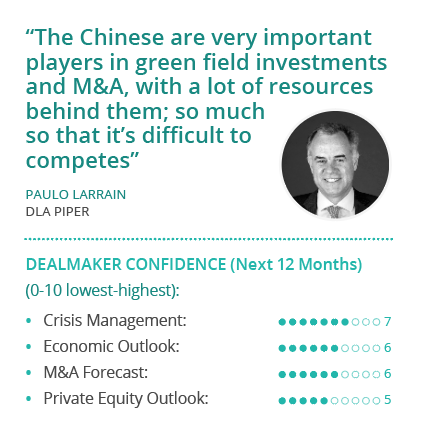
The country avoided a total lockdown from the outset by isolating specific districts with tight quarantines based on an aggressive testing program. This strategy allowed much economic activity to carry on uninterrupted, noted DLA Piper Partner Paulo Larrain.

Notwithstanding, there are industries that have been severely affected, Larrain said. “It’s a very bloody process for many.”

The country was still reeling from the social disruption in October 2019, when protests took over the capital calling for a greater focus on programs geared towards reducing persistent income inequality. “These demands are still pending,” Larrain said, noting the plebiscite on social and constitutional reforms has been relegated to October. 

M&A Outlook
Click here to access the third issue of Transactional Impact Monitor: Andean Region – Vol. 2

COLOMBIA

As May came to a close, hope for a swift return to a normal life was dashed for Colombians as President Iván Duque extended the period of mandatory self-quarantine through the end of June, while extending the public health emergency through to the end of August. The official death toll in the country attributed to Covid-19 stands at just over 1,000 with some 33,000 confirmed cases.

Under Colombia’s new phase of restrictions imposed to face the SARS-CoV-2 threat, 43 exceptions were granted permitting the reopening of several non-essential businesses, including museums, libraries, malls and hair salons, while limiting those venues to 30% occupancy. Residents of Bogotá remain confined to their homes until 15 June.

The rosy prospects of 3.7% GDP growth projected at the beginning of 2020 have long since faded, replaced by apprehension over the health threat, and increasingly, an economic recession likely to persist for the next several years, Inverlink Managing Partner Mauricio Saldarriaga told TTR. 

“It’s a call to a simpler life,” said Saldarriaga. Inverlink presciently began implementing an internationalization in 2015, joining global boutique investment bank network IMAP and establishing its own footprint across the region. The move paid off, Saldarriaga said, noting the firm grew through several tough years, including 2018, when the presidential election featured a leftist candidate and many investments in the country were put on hold.

Despite Iván Duque’s victory, the following year was much slower than most thought it should be, Saldarriaga said. “People thought that within two months, things would be flying.” When the country finally turned the corner in early 2020 with a robust start to the year such as hadn’t been seen in a long time, with real estate and financial services deals booming, “the little meteor” of SARS-CoV-2 hit, he noted, and the situation changed entirely; many deals were put on hold, frozen. “Some will die, others are in the process of being reactivated, but everybody went into survival mode, to preserve cash.” In general, companies began to focus on reducing costs, “trimming the fat”, Saldarriaga said. 

“Many companies will face difficulties, even those with healthy balance sheets,” he said. Restaurants, hotels, retailers, all commerce has been hit hard, and there are few winners, Saldarriaga said, namely personal care products, household cleaning products and food retail. “That’s about 10% of companies. Then there’s the 60% that have been heavily affected, and the rest that will have difficulty surviving.” 

Colombia will now enter a period of repositioning and restructuring, Saldarriaga said. “We’re in discussions with a lot of providers of capital and getting started with the airlines, construction companies and industrial entities, which were already suffering. This was the final straw. We all know this is temporary, but with an undetermined duration, it’s very difficult to make plans.”

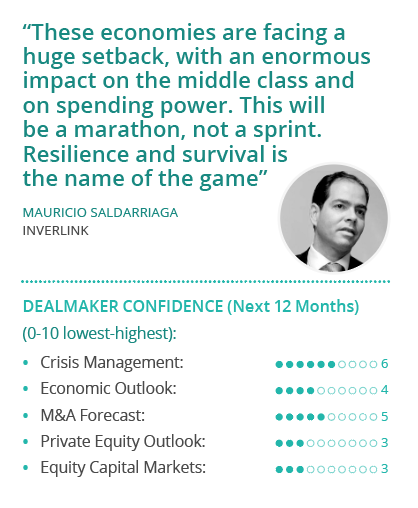
The crisis will cause great difficulty in Colombia and across Latin America over the next 24-to-36 months, he said, noting the region will face a slower recovery owing to the heavy dependence on commodities. “These economies are facing a huge setback, with an enormous impact on the middle class and on spending power. This will be a marathon, not a sprint. Resilience and survival is the name of the game.” 

Colombia’s ambitious 4G program designed to develop the country’s airports, seaports, highways and social infrastructure, was already enduring growing pains Saldarriaga attributed to trying to go “from crawling to running from one day to the next”. The government’s capacity to keep these projects on track and make them a countercyclical engine of growth following this crisis is challenging in the context of the country’s fiscal issues, he said. 

“Infrastructure has become a great lesson in all of this,” he said. The sector was seen as low risk, with low transaction costs, but the these assets are facing a grave impact as tolls evaporate along with traffic through airports, both previously considered predictably stable. It may be a hiccup, Saldarriaga said, and traffic will surely recover, but in the short term, the sector faces a liquidity crunch. “The materialization of risks in the sector will lead to much negotiation with the National Infrastructure Agency (ANI) and a lot of litigation, reclamations and negotiations between the government and concession holders as they hash out how to assign risks in the context force majeure, he said.

“This will be an opportunity for Canadian infrastructure funds, the Brookfields of the world, to recycle capital and keep companies afloat,” Saldarriaga said. Pension funds that have liquidity now can also benefit from the tight situation over the next six-to-12 months in which there will undoubtedly be a lot of distressed M&A and assets that change hands by necessity, he added. “Institutional investors are watching to see how this will play out.”

Colombia’s dependence on oil revenue, which represents nearly 50% of the federal budget, has led to a simultaneous shock that amplifies the economic shock brought about by restrictions imposed to contain the spread of SARS-CoV-2, Saldarriaga noted. The oil market is distorted and manipulated, and this dependence will make the recovery more difficult, Saldarriaga said. “It obligates us to seek ways to depend less on raw materials and more on value-added products,” he said. The falling value of the Colombian peso makes labor costs and many products more competitive, Saldarriaga added. “These are countries that don’t just need to bounce back, they need to reinvent themselves and bounce back, and we better do it, because oil is surely not a stable bet for the future.” 

Diversifying its revenues beyond oil is an important goal for Colombia, but it’s rightly a medium-term project, Saldarriaga said, given the country is still heavily dependent on extractive resources to improve the standard of living for its citizens. “If we have natural resource wealth, we need to develop it. In the end, it’s what can bring us all prosperity.” The important contribution of hydropower powering Colombia’s electric grid makes the country unique, Saldarriaga pointed out, and balances out to an extent the dependence on oil for fiscal revenue. While the country has indeed put a growing emphasis on renewable energy development in recent years, incentivizing wind and solar, the debate underway in the US and the EU in which proponents are calling for de-carbonization as an engine of growth out of recession is more a first world dilemma at present, he said.

M&A Outlook
Click here to access the third issue of Transactional Impact Monitor: Andean Region – Vol. 2

PERU

On 3 June, the government of Peru extended the country’s health emergency for another three months in the face of the highest death toll in the Andean Region attributed to SARS-CoV-2. The official toll stood at nearly 5,000 with more than 178,000 reported cases. The extension of the declared health emergency is in addition to the state of emergency in place until 30 June.

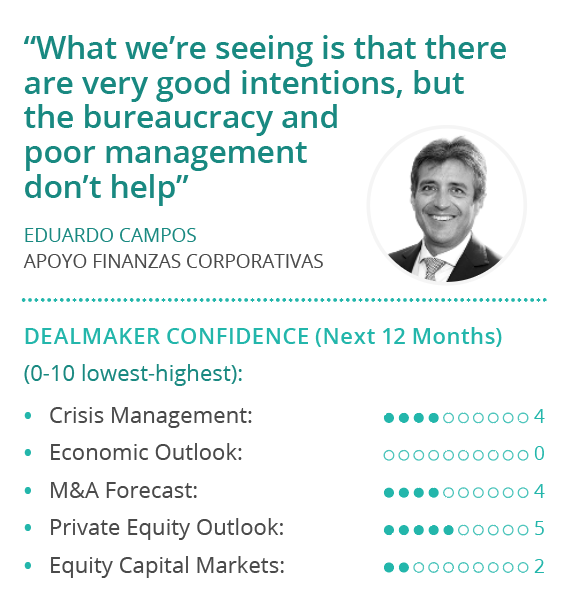
Peru was among the first countries in the region to implement strict health protocols, ground air travel and impose quarantines and curfews, noted APOYO Finanzas Corporativas Partner Eduardo Campos, “but we were already in a precarious situation”.

M&A Outlook
Click here to access the third issue of Transactional Impact Monitor: Andean Region – Vol. 2

The View from Milan

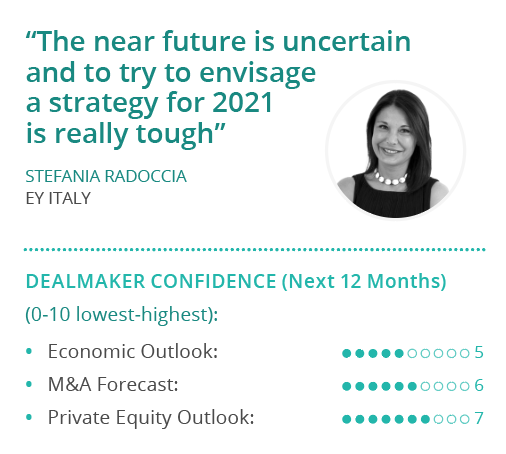
The Special Report has sections on M&A, Private Equity and Handling the Crisis, as well as a first-hand account from Italy in The View From Milan, featuring EY Italy Managing Partner Tax & Law and Mediterranean Region Accounts Leader Stefania Radoccia.

Transactional Impact Monitor: Andean Region – Vol. 2

Informe Mensual América Latina – Mayo 2020

El mercado M&A de América Latina registra una disminución del 33% hasta mayo de 2020 

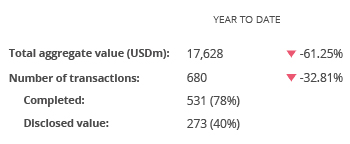
Hasta mayo se han registrado 680 operaciones y un importe de USD 17.628 

En el año se han registrado 38 operaciones de Private Equity y 165 de Venture Capital 

Operaciones de Venture Capital aumentan 2,48% hasta mayo de 2020 

Brasil, México y Chile, países que registran mayor número de operaciones en LatAm 

El mercado transaccional de América Latina ha registrado en mayo un total de 102 fusiones y adquisiciones, entre anunciadas y cerradas, por un importe agregado de USD 534,28m, según el más reciente informe de Transactional Track Record

Por su parte, en los cinco primeros meses del año se han contabilizado 680 fusiones y adquisiciones, entre anunciadas y cerradas, por un importe agregado de EUR 17.628m. 

Estas cifras implican un descenso del 32,81% en el número de operaciones y una disminución del 61,25% en el importe de estas, con respecto a mayo de 2019.

Ranking de Operaciones por Países

Según datos registrados en el transcurso hasta el mes de mayo, por número de operaciones, Brasil lidera el ranking de países más activos de la región con 411 operaciones (con un descenso interanual del 28%), y con una diminución del 69% en el capital movilizado (USD 9.462m). Le sigue en el listado México, con 99 operaciones (con un descenso del 25%), y una disminución del 61% de su importe con respecto al mismo periodo de 2019 (USD 2.779m). 

Por su parte, Chile mantiene su posición en el ranking, con 67 operaciones (una disminución del 37%), y con un descenso del 67% en el capital movilizado (USD 1.361m). Colombia, por su parte, sube una posición en el ranking, desplaza a Argentina y registra 46 operaciones (un descenso del 56%), y una disminución del 19% en el capital movilizado (USD 2.138m). 

Entretanto, Argentina ha registrado 45 operaciones (una baja del 29%), con una disminución del 71% en su importe respecto al mismo periodo del año pasado (USD 578m). Y en último lugar, Perú presenta 26 operaciones (caída del 64%) y con una disminución del 76% en su capital movilizado (USD 571m).

Ámbito Cross-Border

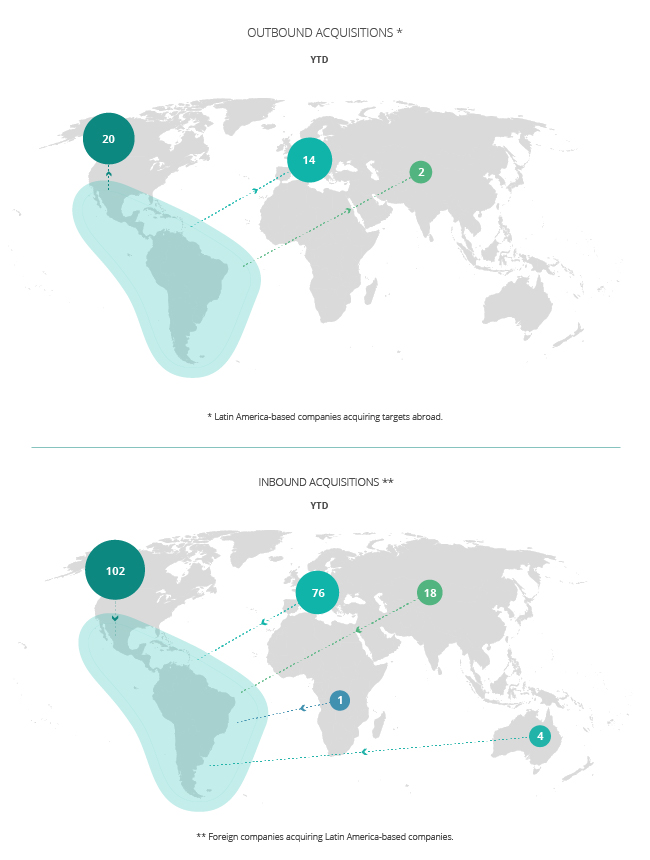
En el ámbito cross-border se destaca hasta mayo el apetito inversor de las compañías latinoamericanas en el exterior, especialmente en Norteamérica, donde se han llevado a cabo 20 operaciones. Por su parte, las compañías que más han realizado operaciones estratégicas en América Latina proceden de Norteamérica y Europa, con 102 y 76 operaciones, respectivamente. 

Private Equity, Venture Capital y Asset Acquisitions

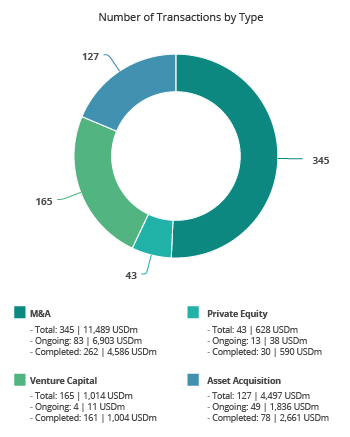
Hasta mayo de 2020 se han contabilizado un total de 43 operaciones de Private Equity por USD 628m, lo cual supone un descenso del 31,75% en el número de operaciones y una disminución del 86,63% en el importe de éstas, con respecto al mismo periodo del año anterior.  

Por su parte, el segmento de Venture Capital ha contabilizado en los cinco primeros meses del año un total de 165 operaciones con un importe agregado de USD 1.014m, lo que implica una variación positiva del 2,48% en el número de operaciones y un descenso del 12,30% en el importe de las mismas en términos interanuales. 

En el segmento de Asset Acquisitions, hasta mayo se han registrado 127 operaciones, por un valor de USD 4.497m, lo cual representa un descenso del 33,16% en el número de operaciones, y una caída del 44,28% en el importe de estas, con respecto al mismo periodo de 2019. 

Transacción Destacada

This image has an empty alt attribute; its file name is LATAM_DOM.png

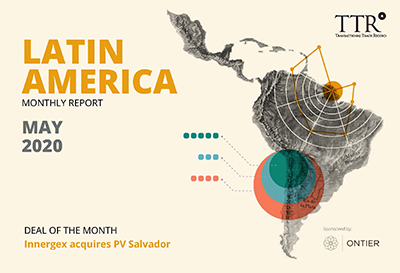
Para mayo de 2020, Transactional Track Record ha seleccionado como operación destacada la adquisición de PV Salvador por parte de Innergex por USD 66m

La operación ha estado asesorada por la parte legal por Claro y Cía. Abogados y por Honorato, Delaveau & Cía. Por la parte financiera, la operación ha sido asesorada por Banco BTG Pactual. 

Ranking de Asesores Financieros y Legales