Portugal: Ranking de assessores financeiros e jurídicos

PORTUGAL: RANKING DE ASSESSORES

PANORAMA TRANSACIONAL

O volume de fusões e aquisições no mercado transacional português somou € 1,02 mil milhões, um salto de 45,86% comparado ao mesmo período de 2016. A TTR registou 16 operações em Portugal em outubro. Desde o início do ano, o país já soma 241 negócios, que alcançaram valor total superior a € 9,4 mil milhões, crescimento de 43,1% no valor das operações.

ASSESSORES FINANCEIROS

O pódio do ranking TTR de assessores financeiros por valores das transações é liderado pelo Natixis Partners, que acumulou em 2017 o valor de € 2,5 mil milhões. Em seguida, aparecem BBVA, com €1,1 mil milhões, e Millennium BCP, €1 mil milhões.

ASSESSORES JURÍDICOS

O ranking de assessores jurídicos por valor é liderado por Morais Leitão, Galvão Teles, Soares da Silva & Associados, €1 mil milhão, seguido por Vieira de Almeida, €1 mil milhão, e Uría Menéndez – Proença de Carvalho, €954 milhões.

Para ver o ranking completo, clique aqui. 

Ranking de Assessores do Brasil

BRASIL

Fusões e aquisições

Foram registradas 64 transações em outubro no mercado de M&A brasileiro, número que representa uma retração de 27,27% em relação ao mesmo mês de 2016. Destas, 29 operações revelaram valores que ultrapassam a casa dos R$ 10,1 bilhões, queda acentuada de 46,74% no período. Outubro foi o mês com menor número de transações no ano.

O setor mais movimentado durante os dez primeiros meses de 2017 foi Tecnologia, com o registro de 142 transações, que não foram suficientes para acompanhar os números do ano anterior, ficando 22% abaixo dos resultados obtidos em 2016, apesar de ter sido o setor com mais transações no mês de outubro, 12. Em seguida, destaque para Petróleo e Gás, com 9 transações no mês. Apenas o segmento Imobiliário obteve crescimento no ano, 61%, devido às 79 operações contabilizadas no período.

RANKING DE ASSESSORES FINANCEIROS

O pódio do ranking TTR de assessores financeiros por valores das transações é liderado pelo Banco Bradesco BBI, que acumulou em 2017 o valor de R$ 17,7 bilhões. Em segundo lugar aparece o Banco BTG Pactual, com R$ 16,4 bilhões, e, na sequência, o Banco Itau BBA- que lidera por número de operações (22) – com R$ 15,7 bilhões.

RANKING DE ASSESSORES JURÍDICOS

O ranking de assessores jurídicos por valor é liderado por Mattos Filho, Veiga Filho, Marrey Jr. e Quiroga Advogados, R$ 36,7 bilhões, que também lidera por número de operações (50). Na segunda colocação está o escritório Pinheiro Neto Advogados, R$ 24,1 bilhões, e Barbosa, Müssnich, Aragão, na terceira posição com R$ 16,7 bilhões.


Monthly report: Latin America- October, 2017

Number of announced and closed transactions in Latin America fell by 13% in October

  • LatAm Deal volume fell 13% in October 2017
  • Aggregate deal value fell 72% to USD 6.3bn
  • Deal of the Month: Intercorp acquires Seguros Sura and Hipotecaria Sura from Sura Asset                           Management and Grupo Wiese for USD 276.4m

LATIN AMERICA: MARKET INSIGHTS

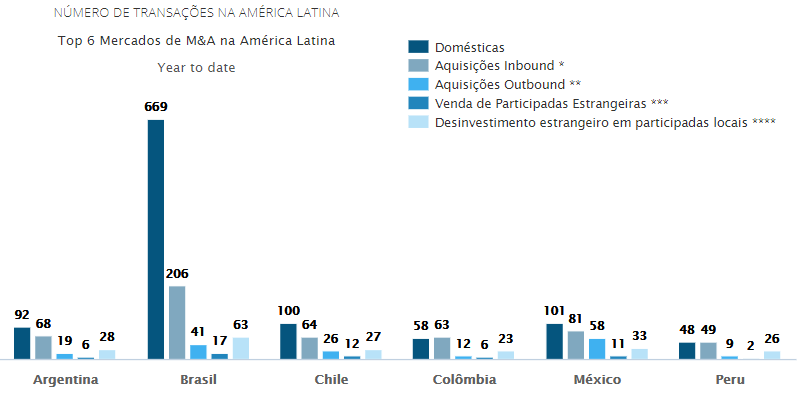
  • The total number of announced and closed transactions in Latin America fell by 13% in October over the same month last year
  • Aggregate transaction value fell 72% relative to the close of October 2016 to USD 6.3bn, considering 68 deals of disclosed consideration region wide.
  • Total transaction volume YTD is up 2.5%, meanwhile, though aggregate deal value has slipped nearly 26% to 72.7bn in the first 10 months of the year, taking into account 719 announced and closed transactions of disclosed consideration regionally.
TOP SIX MARKETS IN LATIN AMERICA
  1.  Brazil leads deal flow regionally with 855 transactions together worth USD 44.6bn to the close of October, up 4% by volume, down 6% by aggregate value compared to the first 10 months of 2016. There were 378 announced and closed transactions with a disclosed consideration in Brazil contributing to aggregate value in the first 10 months of the year.
  2.  Mexico follows with 237 deals worth a combined USD 14.8bn, down 2% by volume and 18% by aggregate value relative to the same 10-month period in 2016, taking into account 109 deals of disclosed consideration.
  3.  Chile ranks third regionally, its 193 deals YTD together worth USD 6.6bn to the close of October, up 15% by volume and down 47% by aggregate value over the first nine months of 2016, taking into account 83 transactions of disclosed consideration.
  4.  Argentina ranks fourth in Latin America at the close of October with 177 announced and closed deals worth a combined USD 4.6bn, up 8% by volume and down 41% by aggregate value, considering 77 transactions for which a deal value was disclosed.
  5.  Colombia follows with 132 deals in the first 10 months of the year, up 5% over the same period last year. Aggregate deal value fell 83% to just under USD 3bn, taking into account 49 transactions of disclosed consideration.
  6.  Peru rounds out the top six M&A markets in the region, though it continues to slip in both transaction volume and aggregate deal value, 12% relative to the first 10 months of 2016 to 105 deals and 27% to USD 3.6bn respectively, taking into account 49 transactions of disclosed consideration.


CROSS-BORDER DEALS

Bidders based in Latin America made three extra-regional cross-border acquisitions in October, two with targets in North America, and one in the EU.

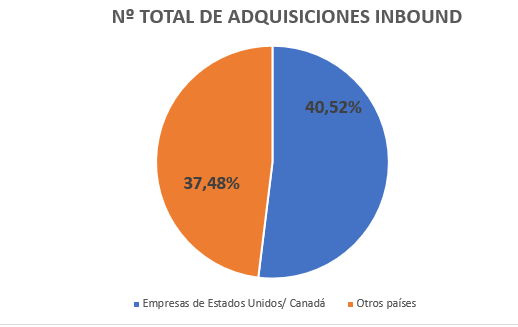
North American buyers led inbound acquisitions in the region during the month of October, with 18 deals originating from the US and Canada. European acquirers made 13 inbound deals in the region. Asian buyers made three acquisitions in Latin America and one Australian firm invested in the region in October.

DEAL OF THE MONTH

TTR selected the closing of Intercorp Financial Services’ USD 276.4m acquisition of Peruvian insurance and mortgage companies Seguros Sura and Hipotecaria Sura from Colombia’s SURA Asset Management and Grupo Wiese as October’s Deal of the Month.

The closing marks the exit of the Colombian financial services group from these segments in Peru. The buyer was advised by Miranda & Amado Abogados, the target used Intralinks. SURA Asset Management and Grupo Wiese were advised by Rebaza, Alcázar & De Las Casas Abogados Financieros.


Reporte mensual: México, Octubre 2017

Capital movilizado en el mercado M&A de México aumenta 22% en octubre de 2017

  • En el mes se han registrado 24 transacciones en el país
  • 16 operaciones registradas en el año alcanzan un importe de USD 2.049m
  • Sector Inmobiliario, el más destacado de octubre con 9 operaciones registradas.

MERCADO TRANSACCIONAL MEXICANO

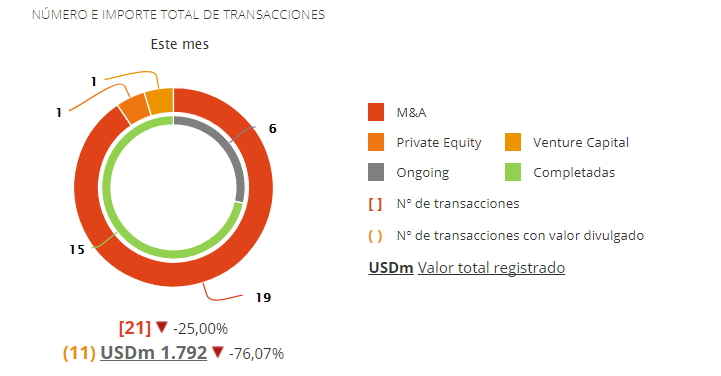
El mercado de M&A en México ha contabilizado en octubre un total de 24 operaciones, de las cuales 16 suman un importe no confidencial de USD 2.049m. Estos datos reflejan una tendencia estable en el número de operaciones y un crecimiento del 22,35% en el importe de las mismas con respecto a octubre de 2016.

Por otra parte, a lo largo del año se han producido un total de 237 transacciones, de las cuales 109 registran un importe conjunto de USD 14.803m, lo que implica un descenso del 2,47% en el número de operaciones y una disminución del 18,29% en el importe de las mismas, con respecto a octubre de 2016. De las operaciones contabilizadas hasta el mes de octubre, 82 son pequeñas transacciones (importes inferiores a USD 100m), 19 transacciones medianas (entre USD 100m y USD 500m) y 8 son grandes transacciones (superior a USD 500m).

En términos sectoriales, el Inmobiliario, además del Financiero y de Seguros, son los que más transacciones han contabilizado a lo largo de 2017, con un total de 40 y 33 operaciones, respectivamente, seguidos por el sector de Industria Alimentaria, con 21 registros; e Internet, con 20 negocios.

ÁMBITO CROSS-BORDER

Por lo que respecta al mercado cross-border, en 2017 las empresas mexicanas han apostado por invertir principalmente en Estados Unidos y Colombia, con 15 y 7 transacciones, respectivamente. Y por importe movilizado en este segmento, se destaca de nuevo a Estados Unidos, con USD 2.653,91m.

Por otro lado, Estados Unidos, España y Reino Unido son también los países que más han apostado por realizar adquisiciones en México, con 30, 15 y 8 operaciones, respectivamente. Por importe destaca en este periodo Canadá, con USD 1.841,75m, y Estados Unidos, con USD 863,23m.

PRIVATE EQUITY Y VENTURE CAPITAL

Hasta el mes de octubre se han producido un total de 31 transacciones de Private Equity, de las cuales 11 suman un importe no confidencial de USD 2.636,01m. Esta actividad representa un aumento del 24% en el número de operaciones y un descenso del 10% en el capital movilizado, con respecto al mismo periodo de 2016.Por su parte, en 2017 se han contabilizado 43 operaciones de Venture Capital, de las cuales 20 suman un importe no confidencial de USD 365,39m. Estos datos representan un aumento del 34% en el número de transacciones, y un significativo ascenso del 124% en el capital movilizado en términos interanuales.

MERCADO DE CAPITALES

En el mercado de capitales mexicano se han cerrado en los diez primeros meses del año 5 salidas a Bolsa y 2 ampliaciones de capital, con importes agregados de USD 2.005,27m y USD 259,04m, respectivamente.

TRANSACCIÓN DESTACADA

Para octubre de 2017, Transactional Track Record ha seleccionado como operación destacada la adquisición de East Balt Bakeries por parte de Grupo Bimbo.

La operación, que ha registrado un importe de USD 650m, ha estado asesorada por la parte legal por Cleary Gottlieb Steen & Hamilton US, White & Case México, NautaDutilh, Morgan Lewis & Bockius,  y por Baker McKenzie US. Por la parte financiera, la transacción ha estado asesorada por Atlas Advisors, y la auditoría ha sido realizada por Deloitte México.

ENTREVISTA CON RODRIGO ROJAS

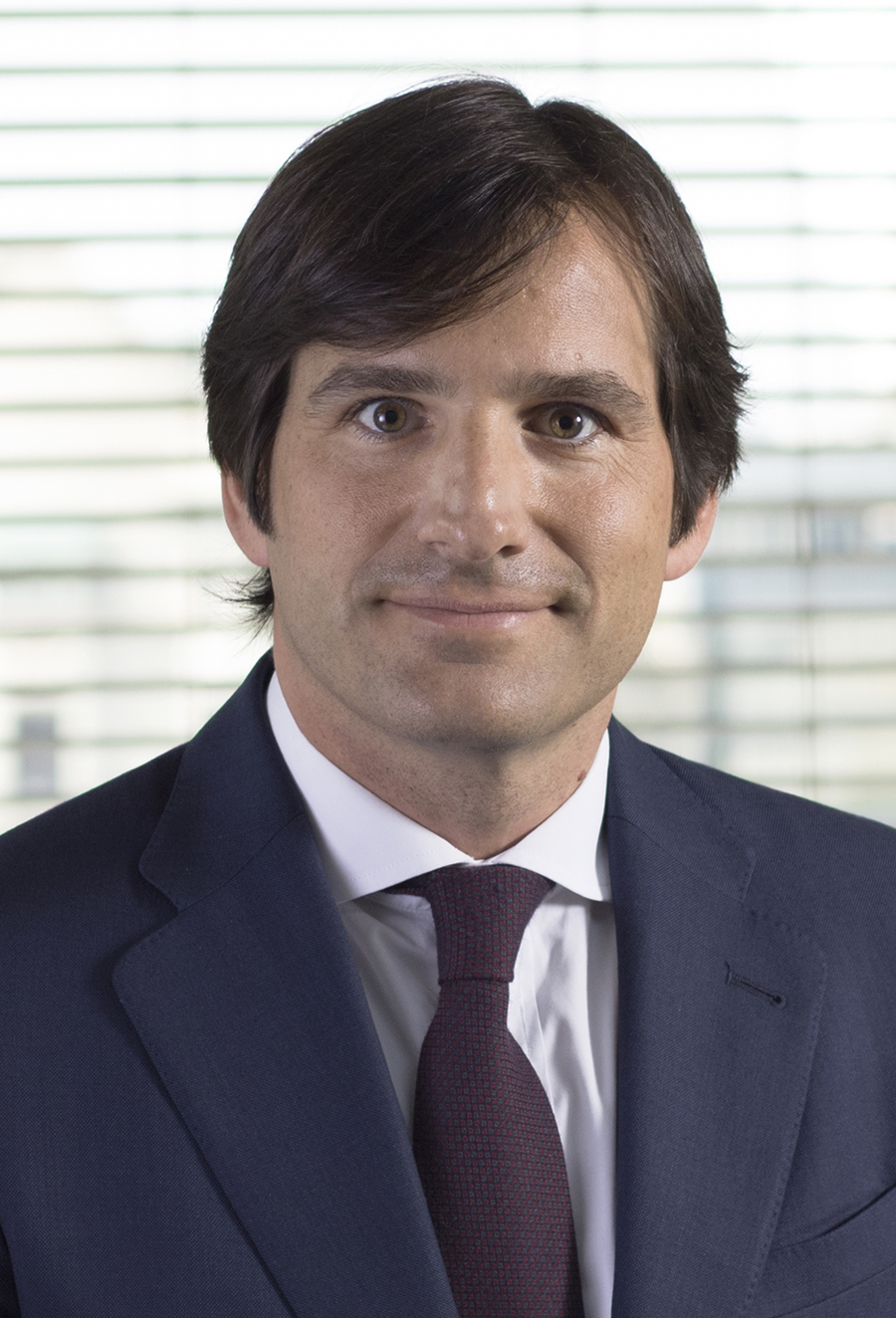
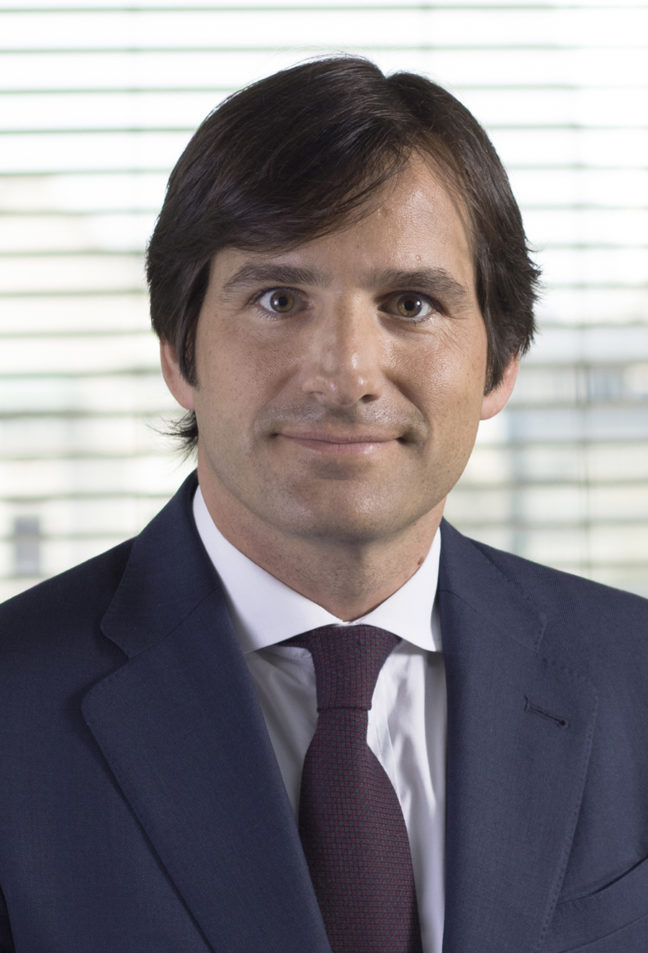
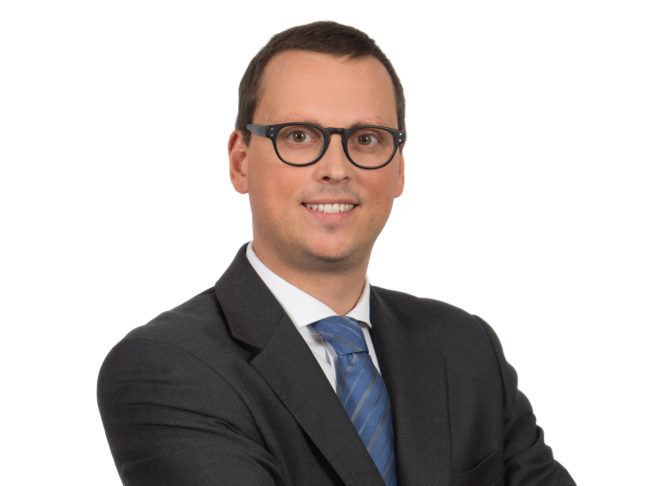
Rodrigo Rojas, socio de la firma González Calvillo en México, ha participado y asesorado en múltiples transacciones. Su práctica se encuentra enfocada en el área bancaria, de financiamiento de proyectos y fusiones y adquisiciones, así como en el área corporativa y de inversiones extranjeras.

“Pareciera que los jugadores del mercado comprenden que, por un lado, la situación política y económica no sólo en México sino en el resto del mundo no puede ni debe detener los negocios y proyectos…”

Lea la entrevista completa aquí.


Rodrigo Rojas, socio de la firma González Calvillo (Español/English)

Rodrigo Rojas, socio de la firma González Calvillo en México, ha participado y asesorado en múltiples transacciones durante los últimos 19 años. Su práctica se encuentra enfocada en el área bancaria, de financiamiento de proyectos y fusiones y adquisiciones, así como en el área corporativa y de inversiones extranjeras.

Sr. Rojas, en primer lugar, para ponernos en situación ¿podría hacernos un pequeño resumen de la situación del mercado de M&A en México actualmente en relación con ejercicios anteriores? 

Aunque la situación política y económica en México durante el ejercicio actual es compleja –por factores tanto internos como externos-, desde mi perspectiva, las transacciones del mercado de M&A en México han resurgido en fechas recientes y de manera importante. Pareciera que los jugadores del mercado comprenden que, por un lado, la situación política y económica no solo en México sino en el resto del mundo no puede ni debe detener los negocios y proyectos, y por el otro, que las reformas estructurales y de negocios emprendidas durante este sexenio han propiciado las condiciones para que el país sea una jurisdicción atractiva para los negocios.

Según su experiencia como asesor en operaciones de M&A relacionadas con el sector energético ¿qué importancia considera que tiene este segmento en la economía mexicana? ¿Ha percibido en los últimos años cambios en cuánto a las transacciones realizadas? 

No cabe duda de que, a raíz de la profunda reforma en el sector energético, éste se ha convertido quizá en el sector más activo y pujante en México. Por esta misma razón, las transacciones en materia energética se han vuelto ciertamente novedosas. La casi total apertura del sector y la gran cantidad de legislación primaria y secundaria emitida por las distintas instancias gubernamentales, han causado que las transacciones en materia energética contengan nuevos temas, aspectos y oportunidades, y también ha causado que los profesionales que nos desempeñamos de alguna u otra forma en el sector debamos reinventarnos y regresar al estudio constante y directo de esta materia.

También ha participado en la asesoría de operaciones Project Finance, ¿podría explicarnos brevemente el proceso para la obtención de financiación que siguen las empresas en México para el desarrollo de sus proyectos, así como la dificultad que entraña? ¿Han existido cambios, o cree usted que deberían producirse, para facilitar el acceso a este tipo de financiación?

El proceso de obtención de financiación para proyectos en México no es diametralmente distinto al de otras jurisdicciones, pero tiene sus particularidades. La forma en que se estructura y obtiene un financiamiento depende de diversas variables típicamente asociadas al proyecto específico y a sus participantes, pero en condiciones normales y en términos muy generales:

  • la empresa o consorcio en cuestión identifica el proyecto específico de que se trate, determinando si se trata de un proyecto derivado de procesos de licitación pública, asignación directa, procesos de asociación público-privada o proyectos de inversión privada sujetos a permiso o autorización gubernamental específica;
  • durante el proceso de asignación del proyecto, la empresa o consorcio (directamente o a través de asesores y estructuradores financieros y legales) acude a instituciones financieras nacionales o extranjeras (incluyendo, en su caso, banca de desarrollo) para determinar conjuntamente, entre otras cosas,  (i) el monto total de inversión requerido para el proyecto, (ii) el monto de inversión directa o indirecta de los socios del proyecto (equity) y el monto a financiarse, (iii) los términos y condiciones esenciales de plazo, pago, condiciones y obligaciones, y (iv) el esquema y mecanismo de garantías y pagos del financiamiento; y
  • durante o una vez concluido el proceso de asignación y autorización del proyecto, las instituciones financieras participantes y la empresa o consorcio negocian los documentos de crédito y garantía que forman parte del paquete de financiamiento, hasta su firma y hasta el eventual desembolso del financiamiento respectivo.

Desde luego que cada proceso es individual y único, y no puede pensarse que la estructuración y cierre de estos financiamientos es igual en cada caso.

Las dificultades más frecuentes en la estructuración de estas transacciones suelen ser, entre otras, la implementación adecuada de mecanismos de garantía sólidos, la obtención de autorizaciones gubernamentales relacionadas con los proyectos para permitir la adecuada implementación de los financiamientos, y la negociación de condiciones que permitan a los inversionistas materializar adecuadamente los beneficios buscados al participar en estos proyectos.

En épocas recientes y dado el importante flujo de proyectos de financiamiento en México, los documentos y modelos que conforman financiamiento de proyectos se han estandarizado hasta cierto punto. Sin embargo, sería un error concluir que esta estandarización parcial implica una recomendación a los participantes para evitar involucrar asesores financieros y legales experimentados que profundicen en los temas específicos, aunque en ocasiones esta pareciera ser una tendencia. Como hemos señalado, los profundos y constantes ajustes a la regulación aplicable naturalmente implican la necesidad de crear esquemas y procesos novedosos y adaptables a las necesidades específicas del proyecto de que se trate. En mi opinión, algunos ajustes en estos procesos que ayudarían al desarrollo de proyectos y a otorgar agilidad a los procesos de financiamiento de proyectos en México serían los siguientes:

  • Que la regulación aplicable a los proyectos de energía e infraestructura base su desarrollo en esquemas que permitan flexibilidad a los participantes en la financiación de los proyectos, haciendo a estos “bancables”; aunque ciertamente la regulación reciente intenta permitir la adecuada financiación de los proyectos, en muchas ocasiones las reglas son contradictorias, limitadas y/o no regulan de forma comprensiva los distintos escenarios posibles, y eso puede causar incertidumbre en los inversionistas y en las instituciones financieras participantes; y
  • Dada la gran cantidad de nuevos participantes en proyectos de energía en México, que las instituciones financieras flexibilicen sus procesos de aprobación y términos de financiamiento. Es verdad que con el paso del tiempo las instituciones financieras (incluyendo las extranjeras) han hecho esfuerzos importantes por modificar sus procesos para permitir mayor apertura a los proyectos que financian, pero en mi experiencia aún existe cierto retraso al respecto.

En lo que llevamos de año, sectores como el del transporte, la alimentación y el del agua y saneamiento, entre otros, también han registrado importantes transacciones ¿Cuál o cuáles de ellos cree que ha experimentado un mayor crecimiento en un periodo reciente? ¿Cuáles considera que han sido los motivos? 

Evidentemente el sector con mayor publicidad es el energético. Sin embargo, las reformas estructurales de la administración actual en ninguna forma se limitan a dicho sector. Además del energético, quizá el sector que más llama la atención es el de telecomunicaciones y transportes. Reformas profundas en estos sectores, además de la necesidad evidente de infraestructura de telecomunicaciones y transportes en México y la consecuente atención específica de la administración en turno a este sector, son las causas principales del incremento en transacciones en estos sectores en últimas fechas. Como ejemplo, recientemente se logró el financiamiento al proyecto “Red Compartida”, que es el primer proyecto público privado relevante en la industria de telecomunicaciones en México, por un monto aproximado de USD$1.9 mil millones, y que sin duda representa un hito en los proyectos de telecomunicaciones bajo la reforma del sector.

Siguiendo con la dinámica de la cuestión anterior, según su parecer ¿Qué sectores cree que tienen todavía un gran potencial de crecimiento? ¿Cuáles cree que en lo que resta de año e inicios del próximo podrían sorprendernos?

Creo que sin duda los proyectos en el sector energético y de infraestructura continuarán siendo los de mayor desarrollo, seguidos por transporte y telecomunicaciones. Como efecto de las multicitadas reformas, apenas estamos comenzando a materializar el enorme potencial de estos sectores.

Para leer sobre Rodrigo Rojas y sus transacciones, haz click aquí. 

Para saber de la firma González Calvillo, haz click aquí. 


Rodrigo Rojas is a partner at González Calvillo, S.C. Rodrigo has participated and advised in multiple transactions during the past 19 years. His main practice is in the banking, project finance and mergers & acquisitions areas, as well as in the areas of corporate and foreign investment.

Mr. Rojas, to begin with, could you give us an overview of the current state of the Mexican M&A market compared with previous years? 

Although the political and economic situation in Mexico during the current year is complex – as an effect of both domestic and foreign factors-, from my perspective, the M&A transactional market in Mexico has had an important resurgence in recent dates. It seems that the market players understand that, on the one hand, the world and Mexican political and economic situation must not and cannot stop business and projects, and on the other hand that the structural legal and business reforms ignited and performed during the current administration have fostered the conditions to make the country an attractive destination for business.

Based on your experience as an advisor in M&A transactions in the energy sector, how important is this sector in the Mexican economy? Have you perceived changes in the last few years regarding transactions made?

There is hardly an argument against the fact that the profound reform in the energy sector in Mexico has caused the latter to probably become the most active and burgeoning sector in the Mexican economy. For this same reason, transactions related to the energy sector have become quite innovative.  The practically complete opening of this sector to private investment and the vast amount of primary and secondary legislation that such opening has forced the Mexican governmental instances to enact has caused transactions related to the energy sector to be full of new areas, aspects and opportunities, and has also caused professionals that are in one way or another involved in this sector to reinvent themselves and return to direct and constant learning of these matters.

You have also been an advisor in Project Finance transactions: could you briefly explain the process followed by companies in Mexico to obtain funding to develop their projects, as well as the difficulties it poses? Have there been changes or do you think there should be changes to make that type of funding more accessible?

The process for obtaining project financing in Mexico is not substantially different to that from other jurisdictions, but it does have its peculiarities.  The way a financing is structured and closed depends on multiple variables typically associated with the specific project and its participants, but in normal conditions and in very general terms:

  • the relevant company or joint venture identifies the specific Project, determining whether such Project is associated with a public bidding or government procurement process, a direct award, public private partnerships (PPP) or private investment projects subject to government specific authorizations or permits;
  • during the awarding process of the project, the company or joint venture (directly or through financial and legal advisors and agents) seeks domestic or foreign financial institutions (including, if applicable, development banks and institutions) to jointly determine, amongst other aspects, (i) the total amount of the investment required for the project, (ii) the amount of direct or indirect investment for the partners of the project (equity) and the percentage of the total investment to be financed, (iii) the general terms and conditions of term, payment, covenants and conditions, and (iv) the financing’s payment, security packages and mechanisms; and
  • during or upon completion of the process of awarding and authorization of the project, the participating financial institutions and the company or joint venture negotiate and execute the relevant financing and security documents, until closing and disbursement of the financing.

Each process is obviously individual ad unique, and therefore it cannot be stated that the structuring and closing of these financings is the same in each case.

The most frequent difficulties found in the structuring of these transactions are usually, among others, the correct implementation of solid security packages and mechanisms, the timely and proper obtaining of governmental authorizations and clearances related to these projects that allow the functional implementation of the relevant financing, and the negotiation of conditions that allow investors to adequately materialize the benefits intended by investing in these projects.

In recent times and as a consequence of the relevant flow of project financings in Mexico, the models and documents conforming a project financing deal have been standardized to a certain degree. However, it would be a mistake to conclude that this partial standardization implies a recommendation to the relevant participants to avoid involving experienced financial and legal advisors that do make detailed work for specific matters, although this seems to be a tendency in certain cases.  As pointed out already, the profound and constant adjustment to the applicable rules naturally imply the need to create innovative schemes and processes that are adaptable to the specific circumstances of the project at hand.  In my opinion, a couple of adjustments to these processes that would aid development of the deals and would give agility to project financing in Mexico are the following:

  • That the regulation applicable to energy and investment projects is developed under a basis that allows flexibility to the participants in the financing of projects, so that the projects are indeed bankable; although recent regulation does intend to allow proper financing for projects, in many occasions the rules are incomplete, contradictory and/or do not regulate the different scenarios on a comprehensive manner, which can logically cause uncertainty for the investors and participating financial institutions; and
  • Considering the vast number of new participants in energy projects in Mexico, that the participating financial institutions make their approval processes and terms of financing more flexible. It is true that as time has passed the financial institutions (including foreign financial institutions) have made important efforts to modify their processes to allow greater participation and targets, but in my experience, there are still some barriers.

So far this year, sectors such as transport, food, and water and sanitation, among others, have registered significant transactions. Which of these underwent a greater growth in a recent period? What do you think were the reasons?

The energy sector is obviously the most publicized sector in recent times. However, the structural reforms of the current administration are in no way limited to such sector. Aside from energy, the sector that probably gains more attention is the telecommunications and transport areas. Profound reforms in these sectors, as well as the inevitable need to procure telecommunications and transport infrastructure in Mexico and the consequent specific attention of the current administration, are the main reasons of the increase in transactions related to these sectors lately. As an example, the implementation and closing of the “Red Compartida” project finance, which is the first relevant PPP project in the telecoms sector in Mexico, was completed for an amount of approximately USD$1.9 billion, and which without a doubt represents a turning point for telecom projects under relevant sector’s reform.

Following the previous question, in your opinion, which sectors still have high potential for growth? Which could surprise us in the rest of 2017 or at the beginning of 2018?

I believe, without a doubt, that projects in the energy sector and infrastructure in general will continue to be the ones of greater development, followed by projects in the telecommunications and transport sectors. We are only beginning to materialize the enormous potential of these sectors under the structural reforms.

To read more about Rodrigo Rojas and his transactions, click here.

To know about the law firm González Calvillo, click here.