DealMaker Q&A

Alberto Rebaza

TTR DealMaker Q&A with Rebaza, Alcazar & De Las Casas Partner Alberto Rebaza

Alberto Rebaza
Alberto Rebaza

Alberto Rebaza is founding partner and managing partner of Rebaza, Alcazar & De Las Casas law firm. Partner leads to mergers and acquisitions and corporate areas. In addition to his masters, he has studies at Georgetown University and England. He has also been director in several companies and organizations such as Edegel (Energy), Rigel Peru (Insurance), Liderman (Services), Amrop (Services), IPAE, Pesquera Alexandra (Fishing), YPO, among others.

TTR: Mr. Rebaza, firstly we would like to get your expert opinion, in a brief analysis, on the progress of the Peruvian M&A market in the first four months of the year.

AR: The Peruvian legal market has experienced an unusual volume of M&A closings in 1Q19 for all type and sizes of transactions. From the small/medium size deals with a strong strategic focus, to the multimillion dollar/cross-border deals that cover most of our newspapers. Our team has participated in 7 closings in 2019 so far (including strategic deals such as the sale of Papelsa to Grupo Gloria, the sale of Holding Plaza to Parque Arauco or the purchase of Duraplast and Novatec by Wenco). We are thrilled and have high expectations with our pipeline of transactions for 2Q19.


TTR: According to our data, Peru allocated a significant part of its investments to other Latin American countries, mainly Colombia and Chile. What attracts the interest of Peruvian investors? 


AR: There are several factors that may explain this phenomenon. First, Colombia and Chile are two countries with lots of social, historic, cultural and legal similarities with Peru. A regional expansion within those countries is normally catalogued as a soft landing for foreign investors.

Second, since the launching of the Pacific Alliance (Latin American trade bloc, formed by Peru, Chile, Colombia and Mexico) in 2011, Peruvian investors are taking a close look to the participant countries of the Pacific Alliance to diversify or expand their businesses. It is worth noting that, despite certain tax benefits (agreements to avoid double taxation or tax reductions, among others), the founding members of the Pacific Alliance executed an agreement to abolish all tariffs of merchandise trade by January 2020, making this integration a unique Latin American marketplace for producers.


TTR: Similarly, Colombia appears so far in 2019 as one of the main investors in the country. How do you think this reciprocal business relationship between the two countries will evolve? How does it benefit their economies?


AR: Colombian investors have been major players in the M&A industry in the recent years and I wouldn’t expect that to change in the near future. They are the third major foreign investors in Peru, after Spain and Chile.

Back in 2018, the Colombian Business Council in Peru announced fresh investments for over US$ 2B in Peru for the years 2018 and 2019. Their main focus is on projects related to the infrastructure, electricity, hospitality, transport and in the cosmetic industry.

In addition to the investment projections of Colombian players, I think the real deal will come once the corruption crisis in Peru is overcome. The Colombians experience in public-private partnerships and Public Works Tax Deduction projects will for sure contribute our economy in a positive way. Their input and investment will boost public projects (and therefore our economy) and increase our employment rate considerably.


TTR: Meanwhile, transactions in Agriculture, Agribusiness, Farming and Fishing have increased in Peru, compared with previous years when that subsector wasn’t as prominent. What could you tell us about that? Do you think the tendency will remain?


AR: The fishing industry in Peru is now consolidated, however, the government has been debating the last months certain legislative modifications that may heavily impact the industry, such as the increase of the fishing rights.

On the other hand, we have viewed a transactional boom related to shrimp-based business like the purchase of La Fragata by Marinazul (affiliated to Grupo Camposol).

Furthermore, the agricultural-related industries are facing an unusual increase in their sectors due to the international demand for agricultural products. We have notice the peculiar interest of foreign investments funds and, particularly, private investors from Chile in the purchase of estates in the north of Peru to develop agribusiness and farming companies. Peru is a privileged country for the agribusiness, making it one of the most suitable natural producers. The progressive increase of the worldwide demand, followed by a friendly legal framework that includes income tax reductions and special depreciation conditions are the perfect match for this boost.


TTR: Lastly, Peru has recently suffered and been involved in certain corruption scandals. How do you think those scandals affect the country’s economy today? What is your outlook on the matter?


AR: Thankfully, the political crisis experienced in Peru last year and the current corruption cases have not prevented the unstoppable growth of our economy and, specifically, of the M&A players’ appetite.

However, it is important to note that all major infrastructure projects have been stopped and their continuity is under analysis. This has deeply affected our economy and the governmental stability, lowering the Peruvian employment rate. I believe this corruption turmoil may only be disregarded by a strong political force that needs to convey economic trust and decision-making features. Furthermore, we are now facing an exchange in the players or the main public projects. The typical powerful Brazilian and local companies are been replaced by international actors of various backgrounds.

Should the current government be unable to revert this situation, I believe the presidential elections in 2021 will be the right moment to overcome this scenario.


DealMaker Q&A

Luiz Nicolau

TTR DealMaker Q&A with Ritch Mueller Partner Luis Nicolau

Luiz Nicolau
Luis Nicolau

Luis A. Nicolau has been a partner at Ritch Mueller since 1990. He specializes in mergers and acquisitions, debt and equity capital markets transactions and banking and finance. He is a leading expert in assisting underwriters and issuers in debt and equity offerings in Mexico and abroad. He has participated in many of the largest public Mexican M&A transactions and advises foreign and domestic private equity funds on a regular basis. He has assisted numerous international financial entities in setting up their Mexican operations, including Scotiabank, JPMorgan, Credit Suisse, Santander and Morgan Stanley.

He currently maintains several board memberships, including at Grupo Posadas, Coca-Cola FEMSA, the public equity fund IGNIA, Morgan Stanley Mexico, UBS Asesores, KIO Networks,  Grupo Cementos de Chihuahua, Gentera, and of the investment committee of Promotora Social México; former President of Fullbright Mexico’s Governing Body, former member of the board of directors of Papalote Museo del Niño, former member of the board of directors of the Indian Mountain School and former member of the Supervisory Board of the Mexican Stock Exchange.

Mr. Nicolau graduated from the Escuela Libre de Derecho in Mexico City in 1986. He obtained a Master in Laws from Columbia University in 1988, where he was a Fulbright Scholar. Before joining Ritch Mueller, he was a foreign associate at Johnson & Gibbs, Dallas, and at Shearman & Sterling in New York. He joined Ritch Mueller in 1990 and has been a partner since then, except for the years 2001 and 2002, when he was the Chief Financial Officer of Vitro.

TTR: To begin, we would like you to give us a brief overview of the course of the first four months of the year in the Mexican M&A market. 

LN: The Mexican market for M&A transactions has been particularly slow for two (2) specific reasons. The first relates to political uncertainty and the lack of visibility in respect of prospects of the Mexican economy. The second, because the aforementioned factors have affected multiples applicable to M&A transactions involving Mexican companies. The good news is that the Fintech market is showing a significant level of activity, given the approval of the new Fintech Law and the fact that the period to obtain licenses under the Fintech Law has commenced. In addition, many Mexican families are showing interest in diversifying holdings and selling stakes, coupled with a different perception of political risk by foreign investors.


TTR:  Year-to-date, the number of transactions in the Internet subsector has increased, compared to last year; what can you tell us in relation to this data? What other sectors do you think will emerge during 2019?


LN: The reality is that generally the technology sectors have shown a substantial level of activity, fueled primarily by dedicated funds with excess liquidity, multiples used in other jurisdictions and the generalized underservice of the Mexican market.

¿Qué otros sectores, cree que, despuntarán a lo largo de 2019? As indicated, the Fintech sector has continued to show dynamism. In addition, the financial services industry has shown signs of further consolidation and there is continued interest in the pharma industry.


TTR:  In relation to the previous question, the majority of investments in the technology sector were from Venture Capital. What place do entrepreneurs and new companies occupy in the country?

LN: Although specific market data is not generally available, this is a sector of special interest, as a result of the new Fintech Law that has provided certainty to the industry, together with the fact that Mexico continues to be underserved from a technology perspective.


TTR:  Meanwhile, according to our records, although Mexico usually allocates a large part of its investments to Latin American countries, it does focus them in the country itself. Why does this unilateral relationship occur? 

LN: Again, this question is difficult to answer without the aid of economic data. However, there has been renewed and ongoing interest by Latin American investors in Mexico, in the Mexican oil and electricity sectors. Real estate and Fintech have shown some dynamism (see the examples of Mercado Libre and Rappi). It seems, however, that the Mexican market is larger, slightly more complex and subject to more competition, and that interesting opportunities remain in existence in several markets in Latin America.


TTR:  Continuing with the same topic, in the medium term, what Latin American countries do you think have the greatest potential to establish new trade links with Mexico and why?

LN: Difficult question to answer and will be dependent upon the desire to diversify, the availability of accretive multiples, competitive financing and the existence of liquidity. Larger Central American groups are likely to continue to look at Mexico as a stable hub, together with Colombia and Peru that are going through stable processes, and of course Brazil with its economic might and better skills to adapt to a large market as Mexico.


TTR:  Apparently, the beginning of the year has not been as economically positive as expected. However, you can see many local businesses in expansion and with the intention of entering new markets. Do you think that this situation could be improved?


LN: It is hard to see significant economic improvement this year, notwithstanding the efforts of private sector groups, because of remaining uncertainties in respect of economic conduction. The end of the year may bring a surprise or two, if the economy remains stable.

Informe México – Abril 2019

Mercado transaccional mexicano registra USD 4.058m de capital movilizado en abril de 2019 

En el mes se han registrado 19 transacciones en México 

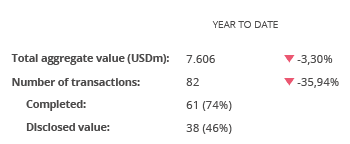
A lo largo de 2019 se han registrado 82 transacciones y un importe de USD 7.606m 

Sector de Internet, el más destacado del año, con 15 operaciones  

El mercado de M&A en México ha contabilizado en los cuatro primeros meses de 2019 un total de 82 operaciones, de las cuales 38 suman un importe no confidencial de USD 7.606m, de acuerdo con el informe mensual de Transactional Track Record. Estos datos reflejan un descenso del 35,94% en el número de operaciones y una disminución del 3,30% en el importe de las mismas con respecto a abril de 2018. Por su parte, en el mes de abril se han producido un total de 19 transacciones, y un importe conjunto no confidencial de USD 4.058m. 

De las 82 operaciones contabilizadas en 2019 con importe revelado, el 16,94% pertenece a operaciones menores a USD 1m, el 9,12% pertenece a operaciones entre USD 1m y USD 10m; el 8,79% pertenece a operaciones entre USD 100m a USD 500m; el 7,17% pertenece a operaciones entre USD 50m y USD 100m; y el 6,51% pertenece a operaciones mayores a USD 500m.   

En términos subsectoriales, el de Internet y Tecnología son los que más transacciones han contabilizado a lo largo del año, con un total de 15 y 14 operaciones respectivamente; seguidos por el Inmobiliario, además del subsector Financiero y de Seguros, con 10 y 9 operaciones, respectivamente.   

Ámbito Cross-Border  

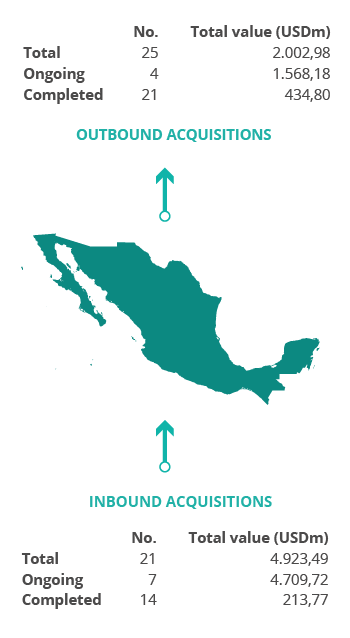
Por lo que respecta al mercado cross-border, a lo largo del año las empresas mexicanas han apostado principalmente por invertir en Estados Unidos, España y Perú, con 6, 5 y 3 transacciones, respectivamente. Y por importe destaca Brasil, con USD 912,13m.  

Por otro lado, Estados Unidos, es el país que más ha apostado por realizar adquisiciones en México, con 7 operaciones, seguido de España, con 3 transacciones. Por importe, se destaca en este periodo España, con USD 2.947,22m. 

Private Equity y Venture Capital  

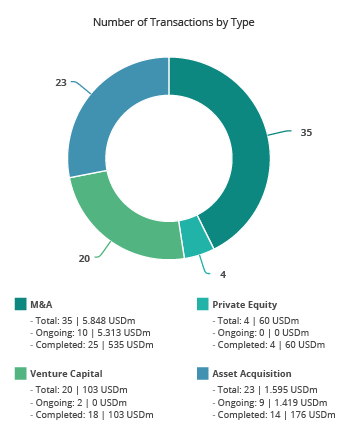
En lo que va de 2019 se han producido un total de 4 transacciones de Private Equity valoradas en USD 60m, lo que representa una disminución del 75% en el número de operaciones y una baja del 96% en el valor total registrado con respecto al mismo periodo de 2018.  

Por su parte, hasta abril de 2019 se han contabilizado 20 operaciones de Venture Capitalcon un valor de USD 103m, lo que representa una disminución del 20% en el número de operaciones y una baja del 46,76% en el importe de las mismas con respecto al mismo periodo de 2018. 

Transacción Destacada  

Para abril de 2019, Transactional Track Record ha seleccionado como operación destacada la adquisición del 100% de Harmon Hall por parte de Talisis

La operación, que ha registrado un importe de aproximadamente USD 28,16m, ha estado asesorada por la parte legal por Santamarina y Steta Abogados, y Ritch Mueller, y en la parte financiera por 414 Capital e IBIS Capital.  

Ranking de Asesores Legales y Financieros 

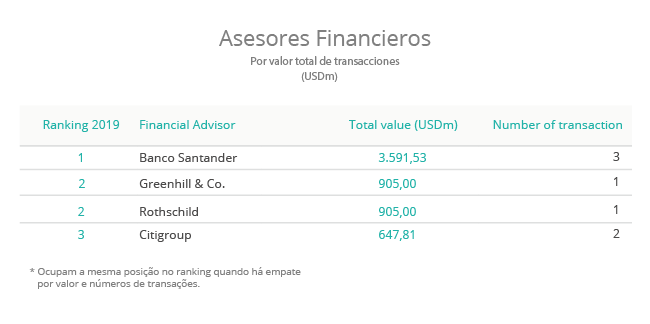
En el ranking TTR de asesores financieros en México, por número de operaciones y por importe, lidera en los cuatro primeros meses de 2019 Banco Santander, con 3 operaciones valoradas en USD 3.591,53m.  

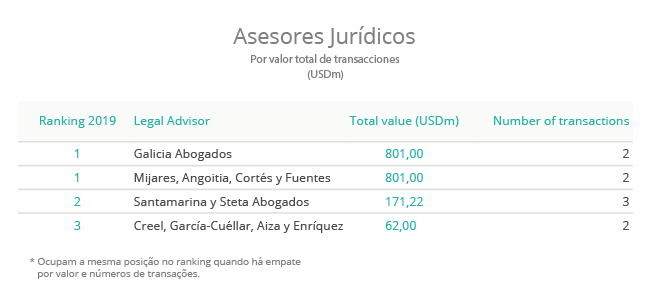
En cuanto al ranking de asesores jurídicos, por importe, lideran las firmas Galicia Abogados y Mijares, Angoitia, Cortés y Fuentes con USD 801m cada uno. Por número de transacciones, el ranking es liderado por Santamarina y Steta Abogados con 3 operaciones asesoradas. 

DealMaker Q&A

TTR DealMaker Q&A with Rivero & Gustafson Abogados Partner Eliecer Pérez

Eliecer Pérez

TTR: As the responsible of Corporate /M&A area, how you Will describe the beginning of the year in Spain in mergers and acquisitions?

EP: Generally, the beginning of the new year, has started with the positive trend of 2018, we have seen a significant growth in the operations of M&A, specially from foreign investors that hope in Rivero&Gustafson to go on with its operations in Spain.


TTR: How attractive is the Spanish market against other international economies?

EP: Actually, Spain has a big attractive market for international investors. In 2018, our country finished in an historical position with the M&A operations.
In this sector, the trends are playing a very important paper because they are a sign of confidence for the investors. In this way, the fact that Spain is over other economies, even more solid, confirm that our market will continue to consolidate as one of the best options for M&A operations.


TTR: How can Brexit affect to our market?

EP: Great Britain is still being a high activity market in financial terms. In fact, is expected a period of retaining from investors, waiting for the new political situation to guarantee the same conditions to go on working.
Precisaly, during this expectation period, the Spanish market is a fine opportunity to those investors that, for the first time, are thinking to carry out transactions in our country.
So Brexit, can be an opportunity for uncommon investors in our country that start to make financial projections in Spain.


TTR: In which sector can we see a big interest for the national and international investors?

EP: No doubt, the real estate sector is growing and is a big attractive for the investors we are working with.
In other way, the technological sector is in a very interesting rapid growth phase. The investors are very interested in startups. In that way, in Spain we´ve got an important leader ambition in the young people, which is an important economic incentive for the area professionals.


TTR: Historically, the real estate sector is the most transactions sector in Spain, and 2019 is not an exception, what´s the reason for this?


EP: The real estate sector in Spain count with several factors that explain the wide business volume. The price of property in Prime locations in Madrid and Barcelona is still being very attractive. In comparison with other big European capitals. In addition, the profitability of that real estate inversions, in residential and commercial, are high due to the good functioning of renting market. Is convenience to considerer that our climatic conditions and quality of life, invite to particulars for inversions.


TTR: Into the real estate sector, which locations, besides Madrid and Barcelona, offer a big attractive for investors? Why?

EP: Everything relationed with seasonal tourism offers a big economic attractive. Actually, Costa del Sol and Islas Baleares, are two of the best options to every investors interested in a big profit margins. In other way, Islas Canarias, due to their magnifique climatic conditions, are being a great option for investors against other crowed locations.


Entrevista con Eliecer Pérez Socio Coordinador del Área Mercantil
en Rivero & Gustafson Abogados.

Eliecer Perez es licenciado en Derecho por la Universidad Autónoma (1994) y tiene un Máster en Asesoría Jurídica de Empresa por el Instituto de Empresa (1995). Se incorporó a Rivero & Gustafson Abogados en julio de 2009, pero ya estuvo trabajando 8 años (1997-2005) en el despacho con anterioridad. Fue director de la asesoría jurídica del grupo Cosmani y después director de la asesoría jurídica del RACE (Real Automóvil Club de España).


TTR: Como responsable del Área Mercantil de Rivero & Gustafson, ¿cómo definiría el comienzo de año en materia de fusiones y adquisiciones en España?


EP: En términos generales, podemos decir que el comienzo de año ha venido muy marcado por la tendencia positiva de 2018, hemos comprobado un aumento significativo de las operaciones de M&A, especialmente de inversores extranjeros que confían en Rivero & Gustafson para llevar a cabo sus operaciones en España.


TTR: ¿Cómo de atractivo resulta el mercado español respecto a otras economías internacionales?


EP: A día de hoy, España es un mercado de gran atractivo para inversores internacionales. En 2018, nuestro país acabó en una posición histórica en lo que respecta a operaciones de M&A. En este sector, las tendencias juegan un papel fundamental en tanto que son signo de confianza para los inversores. En este sentido, el hecho de que España esté por encima de otras economías, a priori, más sólidas no hace sino confirmar que
nuestro mercado seguirá consolidándose como una de las mejores opciones para realizar operaciones de M&A.


TTR: ¿De qué manera puede afectar el Brexit a nuestro mercado?


EP: Reino Unido sigue siendo un mercado con una tremenda actividad en términos financieros. Lo cierto es que se prevé un periodo temporal de contención por parte de los inversores, a la espera de que la nueva situación política pueda seguir garantizando las mismas condiciones con las que venían operando.

Precisamente, durante este periodo de expectación, el mercado español es una estupenda oportunidad para aquellos inversores que, por primera vez, se planteen realizar operaciones en nuestro país. De modo que, en definitiva, el Brexit puede suponer una oportunidad para que inversores no habituales en nuestro país comiencen a realizar proyecciones sobre futuros proyectos en España.

TTR: ¿En qué sectores se percibe un mayor interés por parte de inversores nacionales e internacionales?


EP: Sin duda alguna, el sector inmobiliario está en clara tendencia alcista, y constituye un gran atractivo para los inversores con los que trabajamos en Rivero & Gustafson. Por otro lado, el sector tecnológico está igualmente en una fase muy interesante de expansión. Las Startups copan gran parte del interés de los inversores. En este sentido, creo que en España hay un importante espíritu emprendedor por parte de muchos jóvenes, lo cual supone un importante estímulo económico para los profesionales del área.


TTR: Históricamente el sector inmobiliario es el que más operaciones contabiliza en España, y 2019 no es una excepción, ¿a qué se debe esta circunstancia?


EP: El sector inmobiliario en España cuenta con varios factores que explican su
amplio volumen de negocio. El precio de los inmuebles en las zonas Prime de Madrid y Barcelona sigue siendo muy atractivo en comparación con otras grandes capitales europeas.

Además, la rentabilidad de dichas inversiones mobiliarias, tanto en residencial como en comercial, es alta debido al buen funcionamiento del mercado de alquiler. Por último, conviene tener en cuenta que las condiciones de climáticas y de calidad de vida en España, invitan a la inversión de particulares en este sector.


TTR: Dentro del sector inmobiliario, ¿qué localizaciones diría usted, además de Madrid y Barcelona, que ofrecen un mayor atractivo para los inversores? ¿Por qué?


EP: Toda el área vinculada al turismo estacional ofrece siempre un gran atractivo económico. En la actualidad, la Costa del Sol e Islas Baleares son dos de las mejores opciones para cualquier inversor interesado en amplios márgenes de rentabilidad.

Por otro lado, las Islas Canarias, debido a sus magníficas condiciones climatológicas, se están presentando igualmente como una muy buena opción para cualquier inversor frente a otras zonas de España más masificadas.

Informe Mensual España – Abril 2019

El importe de operaciones de M&A en España se incrementa en un 10,59% interanual hasta abril de 2019

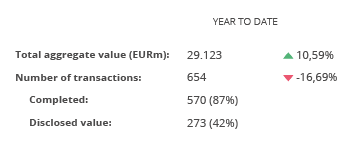
En lo que va de año se han contabilizado 654 transacciones valoradas en EUR 29.123m 

El sector Inmobiliario es el más activo, con 186 transacciones  

En 2019 se han registrado 67 operaciones de Private Equity y 113 de Venture Capital 

El mercado transaccional español ha registrado en los cuatro primeros meses del año un total de 654 operaciones con un importe agregado de EUR 29.123m, según el informe mensual de TTR. Estas cifras suponen un aumento del 10,59% en el capital movilizado y una disminución del 16,69% en el número de operaciones, con respecto al mismo periodo de 2018. 

Por su parte, en el mes de abril se han contabilizado 160 fusiones y adquisiciones, entre anunciadas y cerradas, por un importe agregado de EUR 13.620,51m, lo que implica un aumento del 39,56% en el capital movilizado y una disminución del 23,81% en el número de operaciones con respecto a abril de 2018.  

En términos sectoriales, el sector Inmobiliario ha sido el más activo del año, con un total de 186 transacciones, seguido por el de Tecnología, con 85, y el Financiero y de Seguros, con 44. 

Ámbito Cross-Border 

Por lo que respecta al mercado Cross-Borderen los cuatro primeros meses del año las empresas españolas han elegido como principales destinos de inversión a Portugal, con 19 operaciones, y a Estados Unidos, con 12 transacciones.  

Por otro lado, Estados Unidos (42), Reino Unido (33), Francia (29), y Luxemburgo (22) son los países que mayor número de inversiones han realizado en España. Por importe destaca Estados Unidos, con EUR 5.379,54m. 

Private EquityVenture Capital y Asset Acquisitions 

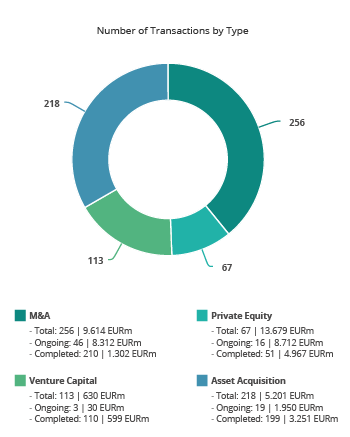
En el transcurso de 2019 se han contabilizado un total de 67 operaciones de Private Equity por EUR 13.679m, lo cual supone un aumento del 43,78% en el capital movilizado y una disminución del 20,24% en el número de operaciones respecto al mismo periodo del año anterior.  

Por su parte, en el mercado de Venture Capital se han llevado a cabo hasta el mes de abril un total de 113 operaciones con un importe agregado de EUR 630m, lo que implica una disminución del 17,52% en el número de operaciones y del 6,42% en el importe de las mismas en términos interanuales. 

En el segmento de Asset Acquisitions, hasta el mes de abril se han registrado 218 operaciones, por un valor de EUR 5.201m, lo cual representa una disminución del 16,79% en el número de operaciones, y un aumento del 63,79% en el importe de estas, con respecto a abril de 2018. 
 

Mercado de capitales 

En el mercado de capitales español se han registrado a lo largo del año cinco salidas a Bolsa y 27 ampliaciones de capital. 

 
Transacción del mes 

En abril de 2019, TTR ha seleccionado como transacción destacada la adquisición de Altamira Asset Management por parte de doBank. 

La operación, que ha registrado un importe de aproximadamente EUR 350,20m, ha estado asesorada por la parte legal por Ashurst y Linklaters, y en la parte financiera por Goldman Sachs, Mediobanca, y UBS Investment Bank. Por su parte, PwC España ha prestado servicios de due diligence, y Oliver Wyman Spain ha actuado como asesor estratégico.  

Ranking de Asesores Legales y Financieros 

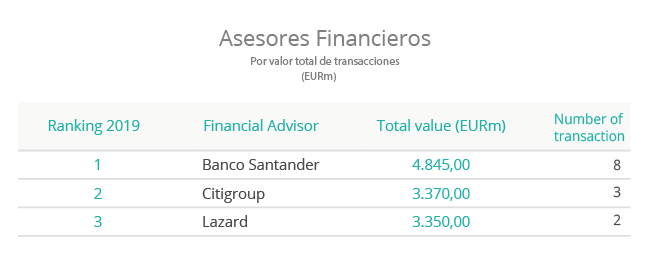
En el ranking TTR de asesores financieros del mercado M&A, por número de operaciones y por capital movilizado, lidera en 2019 Banco Santander, con 8 transacciones y con EUR 4.845m, registrados. 

En cuanto al ranking de asesores jurídicos del mercado M&A, por importe, lidera la firma Linklaters Spain con EUR 7.233,01m. Y por número de operaciones, lidera Garrigues España (Global) con 25 operaciones registradas.