TTR Monthly Report – LatAm February 2018

LatAm deal volume falls 14% in January to 116 deal

· Aggregate deal value fell 12% to USD 5.7bn

· Deal of the Month: Mosaic acquires 40% of Compañia Minera Miski Mayo for USD 1.4bn


The 116 announced and closed deals across Latin America in February together represent a 14% decline in transaction volume and a 12.3% drop in aggregate transaction value over February 2017, according to TTR data.

M&A volume is down 13.8% regionally YTD over the first two months of 2017, meanwhile, with 263 deals registered since the beginning of the year worth USD 11.7bn in aggregate, considering 103 transactions of disclosed consideration across Latin America.


Top Six M&A Markets in Latin America

Brazil accounted for 119 of the 263 deals recorded across the region in the first two months of the year, a 20% decline relative to the transaction volume in the region’s largest market between January and February 2017. Aggregate deal value fell 69% to USD 3.9bn, meanwhile, taking into account 39 deals of disclosed consideration.

Mexico’s 53 deals YTD represent a 39% jump in volume over the same two months last year, while aggregate deal value increased 35% to USD 1.35bn, taking into account 21 deals of disclosed consideration.

Argentina ranks third in Latin America by transaction volume at the close of February with 42 announced and closed deals YTD, a 75% increase in volume over the same two months last year. The 18 transactions of disclosed consideration registered in Argentina YTD are together worth just over USD 1bn, a 155% jump in aggregate value over the January-to-February period in 2017.

Colombia ranks fourth by volume at the close of February with 25 transactions, deal flow increasing 19% over the first two months of 2017. The seven transactions of disclosed consideration registered in Colombia YTD are together worth USD 258m, representing a 77% jump in aggregate value over the same two-month period of 2017.

Peru ranks fourth regionally at the close of February, tied with Chile by volume, but surpassing its southern neighbor by aggregate value. The 20 deals registered in Peru YTD represent a 23% decline in volume. Aggregate value surged 1,399% meanwhile, to USD 3.4bn, buoyed by Mosaic’s early February acquisition of Compañia Minera Miski Mayo, among 12 transactions of disclosed consideration.

Chile fell to the bottom of the top six regional ranking by the end of February, its 20 deals representing a 55% drop in volume, notwithstanding a 40% increase in aggregate value to USD 209m relative to the first two months of 2017, considering nine transactions of disclosed consideration.

Cross-Border Deals

Bidders based in Latin America made seven extra-regional acquisitions in February, five targeting companies in North America and two with targets in the EU.

North American buyers led the bidding for Latin American targets with 16 inbound deals regionally in February, followed by bidders from the EU with 13, from Asia with two and one acquisition by an Australian firm.

Deal of the Quarter

TTR selected The Mosaic Company’s USD 1.4bn acquisition of a 40% stake in Compañia Minera Miski Mayo as Deal of the Month in February. The Peru-based target mines potassium, phosphate, kaolin and potash in the region of Piura. Estudio Muñiz represented the target in the deal, which represents 41% of Peru’s aggregate transaction value YTD.

LatAm Report January 2018

LatAm deal volume falls 26.5% in January

  • Aggregate deal value fell 33.8% to USD 5.3bn
  • Deal of the Month: Grupo Enfoca acquires 100% of Grupo Ucal-Toulouse for USD 296m

The 125 announced and closed deals across Latin America in January together represent a 26.5% decline in transaction volume and a 33.8% drop in aggregate transaction value over January 2017, according to TTR data.

Top Six M&A Markets in Latin America

Brazil accounted for nearly half the 125 deals recorded across the region in January. Transaction volume fell 28%, however, its 56 deals together worth USD 2.2bn, 67% below the aggregate deal value in the country in January 2017, considering 23 deals of disclosed consideration.

Mexico’s 25 deals in January together represent a 19% bump in volume over the same month last year. Aggregate value surged 80% in Mexico in January to USD 1.6bn, taking into account 15 deals of disclosed consideration.

Argentina ranks third in Latin America by transaction volume at the close of January with 20 announced and closed deals, a 33% increase in volume. The 10 transactions of disclosed consideration are together worth 699m, a 126% jump in aggregate value over January 2017.

Chile ranks fourth by volume in January, its deal flow dropping 30% over the same month last year. Its nine transactions of disclosed consideration contributed to a 535% jump in aggregate value over the same month in 2017 to USD 209m, meanwhile.

Peru jumped to fifth place by volume with nine deals in January. Peru’s deal flow continues to slide, however, 47% relative to January 2017. Aggregate deal value is up 777% to USD 910m compared to the same month last year, however, taking into account seven transactions of disclosed consideration.

Colombia fell to sixth among the top regional M&A markets in January with just eight deals announced or closed during the month, a 38% decline over the same month last year. Aggregate deal value grew 889%, however, with four transactions of disclosed consideration totaling USD 183m.


Cross-Border Deals

Bidders based in Latin America made seven extra-regional acquisitions in January, four targeting companies in North America, and three with targets in the EU.

North American buyers tied bidders from the EU with 14 inbound acquisitions from each region in the first month of the year, alongside four transactions led by investors based in Asia.


Deal of the Quarter 

TTR selected Grupo Enfoca’s USD 296m acquisition of Grupo Ucal-Toulouse from Summa Asesores Financieros, Faro Capital SAFI and a group of shareholder’s together holding 60% of the target’s equity, as Deal of the Month in January.  The Lima-based fund manager was represented by Rebaza, Alcázar & De Las Casas Abogados Financieros while the acquired university was advised by Philippi, Prietocarrizosa, Ferrero DU & Uría Perú.

Quarterly Report of M&A market: Perú – 4T 2017

Informe anual y trimestral sobre el mercado transaccional peruano 

Importe en el mercado M&A en Perú
aumenta un 10,20% en 2017 

  • En 2017 se han registrado 130 transacciones en el país 
  • En el cuarto trimestre de 2017 se han contabilizado 28 operaciones por USD 2.893m 
  • Sector Inmobiliario es el más destacado del año, con 21 operaciones 

Mercado de Fusiones y Adquisiciones de Perú

El mercado M&A peruano cierra el cuarto trimestre de 2017 con un total de 28 operaciones, de las cuales 14 tienen un importe no confidencial que suman aproximadamente USD 2.893m, según el más reciente informe de Transactional Track Record (www.TTRecord.com). Estas cifran suponen decrementos del 24,32% en el número de operaciones y un aumento del 40,26% en el importe de las mismas, respecto al mismo periodo de 2016. 

Por su parte, de enero a diciembre de 2017 se han producido un total de 130 transacciones, de las cuales 64 registran un importe conjunto de USD 6.370m, lo que implica una disminución del 13,33% en el número de operaciones y un aumento del 10,20% en el importe de las mismas, respecto a al mismo periodo del año anterior. 

De las operaciones contabilizadas en los doce meses del año, 55 son de mercado bajo (importes inferiores a USD 100m), 5 de mercado medio (entre USD 100m y USD 500m) y 4 de mercado alto (superior a USD 500m).  

En términos sectoriales, el Inmobiliario es el que más transacciones ha contabilizado a lo largo de 2017, con un total de 21 operaciones, seguido por el Financiero y de Seguros, con 19 operaciones, además del sector Agricultura, Agronegocios y Ganadería, con 15 negocios realizados.

Ámbito Cross-Border

Por lo que respecta al mercado Cross-Border, en lo que va de año las empresas peruanas han apostado principalmente por invertir en Ecuador y Chile con tres operaciones cada uno. Por importe, destaca Ecuador, con USD 11,40m.  

Por otro lado, España (12 operaciones), Estados Unidos (9) y Chile (7) son también los países que más han apostado por realizar adquisiciones en Perú. Por importe destaca Estados Unidos, con USD 1.272,73m. 

Private Equity y Venture Capital

En el transcurso de 2017 se han producido 5 transacciones de Private Equity valoradas en USD 120m, lo cual representa un descenso del 67% en el número de operaciones y del 93% en el importe de las mismas, con respecto al mismo periodo de 2016.  

En cuanto al segmento de Venture Capital, a lo largo del año se han registrado 6 transacciones, de las cuales 5 tienen un importe no confidencial que suman alrededor de USD 1,96m, lo que supone un crecimiento interanual del 100% en el número de operaciones y una disminución del 30% en el capital movilizado.

Transacción destacada

Para el cuarto trimestre de 2017, Transactional Track Record ha seleccionado como operación destacada la realizada por Corporación Pesquera Giuliana, la cual ha adquirido Inversiones Scherma. 

La operación, que ha registrado un importe de USD 17,50m, ha estado asesorada por la parte legal por Estudio Muñiz. 

Entrevista con Sergio Amiel

Socio de la firma Garrigues

“A pesar de la existencia de factores geopolíticos, que generaron cierta incertidumbre, el 2017 ha sido un año bastante activo para el mercado de fusiones y adquisiciones en Latinoamérica”

Lee la entrevista completa (ES / EN) > 

Ranking de asesores financieros y jurídicos

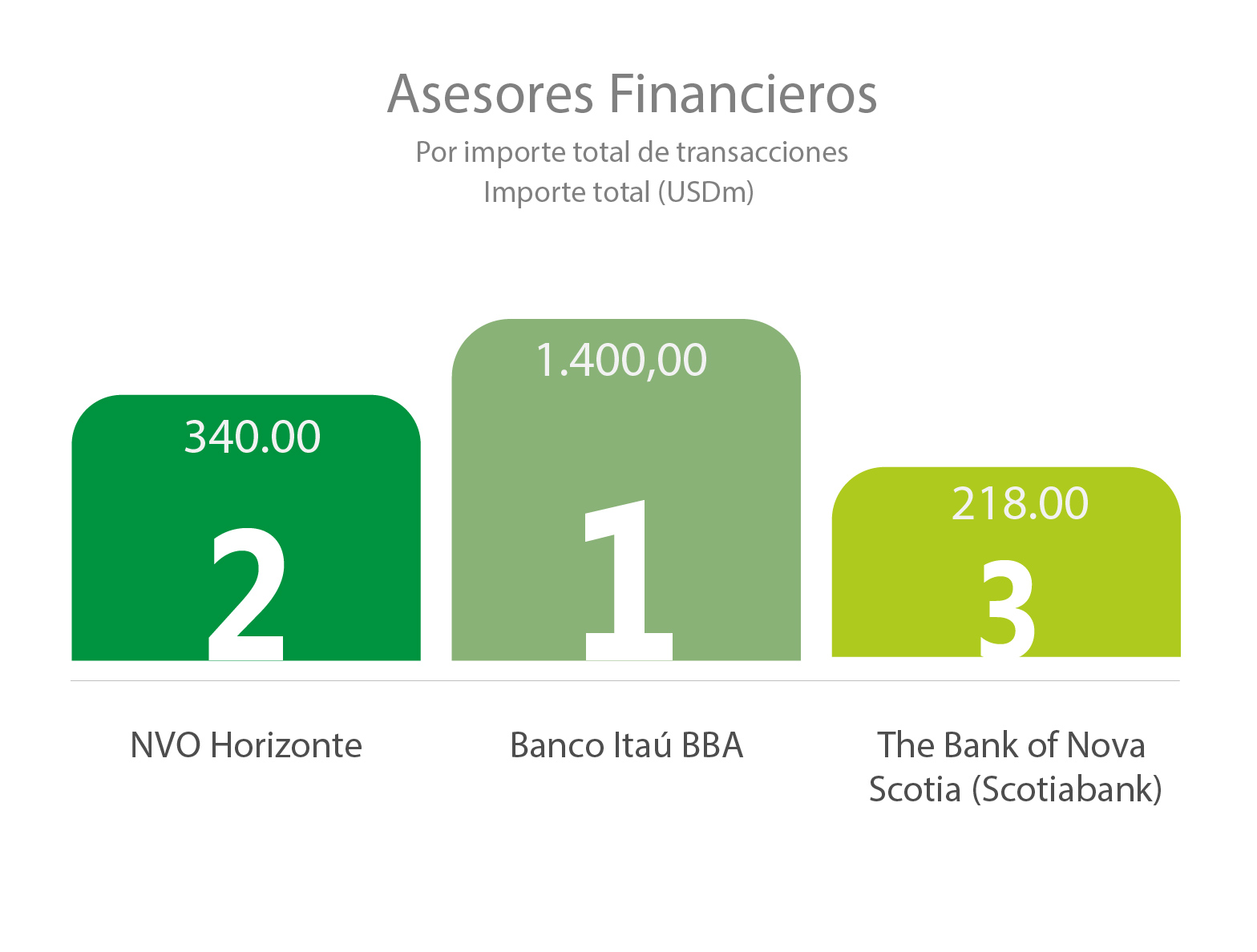
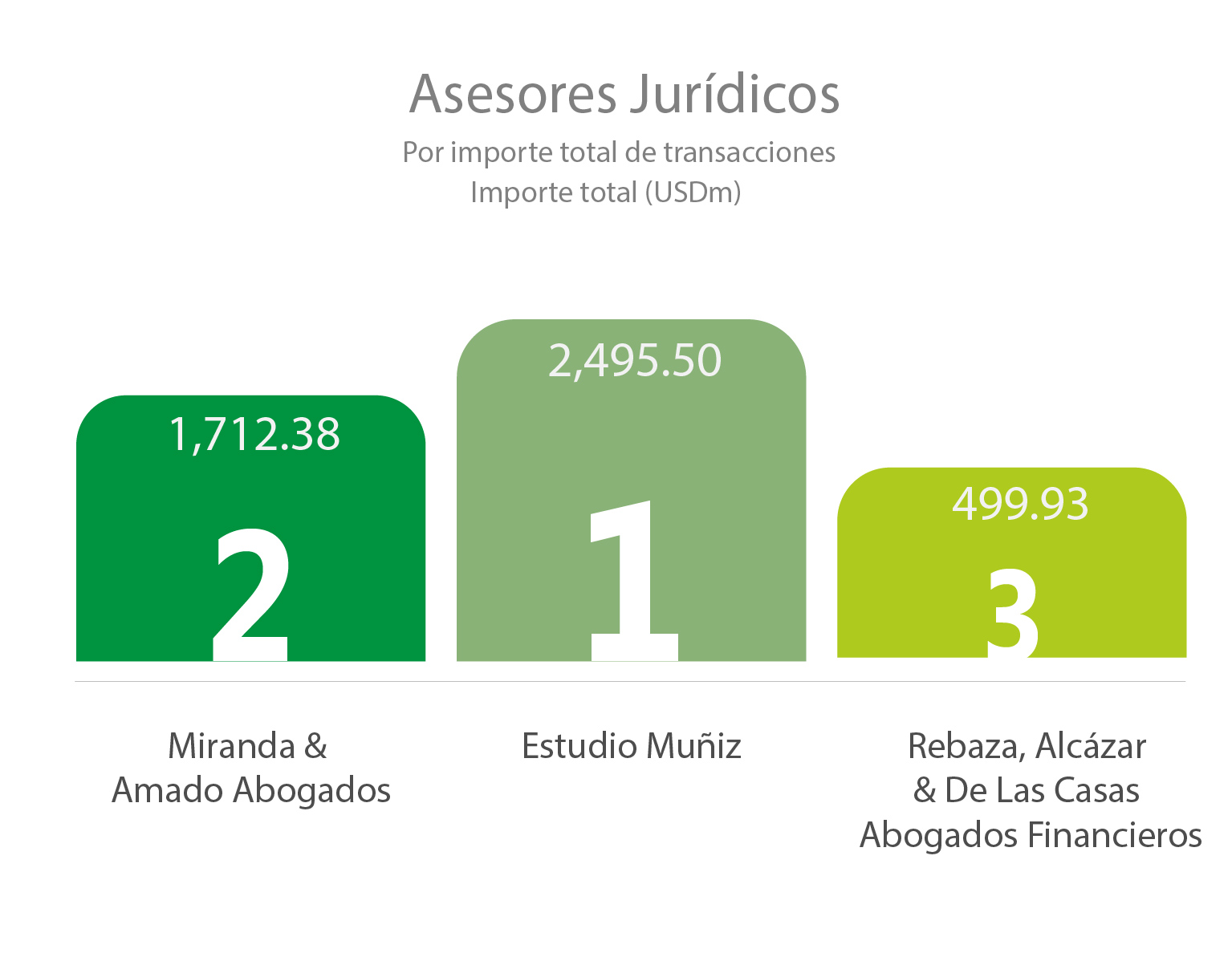
El informe cuatrimestral de Transactional Track Record publica los rankings de asesoramiento financiero y jurídico del mercado M&A colombiano durante el cuarto trimestre de 2017, donde se informa de la actividad de las firmas destacadas por número de transacciones y por importe de las mismas. 


Entrevista con Roberto MacLean- Miranda & Amado Abogados (Es/En)

Roberto MacLean, socio del estudio Miranda & Amado.

Abogado por la Pontifica Universidad Católica del Perú con Maestría en Derecho por la Universidad de Nueva York. Socio de Miranda & Amado desde el año 1999. Tiene amplia experiencia en diversas transacciones corporativas, financieras y de mercados de capitales, principalmente en adquisiciones, financiamiento de proyectos y proyectos de infraestructura. 

Sr. MacLean, en primer lugar ¿podría ofrecernos una valoración general en cuanto a la marcha actual del mercado de M&A en Latinoamérica en comparación con ejercicios anteriores? 

Las cifras que dan los reportes de TTR a octubre parecen indicar que en cuanto a número de transacciones este podría ser igual o mayor al año anterior. Sin embargo, el valor en dólares es menor y viene bajando consistentemente en los últimos cuatro años.

Como profesional en el asesoramiento de fusiones y adquisiciones, ¿podría contarnos brevemente cuáles son los sectores que están experimentando en Perú mayores cambios en el volumen de sus transacciones y por qué?

Basados en la experiencia que hemos tenido en el estudio, los sectores más dinámicos han sido infraestructura, agricultura, el sector financiero, educación e inmobiliario.  El sector de infraestructura se explica por la crisis de las constructoras brasileñas y los problemas financieros de otras dos constructoras internacionales con proyectos importantes, así como el deseo de constructoras peruanas que buscan sobreponerse a la crisis coyuntural que esto ha generado.  El sector agrícola está activo debido a que Perú se ha convertido en un exportador importante de varios productos bien cotizados internacionalmente, lo cual ha generado una ola de adquisiciones y operaciones de private equity.  El sector financiero, educación e inmobiliario están reflejando un reacomodo de actores.

Como experto en el asesoramiento de proyectos que requieren financiación ¿podría explicarnos, a grandes rasgos, en qué consiste el proceso de las modalidades más empleadas para la obtención de crédito?   

En el caso peruano y de adquisiciones donde el adquirente es operador del negocio que ha adquirido o es un grupo empresarial consolidado, la fuente de financiamiento popular son los bonos.  Cuando el adquirente es un fondo de inversión éstos tienden a recurrir primero a deuda bancaria, que luego puede ser refinanciada por una emisión de bonos por parte de la empresa adquirida.

¿Cuáles son las principales barreras o dificultades a las que se enfrentan las empresas a la hora de solicitar dichos préstamos? 

Diría que la principal barrera en el caso peruano son las restricciones a la llamada asistencia financiera, que limita la capacidad de los adquirentes de utilizar los activos de la empresa adquirida para financiar la adquisición.  Por esta razón, el financiamiento de adquisiciones es más sencillo cuando se adquiere una empresa al 100% (o una mayoría muy grande y con muy pocos accionistas minoritarios) y sin deuda o muy poca deuda concentrada en uno o pocos acreedores.

En relación con la pregunta anterior ¿Cree que podría realizarse algún cambio legislativo que facilitase el acceso a este financiamiento para las empresas, teniendo en cuenta las condiciones que ahora mismo existen?  

Considero que en el Perú podrían eliminarse las restricciones a la asistencia financiera bajo ciertas condiciones, protegiendo a minoritarios de conflictos de intereses que puedan presentarse entre los intereses del accionista adquirente y los minoritarios.  Es mejor que restringirla por completo.

Por último, ¿qué sectores destacaría usted como potenciales targets para lo que resta de 2017 en el mercado de M&A latinoamericano? ¿Por qué? 

El gobierno chino parece enfocado en asegurarse la disponibilidad de diversos recursos naturales a largo plazo, esto genera que las empresas chinas estén enfocadas en adquirir activos en toda la región que ayuden a este fin.  La liquidez generada en la región y en otras partes del mundo ha fomentado la creación de fondos de capital privado de toda clase y tamaño, enfocados en una gran diversidad de actividades.  Por otro lado, varias empresas de nuestros países han adoptado la estrategia de convertirse en actores regionales, sumándose a las ya conocidas multilatinas en su estrategia de crecimiento regional.  Todo esto genera un grupo importante de entidades que están en búsqueda de oportunidades de inversión.  Por el lado de la venta están los negocios que sufren reacomodos por razones locales o regionales, como en el caso de las constructoras y las mineras.  Por esto, considero que para el resto del año y el año que viene, en el caso del Perú los sectores más dinámicos podrían ser infraestructura, inmobiliario, agricultura, recursos naturales, energía, pesca, educación y salud.   Mirándolo desde el radar regional, sin embargo, las transacciones más relevantes por su valor en USD serán en el sector minero, energía, infraestructura y pesca.

Para leer de las transacciones en las que Roberto MacLean ha participado, haz click aquí.

Para leer de la firma Miranda & Amado Abogados en Perú y sus transacciones, haz click aquí.


English

Mr. MacLean, first of all, could you offer us a general assessment concerning the current development of the M&A market in Latin America in comparison the previous period?

The figures that the TTR reports offers until October seem to indicate that the number of transactions could be the same or more than last year. However, the value in dollars is smaller and has been going down consistently for the last four years.

As a professional in the advice of mergers and acquisitions, could you tell us briefly what are the sectors in Peru that are showing more changes in the volume of their transactions and why?

Based on the experience that we have had in the firm, the most dynamic sectors have been infrastructure, agriculture, the financial sector, education and the real-estate sector.

The good development of the infrastructure sector is due to the crisis of Brazilian building companies and the financial problems of two others international companies with important projects, as well as the wish of the Peruvian building companies that look forward to overcoming the relevant crisis that it has generated. The agricultural sector is active because Peru has become an important exporting country of several well-valued products at international level. This situation has generated an outbreak of acquisitions and operations of private equity. The financial sector, the education sector and real-estate sector are reflecting a new adjustment of actors.

As a legal advisory expert in projects that require financing, could you explain us the process of the most usual methods for getting credit?

In the Peruvian case in acquisitions where the purchaser is operator of the business that has purchased or it’s a consolidated business group, the source of popular financing is the bonus. When the purchaser is a fund of investment, these tends to go first to banking debt, which can then be refinanced by a bond issue by the acquired company.

What are the main difficulties that companies face to when applying for such loans?

I would say that the main barrier in the case of Peru are the restrictions to the financial assistance that restrict the ability of the purchasers of using the assets of the purchased company to finance the acquisition. For this reason, financing the acquisitions is easier when a company is purchased completely at 100% (or in a very big majority and with very little minority shareholders) and without debts or very few debts condensed in one or few creditors.

Regarding the previous question, do you think that is possible to do some legislative changes to facilitate the access of this kind of financing for the companies keeping in mind the conditions which exist now?

I consider that in Peru the restrictions for financial assistance could be deleted under some conditions, protecting minorities against conflicts of interests that may appear between the interests of the purchased shareholder and minorities. This situation It’s better than restrict it completely.

Finally, what sectors would you consider as main targets for the rest of 2017 in the Latin American market of M&A? Why?

The Chinese government seems to be focus on assure the availability of different natural resources in a long-term, in consequence Chinese companies would be focused on purchasing assets in all the region that helps achieving this objective. The liquidity generated in the region and in other parts of the world has encouraged the creation of funds of private capital in every class and size, focused on a great diversity of activities. On the other hand, several companies of our countries have adopted the strategy of becoming regional actors, incorporating themselves to the great Latin-American companies with their strategy of regional growing. All of this generates an important group of entities which are in search for opportunities of investment.

On the side of the sales are the business which suffer adjustments because of local or regional reasons like building or mining companies. For this reason, I consider that by the rest of the year and for 2018, in the case of Peru, the most dynamic sectors could be: infrastructure, the real-estate, agricultural, natural resources, energy, education, health and fishing. Looking through the regional radar, however, the most important transactions due to their USD Value will be the mining sector, energy, infrastructure and fishing.

To know about Roberto MacLean and transactions he has participated in, click here.

To read about transactions of the firm Miranda & Amado Abogados in Peru, click here.
Reporte trimestral de fusiones y adquisiciones- Perú

Perú registra 30 operaciones en el tercer trimestre del 2017

  • 9 operaciones registradas en el trimestre alcanzan un importe de USD 1.749m
  • A lo largo del año se ha contabilizado 91 transacciones valoradas en USD 3.425m
  • Sector Inmobiliario es el más destacado del trimestre, con 7 operaciones

PANORAMA TRANSACCIONAL DE PERÚ

El mercado M&A de Perú cierra el tercer trimestre de 2017 con un total de 30 operaciones, de las cuales 9 tienen un importe no confidencial que suman aproximadamente USD 1.749m, según el más reciente informe de Transactional Track Record. Estas cifran suponen decrementos del 23,08% en el número de operaciones y del 14,01% en el importe de las mismas, respecto al mismo periodo de 2016.

Por su parte, de enero a septiembre de 2017 se han producido un total de 91 transacciones, de las cuales 41 registran un importe conjunto de USD 3.425m, lo que implica una disminución del 19,47% en el número de operaciones y un descenso del 7,87% en el importe de las mismas, respecto a al mismo periodo del año pasado.

De las operaciones contabilizadas en los nueve meses del año, 36 son de mercado bajo (importes inferiores a USD 100m), 3 de mercado medio (entre USD 100m y USD 500m) y 2 de mercado alto (superior a USD 500m).

En términos sectoriales, el Inmobiliario es el que más transacciones ha contabilizado a lo largo de 2017, con un total de 14 operaciones, seguido por el Financiero y de Seguros, con 13 operaciones, además del sector Agricultura, Agronegocios y Ganadería, con 8 negocios realizados.

Ámbito Cross-Border

Por lo que respecta al mercado Cross-Border, en lo que va de año las empresas peruanas han apostado principalmente por invertir en Ecuador y Chile con tres operaciones cada uno. Por importe, destaca Ecuador, con USD 11,40m.

Por otro lado, España (10 operaciones), Chile (5) y México, Estados Unidos y Canadá (4 operaciones cada una), son también los países que más han apostado por realizar adquisiciones en Perú. Por importe destaca China, con USD 1.400m.

Private Equity y Venture Capital

En el transcurso de 2017 se han producido en Perú 3 transacciones de Private Equity valoradas en USD 120m, lo cual representa un descenso del 73% en el número de operaciones y del 74% en el importe de las mismas, con respecto al mismo periodo de 2016.

En cuanto al segmento de Venture Capital, a lo largo del año se han registrado 4 transacciones, de las cuales 3 tienen un importe no confidencial que suman alrededor de USD 1,53m, lo que supone un crecimiento interanual del 100% en el número de operaciones y una disminución del 45% en el capital movilizado.

Transacción destacada

Para el tercer trimestre de 2017, Transactional Track Record ha seleccionado como operación destacada la realizada por San Miguel, compañía que ha concluido la adquisición de Agrícola Hoja Redonda.

La operación, que ha registrado un importe de USD 64m, ha estado asesorada por la parte legal por Estudio Muñiz, y por Payet, Rey, Cauvi, Pérez Abogados.

Rankings

Para ver los rankings de asesores financieros y jurídicos de Perú y los “Dealmakers” con mayor número de transacciones en el ámbito de fusiones y adquisiciones, haz click aquí.