Informe LatAm – Mayo 2019

Capital movilizado en el mercado M&A de América Latina registra USD 43.254m hasta mayo de 2019

129 operaciones registradas en el mes alcanzan un importe de USD 5.655,53m 

Chile y Colombia son los países que registran los mejores resultados de 2019  

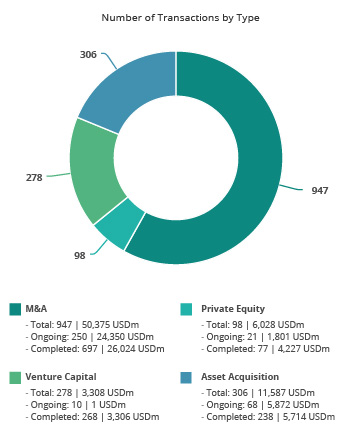
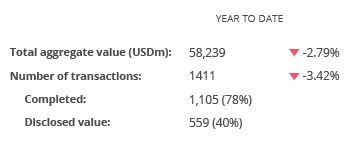
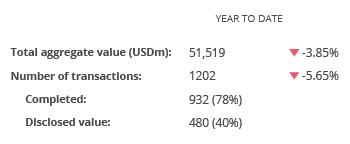
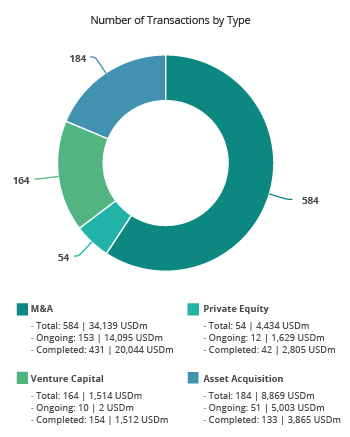
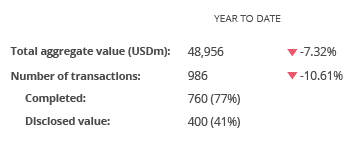
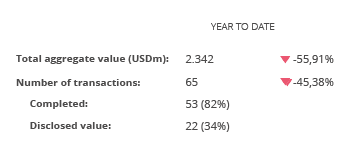
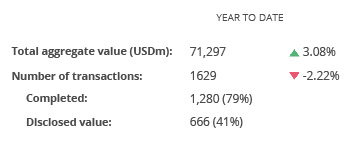
El mercado transaccional de América Latina ha registrado, en los cinco primeros meses del año, un total de 819 transacciones, de las cuales 335 registran un importe conjunto de USD 43.254m, lo que implica decrementos del 8,62% en el número de operaciones y una disminución del 10,10% en el importe de estas, con respecto al mismo periodo del año pasado, según el más reciente informe de Transactional Track Record.     

Por su parte, en el mes de mayo se han contabilizado un total de 129 operaciones, de las cuales 52 tienen un importe no confidencial que suman aproximadamente USD 5.655,53. 

Estas cifras implican un aumento del 4,03% en el número de operaciones, así como un descenso del 24,95% en el importe de las mismas, con respecto a mayo de 2018.

Ranking de Operaciones por Países 

Según datos registrados hasta el mes de mayo, por número de operaciones, Brasil lidera el ranking de países más activos de la región con 453 operaciones (pese al descenso del 8%), con un descenso del 6% en el capital movilizado en términos interanuales (USD 25.628m). Le sigue en el listado México, con 112 operaciones (un descenso del 30%), y con una baja del 2% de su importe con respecto al mismo periodo de 2018 (USD 9.413m). 

Por su parte, Chile sube una posición en el ranking y se posiciona como uno de los países con resultados positivos en la región, con 90 operaciones (un aumento del 6%), y con un aumento del 69% en el capital movilizado (USD 4.112m). Colombia, otro de los países que registra resultados positivos en la región, contabiliza 83 operaciones (un aumento del 17%), y un alza del 62% en el capital movilizado (USD 2.250m).  

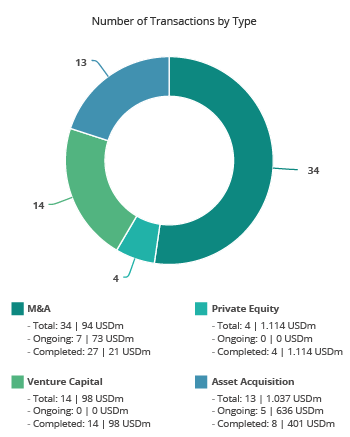
Entre tanto, Perú aumenta una posición y registra 55 operaciones (una baja del 19%), con una disminución del 56% en su importe respecto al mismo periodo del año pasado (USD 1.920m). Por su parte, Argentina se ubica en el último lugar por número de operaciones, con 54 operaciones (caída del 44%) y con un descenso del 51% en su capital movilizado (USD 2.019m). 

Ámbito Cross-Border 

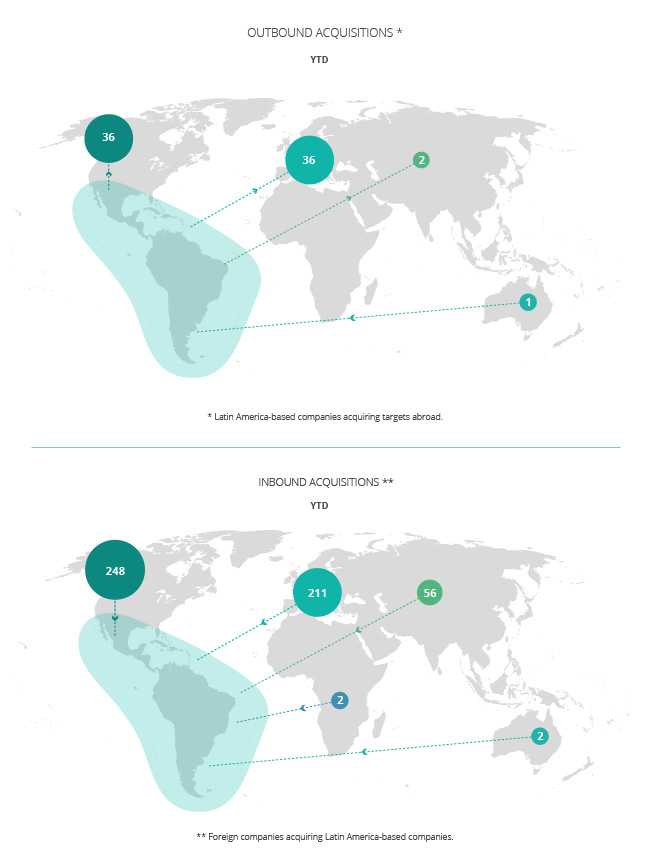
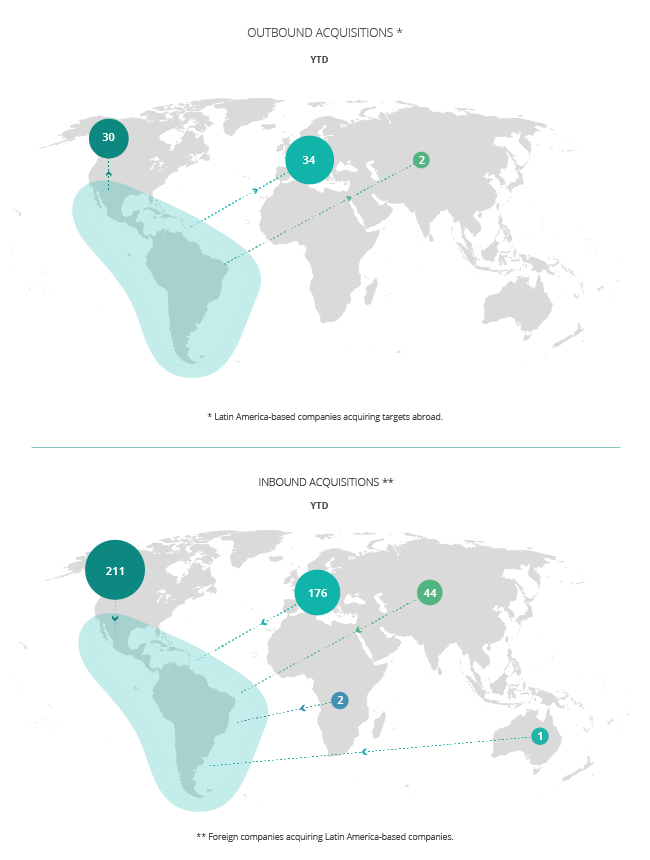
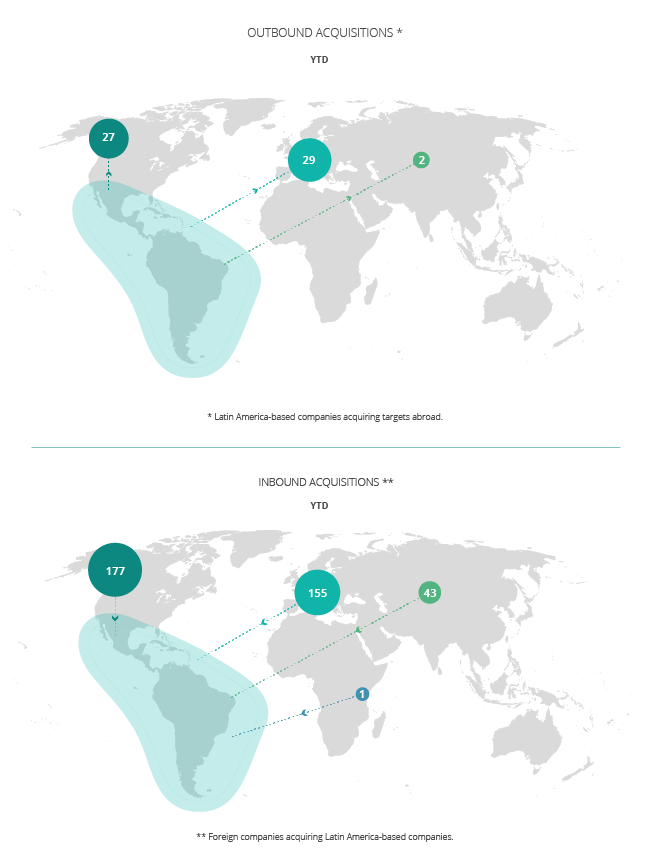
En el ámbito cross-border se destaca en mayo el apetito inversor de las compañías latinoamericanas en el exterior, especialmente en Europa y Norteamérica, donde se han llevado a cabo 22 operaciones en cada región. Por su parte, las compañías que más han realizado operaciones estratégicas en América Latina proceden de Norteamérica y Europa, con 111 y 103 operaciones respectivamente. 

Private Equity y Venture Capital 

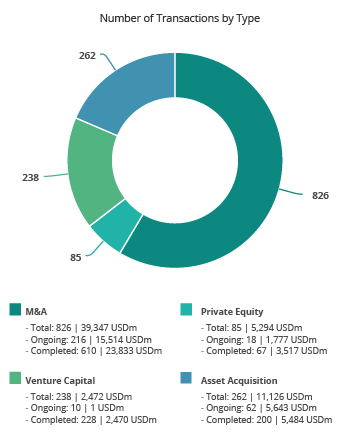
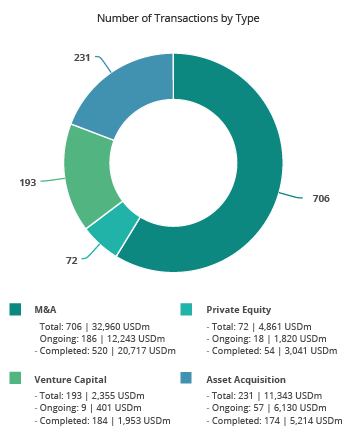
Hasta mayo se han contabilizado un total de 45 operaciones de Private Equity, de las cuales 20 han registrado un importe de USD 3.916m, lo cual supone una disminución del 27,42% en el número de operaciones y un descenso del 13,15% en el importe de las mismas, con respecto al mismo periodo de 2018.  
Por su parte, en el mercado de Venture Capital se han llevado a cabo 126 transacciones, de las cuales 81 registran un importe agregado de USD 679m, lo que corresponde a un descenso del 12,50% en el número de operaciones y una baja del 45,21% en el importe de las mismas, con respecto a mayo del año pasado. 

Transacción destacada 

Para mayo de 2019, Transactional Track Record ha seleccionado como operación destacada en América Latina la relacionada con Telefónica, Facebook, IDB Invest y CAF, los cuales han invertido en IpT de Perú. 

La operación, que ha registrado un importe de USD 156m, ha estado asesorada por Garrigues Perú; Clifford Chance US; DLA Piper Pizarro Botto Escobar; Estudio Echecopar; y Rebaza, Alcázar & De Las Casas. Por la parte financiera, la operación ha estado asesorada por Macroinvest – Grupo Macro. 

DealMaker Q&A

Eduardo Peláez

TTR DealMaker Q&A with UNE Asesores Financieros Partner Eduardo Peláez

Eduardo Peláez

Eduardo Peláez is Partner of UNE Asesores Financieros, an M&A advisory boutique focused in Latin America Small/Mid-Market. Eduardo Peláez has conducted many transactions in diverse sectors including tourism, chemicals, real estate and agriculture. Previously Eduardo was associate of Miranda & Amado Abogados and Hernández & Cía. Abogados. Also, worked in Lindley. 

He is Lawyer from Pontificia Universidad Católica del Perú and holds a MSc Management from Alliance Manchester Business School.

TTR: What’s your general outlook for the M&A market in Latin American this year, and specifically, in Peru?

EP: We believe the Latin American M&A market is experiencing a quite dynamic phase. Notwithstanding, the particular circumstances of each country in terms of macroeconomic conditions and political environment lead to diverse possibilities and projections. 

In the region there are markets like Venezuela, a country with enormous potential but absolutely isolated, but also the case of Chile, a nation with very stable economy and government, but with less opportunities for high returns. Also, there are some up-and-coming countries like Paraguay that has established favorable market conditions through a pro-investment regulatory and tax set of rules. 

The case of Peru is very particular. Despite of the political turbulence and the scandals of corruption, the economy is stable and the National Central Bank maintains its growth´s projections around 4%. The last two years have been marked by iconic transactions led by strategic investors pursuing market consolidation, such as the acquisition of the pharmacy chain MiFarma by Intercorp and the recent acquisition of Intradevco by Alicorp.

TTR: What are the primary factors influencing M&A decisions in the current economic climate? How do these economic fluctuations affect investment priorities?

EP: In the last decade, Peru has grown consistently. Even though the pace slowed since 2014, the Peruvian market maintains healthy indexes and presents opportunities for high returns, making it one of the most attractive markets in Latin America. 

Likewise, the Private Equity industry is taking more prominence in Peru, generating more dynamism in M&A activity. Global funds like Advent and Carlyle are already active investors in the Peruvian market. Also, there are other relevant players specialized in the mid-market such as HIG, L Catterton, Southern Cross and Victoria Capital Partners, that are exploring opportunities in Peru. 

From the sell-side standpoint, the political instability could make some businesses owners’ deciding to sell. Also, the new M&A regulation that will go into effect next year could accelerate the velocity of transactions and increase the volume of deals in the following months.

TTR: What is the state of the capital market in Perú? How has the country evolved in this respect in recent years? What is your forecast for the near-term?

EP: Peruvian capital market is still in an embryonic stage, characterized by low activity and hardly influenced by a few institutional investors. The exclusion of Credicorp from the FTSE Emerging Markets index is symptomatic. 

There are some significant efforts of developing the MAV (capital market for mid-size companies with less than S/. 350MM of annual revenue), but the results are modest, with just 13 listed companies since its inception in 2013. 

In this context, the recent creation of FIRBIs and FIBRAs, vehicles that have similarities with the American REITs, could represent a great opportunity to attract retail investors and increase the activity and liquidity of the capital market.

TTR: How difficult is it for corporates to access financing from local financial institutions in the current environment? What are the main barriers? How is financing structured?

EP: We have experienced a significant evolution in the volume of Peruvian companies accessing to the banking system in the past few years, going from 25% in 2014 to 40% in 2018, according to ASBANC. 

The big challenge is the inclusion of the majority of small and medium enterprises that currently have very few options. The fintech market represents a very interesting alternative for this type of businesses, particularly in the way of factoring platforms. 

Also, the increasing presence of foreign debt funds, especially Chilean, are becoming key participants, even in the small-and-mid size market. For example, recently we helped our client Llaxta Inmobiliaria y Constructora to obtain a US$ 10.5MM loan from Volcom Capital Chile for a real estate project in Piura, part of the social program “Techo Propio”.

TTR: Finally, we would like you to share with us your opinions and forecasts about the opening of the Peruvian market with other countries

EP: The Peru market presents many opportunities for all types of international investors, from strategic regional players to family offices and private equity and debt funds. 

Beyond the usual M&A activity in the mining sector, we see interesting opportunities of consolidation in the agricultural business. For example, there is the case of Hortifrut that became the leading berry producer in the world after the acquisition of El Rocío. Likewise, last year we had the opportunity to advise the British trader Wealmoor and Limones Piuranos in the acquisition of the mango and avocado´s exporter Sunshine. Also, recently we led the sale of the mango´s exporter Dominus to the Peruvian-Danish joint venture Danper

On the other hand, the real estate market still presents superiors return rates compared with other countries in Latin America, attracting global and regional real estate funds. 

Finally, considering the current development of modern retail, we believe Peru represents an interesting possibility for regional companies dedicated to services related with cold chain and specialized storage.

Informe LatAm – Abril 2019

Importe de operaciones de M&A de América Latina registra aumento del 39% en abril de 2019

259 operaciones registradas hasta abril alcanzan un importe de USD 35.336m 

Colombia y Chile, los países que registran los mejores resultados de 2019 

El mercado transaccional de América Latina ha registrado en los cuatro primeros meses del año un total de 636 transacciones, de las cuales 259 registran un importe conjunto de USD 35.336m, según el más reciente informe de Transactional Track Record

Estos resultados implican una disminución del 11,79% en el número de operaciones y un descenso del 17,17% en el importe de estas, con respecto a abril de 2018.   

Por su parte, en el mes de abril han contabilizado un total de 151 transacciones con un importe conjunto de USD 17.029,97m, lo que implica decrementos del 14,69% en el número de operaciones y un aumento del 39,02% en el importe de estas, con respecto al mismo periodo del año pasado. 

Ranking de Operaciones por Países 

Según datos registrados hasta el mes de abril, por número de operaciones, Brasil lidera el ranking de países más activos de la región con 344 operaciones (pese al descenso del 12%), con un descenso del 27% en el capital movilizado en términos interanuales (USD 19.116m). Le sigue en el listado México, con 82 operaciones (una baja del 36%), y con un descenso del 3% de su importe con respecto al mismo periodo de 2018 (USD 7.606m). 

Por su parte, Chile sube una posición en el ranking, con 76 operaciones (un aumento del 25%), y un ascenso del 115% en el capital movilizado (USD 3.278m), lo cual convierte al país, junto a Colombia, como los dos países con mejores resultados en la región. El país cafetero, por su parte, sube en el ranking, supera en los resultados a Argentina, y registra 71 operaciones (un aumento del 22%), con un alza del 59% en el capital movilizado (USD 2.172m).  

Entre tanto, Perú sube un puesto en el ranking, supera a Argentina y ha registrado 44 operaciones (pese a la baja del 17%), con un descenso del 68% en su importe respecto al mismo periodo del año pasado (USD 1.207m). En el último lugar se ubica Argentina, con 44 operaciones (caída del 44%) y con un descenso del 63% en su capital movilizado (USD 1.377m). 

Ámbito Cross-Border 

En el ámbito cross-border se destaca en abril el apetito inversor de las compañías latinoamericanas en el exterior, especialmente en Norteamérica, donde se han llevado a cabo 6 operaciones, mientras que en Europa se han registrado 3 transacciones. Por su parte, las compañías que más han realizado operaciones estratégicas en América Latina proceden de Europa y Norteamérica, con 25 y 18 operaciones, respectivamente. 

Private Equity y Venture Capital 

Hasta abril se han contabilizado un total de 32 operaciones de Private Equity, de las cuales 14 han registrado un importe de USD 2.108m, lo cual supone una disminución del 39,62% en el número de operaciones y un descenso del 52,35% en el importe de las mismas, respecto al mismo periodo de 2018.   

Por su parte, en el mercado de Venture Capital se han llevado a cabo 92 transacciones, de las cuales 60 registran un importe agregado de USD 632m, lo que corresponde a un descenso del 20% en el número de operaciones y una baja del 43,94% en el importe de las mismas con respecto a abril del año pasado. 

Transacción destacada 

Para abril de 2019, Transactional Track Record ha seleccionado como operación destacada en América Latina la adquisición del 30% en Minera Teck Quebrada Blanca por parte de Sumitomo Corporation y Sumitomo Metal Mining

La operación, que ha registrado un importe de USD 1.200m, ha estado asesorada por la parte legal por Carey; Teck Resources; Philippi, Prietocarrizosa Ferrero DU & Uría Chile; Torys; Mayer Brown; Philippi, Prietocarrizosa & Uría – Chile; Bofill Mir & Álvarez Jana Abogados BMAJ; Fasken Martineau Dumoulin Canada y Claro y Cía. Abogados. Por su parte, la operación ha estado asesorada por la parte financiera por KPMG Chile y Rothschild. 

DealMaker Q&A

Alberto Rebaza

TTR DealMaker Q&A with Rebaza, Alcazar & De Las Casas Partner Alberto Rebaza

Alberto Rebaza
Alberto Rebaza

Alberto Rebaza is founding partner and managing partner of Rebaza, Alcazar & De Las Casas law firm. Partner leads to mergers and acquisitions and corporate areas. In addition to his masters, he has studies at Georgetown University and England. He has also been director in several companies and organizations such as Edegel (Energy), Rigel Peru (Insurance), Liderman (Services), Amrop (Services), IPAE, Pesquera Alexandra (Fishing), YPO, among others.

TTR: Mr. Rebaza, firstly we would like to get your expert opinion, in a brief analysis, on the progress of the Peruvian M&A market in the first four months of the year.

AR: The Peruvian legal market has experienced an unusual volume of M&A closings in 1Q19 for all type and sizes of transactions. From the small/medium size deals with a strong strategic focus, to the multimillion dollar/cross-border deals that cover most of our newspapers. Our team has participated in 7 closings in 2019 so far (including strategic deals such as the sale of Papelsa to Grupo Gloria, the sale of Holding Plaza to Parque Arauco or the purchase of Duraplast and Novatec by Wenco). We are thrilled and have high expectations with our pipeline of transactions for 2Q19.


TTR: According to our data, Peru allocated a significant part of its investments to other Latin American countries, mainly Colombia and Chile. What attracts the interest of Peruvian investors? 


AR: There are several factors that may explain this phenomenon. First, Colombia and Chile are two countries with lots of social, historic, cultural and legal similarities with Peru. A regional expansion within those countries is normally catalogued as a soft landing for foreign investors.

Second, since the launching of the Pacific Alliance (Latin American trade bloc, formed by Peru, Chile, Colombia and Mexico) in 2011, Peruvian investors are taking a close look to the participant countries of the Pacific Alliance to diversify or expand their businesses. It is worth noting that, despite certain tax benefits (agreements to avoid double taxation or tax reductions, among others), the founding members of the Pacific Alliance executed an agreement to abolish all tariffs of merchandise trade by January 2020, making this integration a unique Latin American marketplace for producers.


TTR: Similarly, Colombia appears so far in 2019 as one of the main investors in the country. How do you think this reciprocal business relationship between the two countries will evolve? How does it benefit their economies?


AR: Colombian investors have been major players in the M&A industry in the recent years and I wouldn’t expect that to change in the near future. They are the third major foreign investors in Peru, after Spain and Chile.

Back in 2018, the Colombian Business Council in Peru announced fresh investments for over US$ 2B in Peru for the years 2018 and 2019. Their main focus is on projects related to the infrastructure, electricity, hospitality, transport and in the cosmetic industry.

In addition to the investment projections of Colombian players, I think the real deal will come once the corruption crisis in Peru is overcome. The Colombians experience in public-private partnerships and Public Works Tax Deduction projects will for sure contribute our economy in a positive way. Their input and investment will boost public projects (and therefore our economy) and increase our employment rate considerably.


TTR: Meanwhile, transactions in Agriculture, Agribusiness, Farming and Fishing have increased in Peru, compared with previous years when that subsector wasn’t as prominent. What could you tell us about that? Do you think the tendency will remain?


AR: The fishing industry in Peru is now consolidated, however, the government has been debating the last months certain legislative modifications that may heavily impact the industry, such as the increase of the fishing rights.

On the other hand, we have viewed a transactional boom related to shrimp-based business like the purchase of La Fragata by Marinazul (affiliated to Grupo Camposol).

Furthermore, the agricultural-related industries are facing an unusual increase in their sectors due to the international demand for agricultural products. We have notice the peculiar interest of foreign investments funds and, particularly, private investors from Chile in the purchase of estates in the north of Peru to develop agribusiness and farming companies. Peru is a privileged country for the agribusiness, making it one of the most suitable natural producers. The progressive increase of the worldwide demand, followed by a friendly legal framework that includes income tax reductions and special depreciation conditions are the perfect match for this boost.


TTR: Lastly, Peru has recently suffered and been involved in certain corruption scandals. How do you think those scandals affect the country’s economy today? What is your outlook on the matter?


AR: Thankfully, the political crisis experienced in Peru last year and the current corruption cases have not prevented the unstoppable growth of our economy and, specifically, of the M&A players’ appetite.

However, it is important to note that all major infrastructure projects have been stopped and their continuity is under analysis. This has deeply affected our economy and the governmental stability, lowering the Peruvian employment rate. I believe this corruption turmoil may only be disregarded by a strong political force that needs to convey economic trust and decision-making features. Furthermore, we are now facing an exchange in the players or the main public projects. The typical powerful Brazilian and local companies are been replaced by international actors of various backgrounds.

Should the current government be unable to revert this situation, I believe the presidential elections in 2021 will be the right moment to overcome this scenario.

DealMaker Q&A

Luiz Nicolau

TTR DealMaker Q&A with Ritch Mueller Partner Luis Nicolau

Luiz Nicolau
Luis Nicolau

Luis A. Nicolau has been a partner at Ritch Mueller since 1990. He specializes in mergers and acquisitions, debt and equity capital markets transactions and banking and finance. He is a leading expert in assisting underwriters and issuers in debt and equity offerings in Mexico and abroad. He has participated in many of the largest public Mexican M&A transactions and advises foreign and domestic private equity funds on a regular basis. He has assisted numerous international financial entities in setting up their Mexican operations, including Scotiabank, JPMorgan, Credit Suisse, Santander and Morgan Stanley.

He currently maintains several board memberships, including at Grupo Posadas, Coca-Cola FEMSA, the public equity fund IGNIA, Morgan Stanley Mexico, UBS Asesores, KIO Networks,  Grupo Cementos de Chihuahua, Gentera, and of the investment committee of Promotora Social México; former President of Fullbright Mexico’s Governing Body, former member of the board of directors of Papalote Museo del Niño, former member of the board of directors of the Indian Mountain School and former member of the Supervisory Board of the Mexican Stock Exchange.

Mr. Nicolau graduated from the Escuela Libre de Derecho in Mexico City in 1986. He obtained a Master in Laws from Columbia University in 1988, where he was a Fulbright Scholar. Before joining Ritch Mueller, he was a foreign associate at Johnson & Gibbs, Dallas, and at Shearman & Sterling in New York. He joined Ritch Mueller in 1990 and has been a partner since then, except for the years 2001 and 2002, when he was the Chief Financial Officer of Vitro.

TTR: To begin, we would like you to give us a brief overview of the course of the first four months of the year in the Mexican M&A market. 

LN: The Mexican market for M&A transactions has been particularly slow for two (2) specific reasons. The first relates to political uncertainty and the lack of visibility in respect of prospects of the Mexican economy. The second, because the aforementioned factors have affected multiples applicable to M&A transactions involving Mexican companies. The good news is that the Fintech market is showing a significant level of activity, given the approval of the new Fintech Law and the fact that the period to obtain licenses under the Fintech Law has commenced. In addition, many Mexican families are showing interest in diversifying holdings and selling stakes, coupled with a different perception of political risk by foreign investors.


TTR:  Year-to-date, the number of transactions in the Internet subsector has increased, compared to last year; what can you tell us in relation to this data? What other sectors do you think will emerge during 2019?


LN: The reality is that generally the technology sectors have shown a substantial level of activity, fueled primarily by dedicated funds with excess liquidity, multiples used in other jurisdictions and the generalized underservice of the Mexican market.

¿Qué otros sectores, cree que, despuntarán a lo largo de 2019? As indicated, the Fintech sector has continued to show dynamism. In addition, the financial services industry has shown signs of further consolidation and there is continued interest in the pharma industry.


TTR:  In relation to the previous question, the majority of investments in the technology sector were from Venture Capital. What place do entrepreneurs and new companies occupy in the country?

LN: Although specific market data is not generally available, this is a sector of special interest, as a result of the new Fintech Law that has provided certainty to the industry, together with the fact that Mexico continues to be underserved from a technology perspective.


TTR:  Meanwhile, according to our records, although Mexico usually allocates a large part of its investments to Latin American countries, it does focus them in the country itself. Why does this unilateral relationship occur? 

LN: Again, this question is difficult to answer without the aid of economic data. However, there has been renewed and ongoing interest by Latin American investors in Mexico, in the Mexican oil and electricity sectors. Real estate and Fintech have shown some dynamism (see the examples of Mercado Libre and Rappi). It seems, however, that the Mexican market is larger, slightly more complex and subject to more competition, and that interesting opportunities remain in existence in several markets in Latin America.


TTR:  Continuing with the same topic, in the medium term, what Latin American countries do you think have the greatest potential to establish new trade links with Mexico and why?

LN: Difficult question to answer and will be dependent upon the desire to diversify, the availability of accretive multiples, competitive financing and the existence of liquidity. Larger Central American groups are likely to continue to look at Mexico as a stable hub, together with Colombia and Peru that are going through stable processes, and of course Brazil with its economic might and better skills to adapt to a large market as Mexico.


TTR:  Apparently, the beginning of the year has not been as economically positive as expected. However, you can see many local businesses in expansion and with the intention of entering new markets. Do you think that this situation could be improved?


LN: It is hard to see significant economic improvement this year, notwithstanding the efforts of private sector groups, because of remaining uncertainties in respect of economic conduction. The end of the year may bring a surprise or two, if the economy remains stable.