INTERVIEW: TOMÁS GURMÉNDEZ – POSADAS, POSADAS & VECINO

Partner at 
Posadas, Posadas & Vecino

 

(ENGLISH)

Tomás Gurméndez, as an M&A expert, how do you assess the M&A market in Latin America year-to-date, particularly in Uruguay?

M&A activity in Latin America has been growing for the past several years and 2017 has been no different. The data show that M&A activity has grown moderately in 2017 compared to the same months in 2016. This demonstrates that, despite political uncertainty in certain countries of the region, LatAm remains a very attractive region for international investors. In the case of Uruguay, the year started off slow in 1Q17, but starting in April, M&A activity has surged. We’re seeing many deals in agroindustry and forestry, which is logical given Uruguay is a producer of agricultural commodities. We’re also seeing significant transactions in retail and renewable energy.

Energy law is among your practice areas. Overall, energy transactions tend to be robust in Latin America. Do you believe the legal framework in the region facilitates M&A in this sector? Is development of the energy sector a good bet to ensure overall economic growth?

More than the laws, I believe the public policy that has been crafted over the past several years in many countries of Latin America has driven development of the energy sector, primarily for renewables rather than conventional. The great number of renewable projects developed in Latin America over the past several years has mobilized an extraordinary amount of capital, above all for investment funds from the US and other regions, which have demonstrated a lot of appetite for operational renewable assets. The energy industry is among the most sensitive and strategic for any country, given the implications for sovereignty and independence, and without a doubt, Latin American nations will continue betting on the energy sector as one of the most important pillars of economic growth in the region.

Year-to-date, TTR data show there’s been a significant increase in the number of medium-size deals in Uruguay compared to smaller transactions. Do you believe this trend relates to an evolution of the market or simply circumstantial factors?

Given the size of Uruguay, I don’t believe it’s possible to talk about an evolving market consolidation. While transactions this year may appear more sizeable considered individually, the reality is that the total number of deals in 2017 is not significantly higher than in the comparable period of 2016. Rather, the growth in deal volume has been moderate.

Another area of expertise for you and your firm is banking and finance. Do you believe financial institutions in Latin America favor investors to the degree that they support greater M&A activity, and particularly in Uruguay? If not, what are the changes that should be implemented?

The local banking sector in Latin America hasn’t played a significant role as a financier of M&A deals, in many cases owing to market-related factors and other regulatory restrictions. On the other hand, it is very common to see international banks very active in the Latin American M&A market. In the case of Uruguay, local banks have scarcely played a role in important M&A transactions.

Year-to-date, cross-border deals have picked up significantly in Uruguay, with a 38% increase in transactions between local and international companies in 1H17 over the same six months last year. Do you see this as reflecting a process of greater opening in Uruguay? Do you see this reflected across the region as a whole?

Given that Uruguay is a mature democracy with a strong rule of law and equal treatment for foreign investors, the country has long been attractive to the international investor. Uruguay’s opening to the world did not happen recently, and certainly not in 2017. The increase in cross-border deals in 2017 can be explained by the reactivation of the economy in the country relative to 2016, which was a slow year for economic growth.


(ESPAÑOL)

Como experto en M&A ¿cómo evalúa la marcha del mercado Latinoamericano desde el inicio del año hasta ahora? ¿Podría darnos una breve descripción? ¿Y en Uruguay en particular?

La actividad de M&A en Latinoamérica viene en aumento desde hace varios años y 2017 no ha sido la excepción. Todos los números indican que en 2017 la actividad de M&A en lo que va del 2017 ha aumentado moderadamente en comparación con el mismo período de 2016.  Esto demuestra que, a pesar de cierta inestabilidad política que están sufriendo algunos países de la región, LatAm sigue siendo una región muy atractiva para los inversores internacionales.

En el caso de Uruguay, 2017 comenzó algo lento en el primer trimestre, pero a partir de abril la actividad se ha incrementado notoriamente. Estamos viendo mucha cantidad de operaciones de M&A en el sector agro industrial y forestal, lo que resulta lógico al ser Uruguay un país productor de commodities agrícolas. También estamos viendo muchas operaciones en la industria retail y en la energía renovable.

Entre sus áreas de actuación se encuentra Energy Law, en general en Latinoamérica existe un gran número de operaciones que tienen lugar en el sector energético ¿Cree que las leyes en Latinoamérica facilitan estas transacciones? ¿Considera que el segmento de la energía supone una buena apuesta para garantizar el crecimiento de la economía?

Más que las leyes, creo que las políticas públicas que se han implementado en los últimos años en varios países latinoamericanos ha fomentado fuertemente el desarrollo del sector energético, principalmente el de las energías renovables no convencionales.

La gran cantidad de proyectos renovables desarrollados en LatAm en los últimos años ha movilizado una corriente inversora extraordinaria, sobre todo por parte de fondos de inversión americanos y de otras regiones , con mucho apetito por proyectos renovables ya en operación. Eso explica, al menos en parte, la gran cantidad de operaciones de M&A en el sector energético.

La industria de la energía es una de las industrias más sensibles y más estratégicas para cualquier país, incluso por razones de soberanía e independencia, por lo que sin dudas que los países latinos seguirán apostado al sector energético como uno de los pilares imprescindibles para el desarrollo de las economías regionales.

Year to Date, según lo registrado en TTR, en Uruguay ha habido un interesante incremento de las operaciones medianas frente a las pequeñas, ¿cree que el aumento del capital movilizado se debe a una evolución del mercado o se trata simplemente de factores circunstanciales?

Por el tamaño del Uruguay, no creo que sea posible hablar de una evolución consolidada de nuestro mercado. Si bien las transacciones ocurridas en 2017 aparecen como más relevantes individualmente consideradas, la realidad es que monto total de las operaciones 2017 no resulta sustancialmente mayor al verificado para el mismo período de 2016, sino que se aprecia un aumento moderado.

Otra de las áreas en las que usted está especializado es en Banking and Finance, según su experiencia y conocimientos, ¿considera que las entidades financieras latinoamericanas favorecen a los inversores para que haya una mayor actividad en el mercado de M&A? ¿Y en concreto en Uruguay? De no ser así, ¿cuáles cree que son los cambios que deberían realizarse?

La banca local latinoamericana no ha tenido un papel relevante como financiadora de operaciones de M&A, en muchos casos por razones de mercado y en otros por restricciones regulatorias. En cambio, si es común ver muy activa a la banca internacional en el mercado de M&A latino.

En línea con lo anterior, en Uruguay la banca uruguaya tiene escasa participación en las operaciones M&A más relevantes. 

En lo que llevamos de año, en Uruguay se ha manifestado un importante incremento de las operaciones cross-border frente a las que tuvieron lugar durante este mismo periodo el pasado ejercicio. En 2017 un 38% más del total de operaciones sucedidas se han realizado entre empresas uruguayas y extranjeras. ¿Cree que el mercado uruguayo podría estar experimentando un proceso de apertura a la inversión extranjera? ¿Y el resto de Latinoamérica?

Caracterizado por ser una democracia consolidada, con alta seguridad jurídica y trato igualitario para los inversores extranjeros, Uruguay siempre ha sido un mercado atractivo para el inversor internacional. La apertura de Uruguay al mundo no es algo reciente o que haya comenzado en 2017. El incremento de operaciones cross-border en 2017 puede explicarse en la reactivación económica del país en comparación con 2016, que fue un año de escaso crecimiento económico.
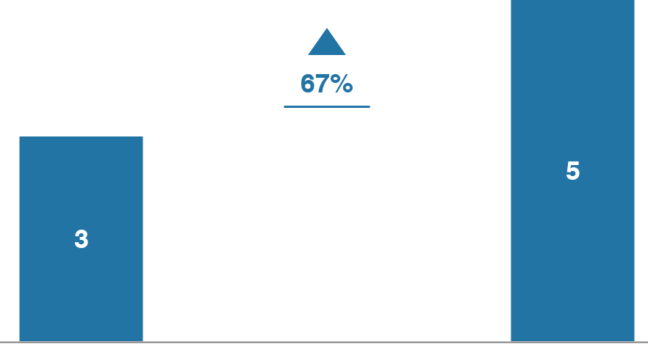
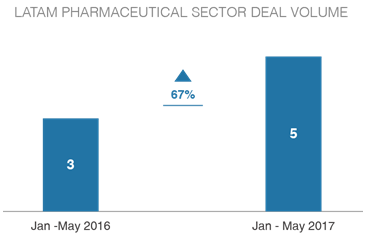
DEAL VOLUME IN LATAM’S PHARMACEUTICAL SECTOR INCREASED 67% IN 2017

Deal volume in Latin America’s Pharmaceutical, Parapharmaceutical and Cosmetics sector increased 67% between January and May 2017 compared to the same five-month period in 2016, according to TTR data, in collaboration with Ontier. There were five announced and closed deals in the sector in the first five months of 2017 compared to three over the same period last year.

LATIN AMERICA: APRIL DEAL VOLUME DOWN MODERATELY WHILE VALUES SURGE

  • Deal volume in Latin America fell 7% in April 2017 over April 2016
  • Aggregate deal value increased 223%
  • Deal of the Month: OMERS acquires 34.6% stake in GNL Quintero
TTR Insight

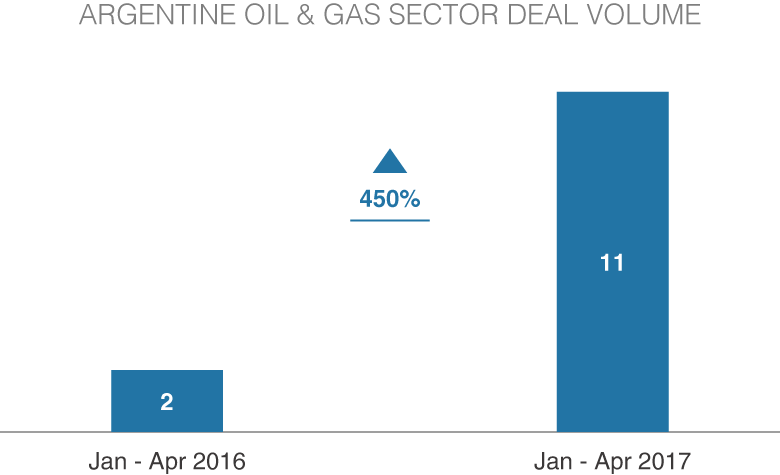
According to TTR, from January to April 2017, deal volume in the Argentine Oil and Gas sector increased 450% over the same period last year. Specifically, there were two transactions in the first four months of 2016 compared to 11 in the same period in 2017.


Deal volume is up 4.7% YTD in Latin America with a total of 668 announced and closed transactions in the first four months of 2017. The aggregate value of the 257 transactions with a disclosed consideration region wide has increased 124%, meanwhile, compared to the same January-April period in 2016.

Top Six M&A Markets in Latin America

Brazil leads the top six most active M&A markets with 342 deals together worth USD 35.7bn YTD, up 5% by volume and 292% by aggregate value compared to the same four-month period in 2016.

Mexico and Chile are tied with a total of 87 announced and closed deals apiece to the close of April, though with USD 8.7bn in aggregate value from 34 deals of disclosed consideration, the region’s largest Spanish-speaking market nearly triples the USD 3bn sum of the 37 deals of disclosed value recorded in Chile YTD.

Deal volume is up 5% in Mexico, while aggregate value is down 2% compared to the January-April period in 2016. In Chile, deal volume is up 28% YTD while aggregate value has declined 53% relative to the first four months of 2016.

Argentina is but eight deals behind Mexico and Chile with 79 transactions recorded in the first four months of the year, up 25% over the corresponding period last year. Aggregate deal value is up 75% in Argentina to USD 3.1bn, putting it just ahead of its Southern Cone neighbor by the total consideration of all transactions in the country in the first four months of the year.

Colombia is down 19% by deal volume and up 281% by aggregate value with a total of 44 transactions to the close of April, 16 with disclosed consideration worth a combined USD 11.8bn.

Peru rounds out the top six M&A markets in the region, despite a 30% decline in deal volume to 35 and a 37% fall in aggregate value to USD 1.1bn, taking into account the 19 transactions of disclosed consideration.

Cross-Border Deals

Latin American firms made four outbound acquisitions in April 2017, two with targets based in North America, one in Africa and one in Australia. Inbound acquisitions were led predominantly by North American buyers, with 25 deals led by firms based in the US or Canada, followed by the EU, represented by 19 transactions, Asia with six and Australia with two buyers targeting companies in Latin America.

Deal of the Month

TTR selected Ontario Municipal Employees Retirement System’s acquisition of a 34.6% stake in Chile-based GNL Quintero from Enagás Chile and ENAP for USD 341m through its Borealis Infrastructure fund as Deal of the Month. GNL Quintero operates a liquefied natural gas reception, storage and regasification terminal. Claro y Cia. Abogados advised the buyer while ENAP was advised by Philippi, Prietocarrizosa Ferrero DU & Uría Chile and Enagás Chile by CMS Carey & Allende.

 Interview with Luis Felipe Arze from CMS Carey & Allende

(Interview in spanish)

Last year, Mérieux NutriSciences Corporation, Illinois, United States-based, acquired 65% of Chilean entity Laboratorio Labser. CMS Carey & Allende partner Luis Felipe Arze advised the buyer.


TTR in the Press

AMÉRICA ECONÓMICA – “Fusiones y adquisiciones crecen 223% en América Latina

LA REPUBLICA – “Monto de fusiones y adquisiciones creció 124% en la región

EL ECONOMISTA – “Mercado transaccional de AL registra aumento de 223% en abril

Rankings – Financial and Legal Advisory

Find the TTR ranking of financial and legal advisors (year to date) in our monthly report. Click to download.

LATIN AMERICA: AGGREGATE DEAL VALUE OF INDUSTRIAL SECTOR GREW 527%

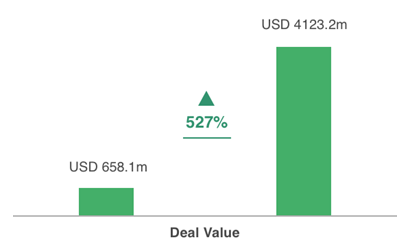
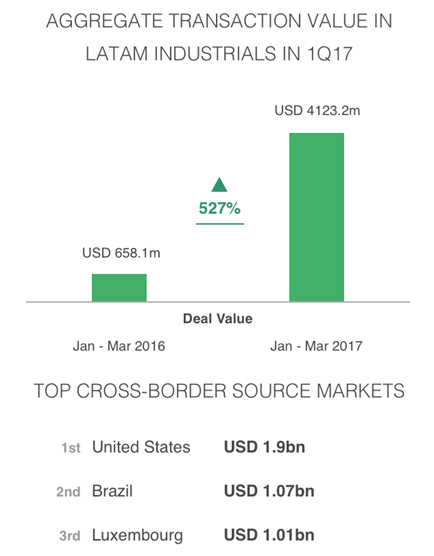
The aggregate deal value of transactions in the industrials sector in Latin America grew by 527% in 1Q17 compared to the same period last year. The growth in aggregate deal value contrasts with deal volume in the sector, which was down from 69 deals in 1Q16 to 50 in the first three months of 2017.

The leading source markets for cross-border deals in Latin America in 1Q17 were the US, with eight transactions together worth USD 1.9bn, followed by Brazil, with 18 transactions worth a combined USD 1.07bn, and Luxembourg, with a sole transaction worth USD 1.01bn.

LATIN AMERICA: COMBINED DEAL VALUE GREW 75% IN 1Q17

  • Deal volume was up 4% to in 1Q17 over 1Q16 to 501 transactions regionwide
  • Aggregate deal value grew 75% in 1Q17 over 1Q16
  • Deal of the Quarter: Coca-Cola and Coca-Cola Femsa acquire AdeS from Unilever for USD 575m

 TTR Insight

The aggregate deal value of transactions in the industrials sector in Latin America grew by 527% in 1Q17 compared to the same period last year. The growth in aggregate deal value contrasts with deal volume in the sector, which was down from 69 deals in 1Q16 to 50 in the first three months of 2017.

The leading source markets for cross-border deals in Latin America in 1Q17 were the US, with eight transactions together worth USD 1.9bn, followed by Brazil, with 18 transactions worth a combined USD 1.07bn, and Luxembourg, with a sole transaction worth USD 1.01bn.


The total combined value of announced and closed transactions in Latin America stood at USD 38.2bn in 1Q17, up 75% over the same quarter last year, according to the latest TTR data.

Deal volume increased more modestly in the quarter at just over 4% over 1Q16 for a total of 501 transactions region-wide, of which 184 had disclosed considerations contributing to regional aggregate value.

Transactional Ranking by Country
  1. Brazil led the top six most active M&A markets by deal volume in 1Q17, with 256 transactions announced and closed in the quarter worth a combined USD 19.9bn, representing a 6% increase in volume and a 249% increase in aggregate value over 1Q16.2. Mexico followed as the second-most active M&A market regionally, with a total of 64 deals worth a combined USD 6.7bn, a 7% increase in volume and 21% decline in aggregate value over 1Q16.3. Chile ranked third in the region, with a 69 deals announced in 1Q17 worth a USD 2bn combined, a 28% increase in transactional volume and a 47% decline in aggregate deal value relative to 1Q16.4. Argentina followed as the fourth ranked market by M&A volume in the region in 1Q17 with 58 deals together worth USD 1.4bn, a 23% increase in deal flow and a 5% increase in aggregate value over 1Q16.5. Colombia was the fifth-most-active market by announced and closed deals in 1Q17 with 29 deals worth a combined USD 10.8bn, a 37% decrease in volume and a 266% increase in aggregate value over 1Q16.6. Peru ranked sixth regionally, with 27 deals in the quarter worth a combined USD 984m, representing a 25% dip in deal volume and a 30% decline in aggregate value compared to 1Q16.
Outbound Cross-Border Deals

Latin American buyers acquired 23 targets in North America, eight in the EU and one in Asia in 1Q17.

Deal of the Quarter


TTR selected The Coca-Cola Company and Coca-Cola Femsa’s joint bid for AdeS, including the target’s operations in Argentina, Brazil, Bolivia, Chile, Colombia, Mexico, Paraguay and Uruguay from Unilever for USD 575m as Deal of the Quarter for 1Q17.

The buyers were advised by Lobo & de Rizzo Advogados, Clifford Chance US, TozziniFreire Advogados, BerkemeyerCurtis, Mallet-Prevost, Colt & Mosle Argentina, Von Wobeser y Sierra and Clifford Chance Brasil. The seller was advised by Baker & McKenzie US (Global), Trench, Rossi e Watanabe Advogados, Baker & McKenzie UK, Lazard (Global) and Alfaro, Dávila y Ríos.

Rankings – Financial and Legal Advisory

Find the TTR ranking of financial and legal advisors (year to date) in our quarterly report.

TTR in the Press

EL ECONOMISTA AMÉRICA: “Latinoamérica cierra un trimestre récord en el mercado de fusiones y adquisiciones”

ECONOMÍA HOY: “Inversiones en AL bailan al ritmo de la samba”

ESTRATEGIA & NEGÓCIOS: “Mercado transaccional de América Latina crece 4,38%”

Complete Report