Financial Services Dealmaking Brisk in Chile

TTR-Deal-Tracker

Deal Tracker
www.TTRecord.com

LATIN AMERICA

Intralinks® Deal Flow Predictor
See the future of M&A.
Forecast of global M&A activity through Q4 2015

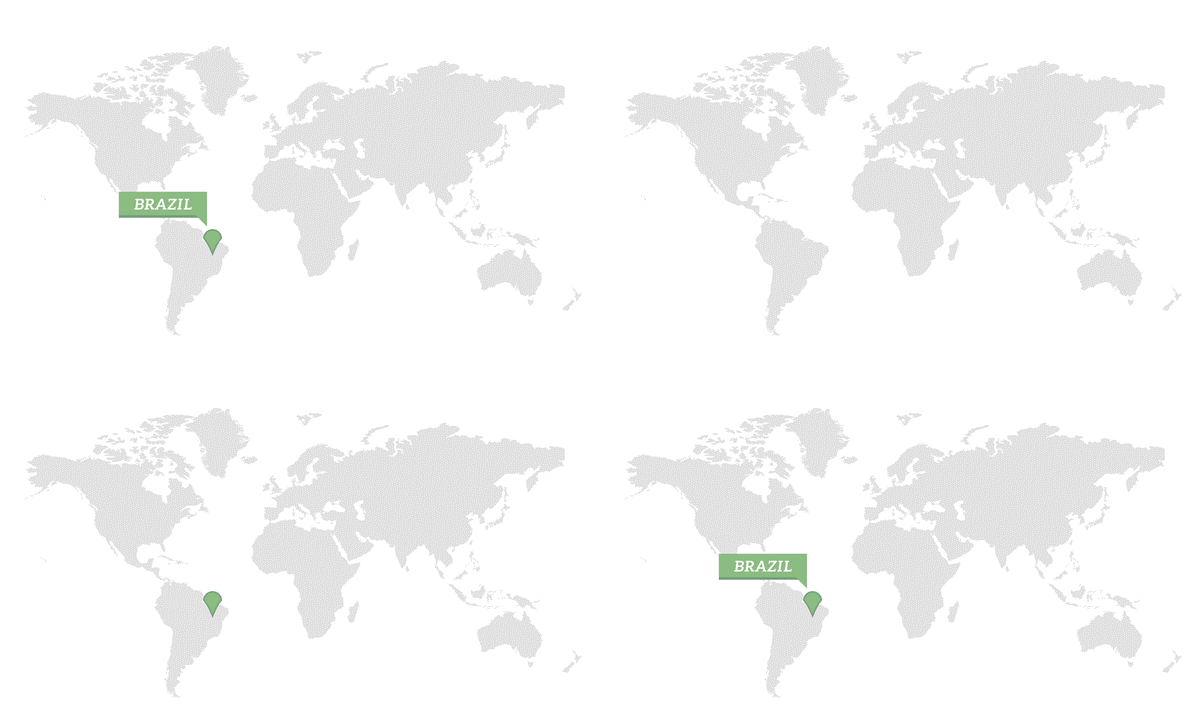
BRAZIL: North American appetite for deals on the rise

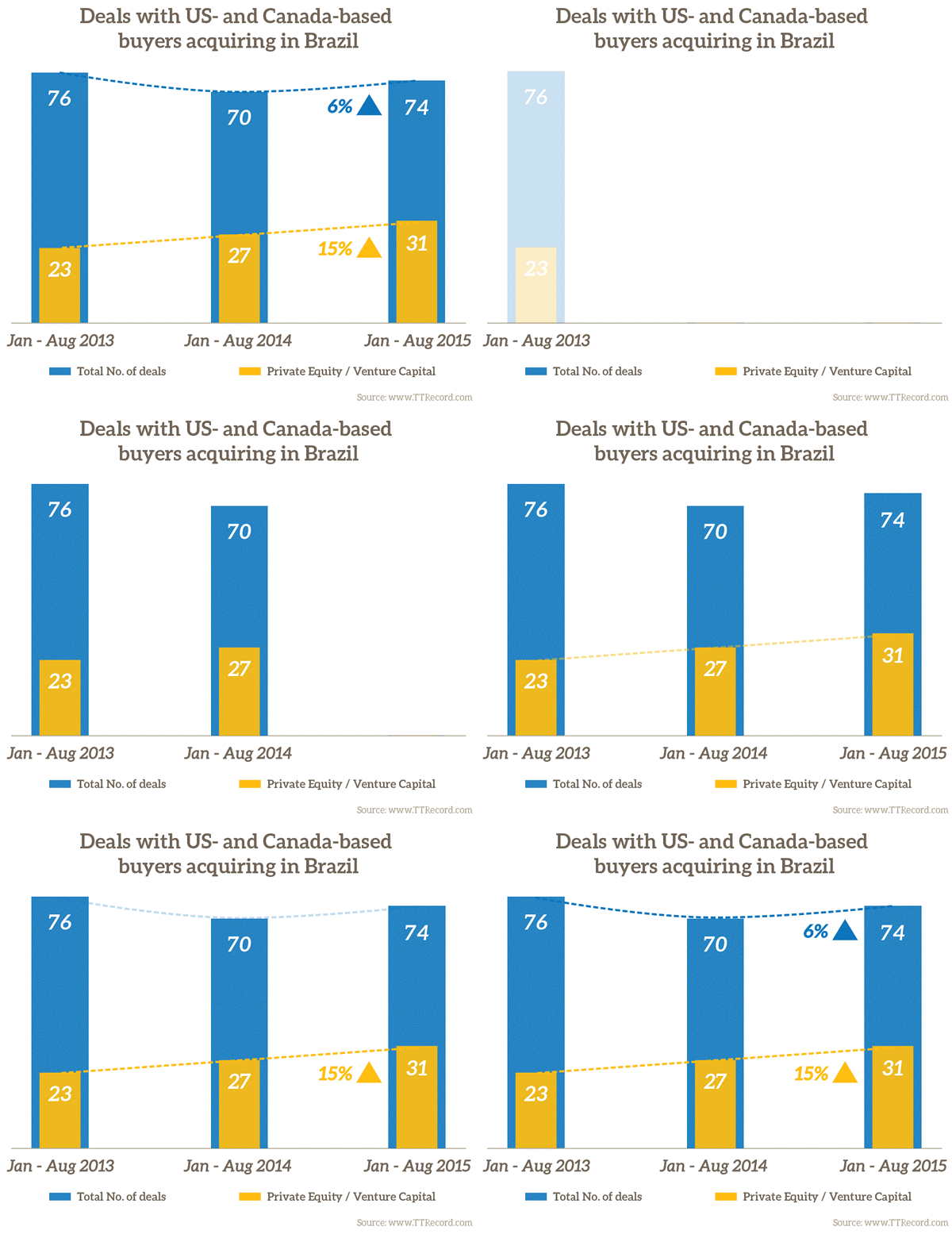
Acquisitions by North America buyers increased by around 6% between January and August, 2015, compared to the same period in 2014, according to TTR data ( www.TTRecord.com). The growing appetite for Brazilian assets reverses a downward trend seen between the first eight months of 2013 and the corresponding period in 2014
1

2

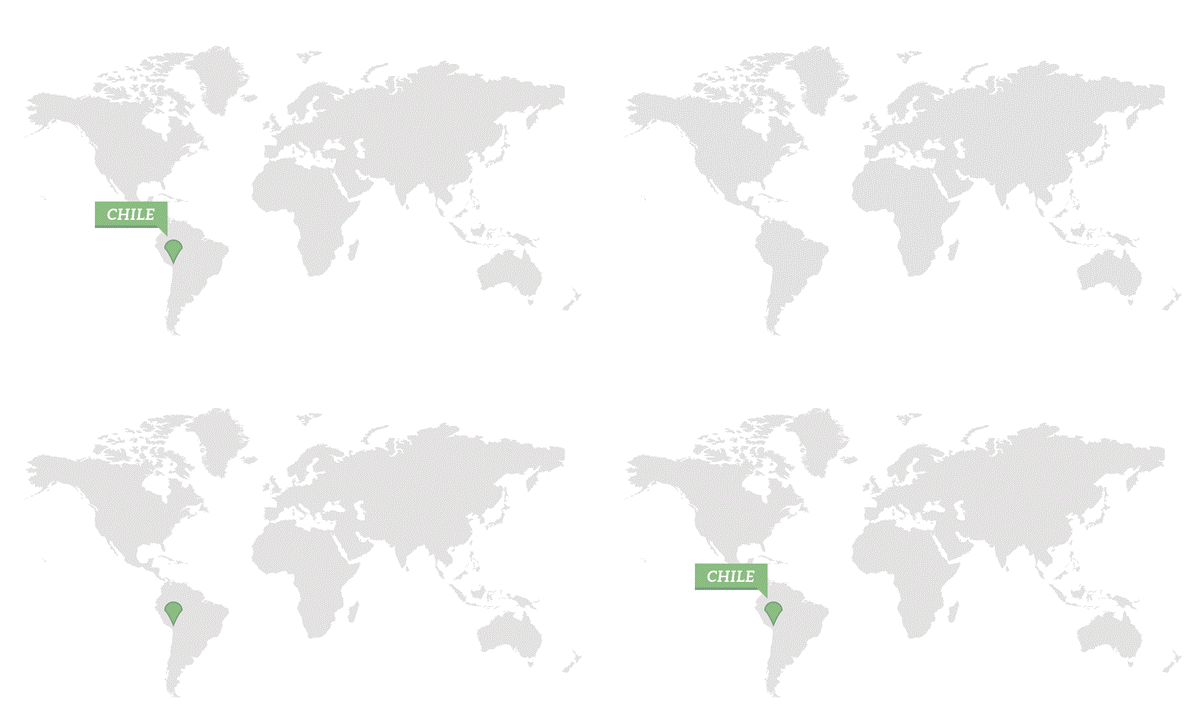
CHILE: Financial services transactions brisk

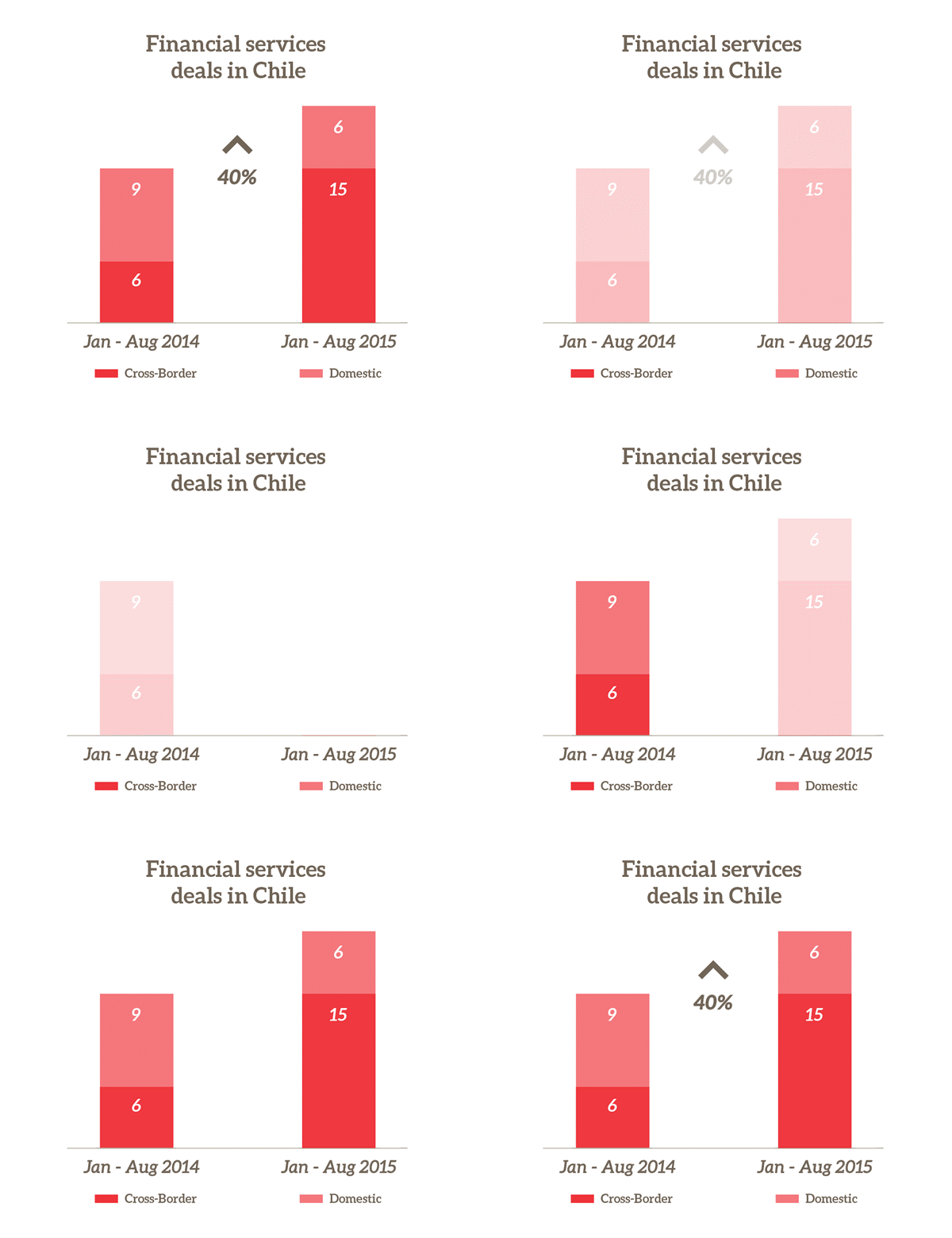
Financial services transactions grew 40% in the first eight months of 2015 to 21 deals compared to 15 in the same period in 2014, according to TTR data ( www.TTRecord.com). Cross-border financial services deals are up 150% over the same period.
3

4

Rankings / League Tables

Latin America Ranking – 2015

Financial Advisory – Year to Date (YTD)
5

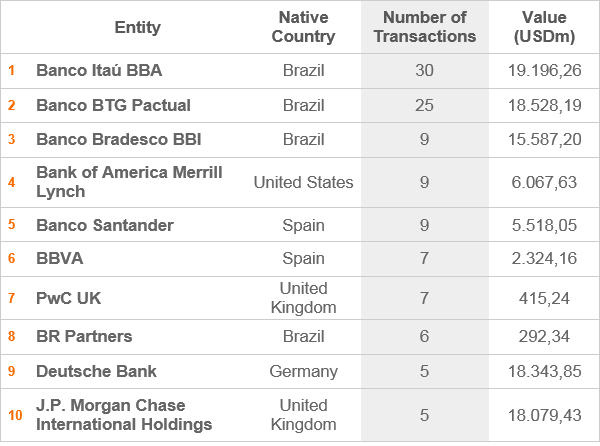
Banco Itaú BBA leads TTR’s Latin America financial advisory ranking at the close of August after advising on 30 transactions worth nearly USD 19.2bn combined. Brazil’s leading bank also led the ranking for the first eight months of 2014, when it’d advised on 47 deals together worth USD 8bn. Banco BTG Pactual follows in second place, as it did a year ago, with 25 transactions under its belt, together worth USD 18.5bn, compared to 27 deals worth USD 10.3bn in the first eight months of 2014. In third place by deal volume, Banco Bradesco BBI closed nine deals by the end of August, worth just under USD 15.6bn in aggregate, up from fifth for the same period in 2014 when it’d closed 10 deals worth USD 4.7bn. BAML and Santander are tied with Bradesco by deal volume, falling into fourth and fifth place, weighted by combined deal value of USD 6bn and USD 5.5bn, respectively. BAML fell from third place in the ranking at this point last year, and Santander from fourth, when both banks had advised on 11 deals. BBVA, in sixth place, and PwC in seventh, have both advised on seven transactions YTD, BR Partners six and Deutsche Bank and JPMorgan five apiece. Of the trailing five in the chart, only Deutsche Bank was among the top 10 in the first eight months of 2014.

Legal Advisory – Year to Date (YTD)
6Legal Advisory – Year to Date (YTD)

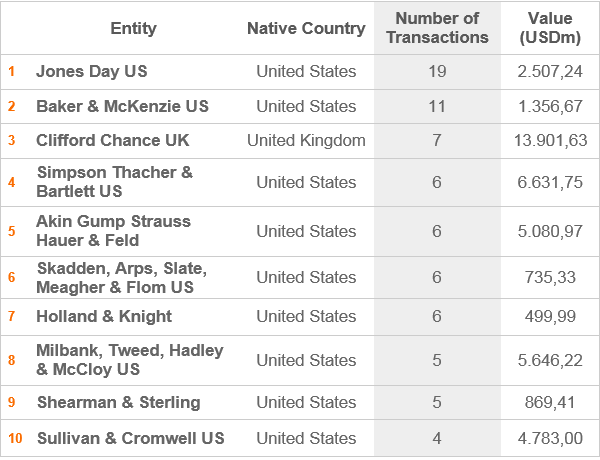
Jones Day dominates the international firms in TTR’s Latin America legal advisory ranking at the close of August after advising on 19 transactions YTD together worth USD 2.5bn. The top firm climbed from third for the corresponding period last year, when it’d advised on 12 deals worth USD 1.9bn. Baker & McKenzie fell from first at this time last year to close August in second place with 11 transactions YTD worth nearly USD 1.4bn combined. Clifford Chance places third by volume, but first in value terms by a long shot, with seven deals worth USD 13.9bn combined. Clifford was not among the top-10 firms by deal volume in the first eights months of 2014. Simpson Thacher & Bartlett placed fourth, with six deals together worth USD 6.6bn, falling from second a year ago when it had advised on 13 deals worth USD 6.5bn combined. Following, also with six deals in their hats, are Akin Gump Strauss Hauer & Feld, alongside Skadden, Arps, Slate, Meagher & Flom, and Holland & Knight, of which only the first firm broke the USD 1bn mark, advising on deals worth USD 5bn in aggregate. Milbank, Tweed, Hadley & McCloy follows in eighth for its five deals worth USD 5.6bn combined. Shearman & Sterling takes ninth, also with five deals, and Sullivan & Cromwell brings up the rear with four deals worth nearly USD 4.8bn in aggregate. ç

Brazil Ranking – 2015

Financial Advisory – Year to Date (YTD)
7

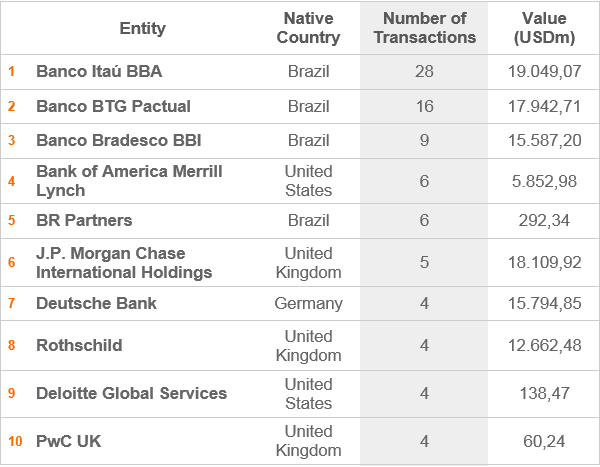
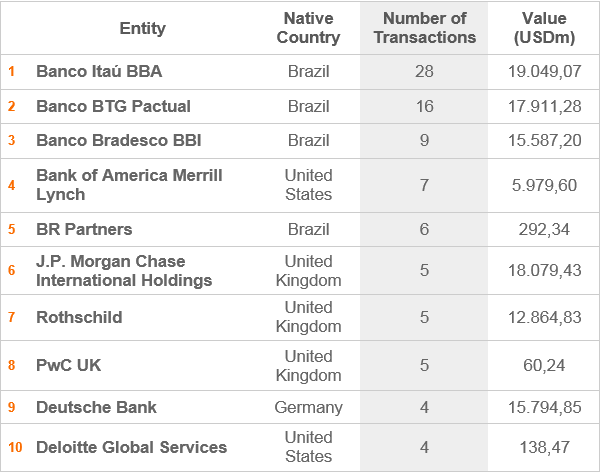
Banco Itaú BBA dominates TTR’s Brazil financial advisory ranking at the close of August, with 28 deals worth a combined USD 19bn, leading its peers as it did a year ago when the bank had advised on 37 transactions worth just shy of USD 4bn. BTG Pactual follows in second, with 16 advisory mandates YTD, together worth USD 17.9bn. At the close of August, 2014, BTG Pactual had advised on 23 transactions worth USD 9.3bn and also ranked second. Banco Bradesco BBI climbed from fourth a year ago to close August ranked third, despite a slight decline in deal flow from 11 to nine transactions. Fewer deals were worth more, however: USD 15.6bn YTD in 2015 compared to USD 4.7bn in the first eight months of 2014. BAML placed fourth in the Brazil chart, with seven deals worth USD 6bn in total, ahead of BR Partners, with six deals worth USD 292m. JPMorgan, Rothschild and PwC each have advised on five transactions in Brazil, worth USD 18bn, 12.9bn and USD 60m, respectively. Neither BAML, JPMorgan nor Rothschild placed among the top 10 by the close of August, 2014. PwC climbed two rungs from its tenth-place position at this point last year when its four transactions were together worth USD 834m. Deutsche Bank and Deloitte Global Services have advised on four deals each, YTD, worth USD 15.8bn combined in the case of the former, and USD 138m in the latter. Deutsche Bank and Deloitte too were absent from the top 10 at the close of August, 2014.

Legal Advisory – Year to Date (YTD)
8

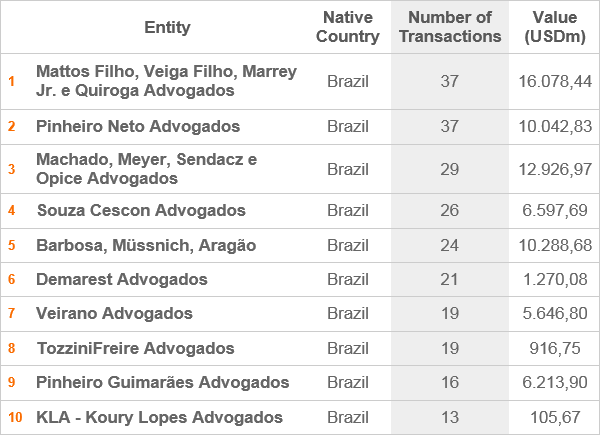
The competition couldn’t get any fiercer in TTR’s Brazil legal advisory ranking between Mattos Filho, Veiga Filho, Marrey Jr. e Quiroga Advogados and Pinheiro Neto Advogados, each with 37 mandates under their belts, together worth USD 16bn and USD 10bn, respectively. The relative positions were much the same between Brazil’s top two firms at the close of August, 2014 when Mattos Filho had advised on 43 deals and its rival 40, worth USD 8.6bn and USD 6.5bn, respectively. Machado, Meyer, Sendacz e Opice Advogados inched up to third from fourth at this point last year, meanwhile, with 29 mandates YTD worth USD 12.9bn, compared to 31 worth USD 2.2bn a year ago, a 475% jump in combined deal value notwithstanding a 6% drop in volume. Souza, Cescon Advogados inched up from sixth a year ago when it’d advised on 24 deals worth USD 11bn to close August in fourth place with 26 deals under its belt worth USD 6.6bn combined. Barbosa, Müssnich, Aragão climbed from ninth to fifth with 24 transactions worth USD 10.3bn YTD compared to 19 worth USD 4.9bn in the eight-month period that ended 31 August, 2014. Demarest is up 5% by deal volume, enough to climb the chart from eighth to sixth, after advising on 21 deals worth just under USD 1.3bn in aggregate. The firm’s combined deal value fell 40%, however, compared to its 20 deals worth USD 2.1bn a year ago. Veirano has retained the seventh-place position it held at the close of August, 2014, with 19 mandates YTD worth USD 5.6bn combined. Also with 19 deals under its belt, TozziniFreire Advogados fell three spots from fifth to eighth. It’d advised on 27 deals in the eight-month period ending 31 August, 2014, representing a 30% decline in deal volume, while combined deal value declined 73% from USD 3.4bn then to USD 917m YTD in 2015. Pinheiro Guimarães Advogados appears at ninth, with 16 transactions worth USD 6.2bn in aggregate. The firm wasn’t among the top-10 in Brazil at the close of August, 2014. Koury Lopes Advogados brings up the rear, as it did a year ago, with 13 deals worth USD 106m combined compared to 16 worth USD 1.4bn at the end of August, 2014, representing a 19% decline in volume and a 92% drop in aggregate value.

Mexico Ranking – 2015

Financial Advisory – Year to Date (YTD)
9

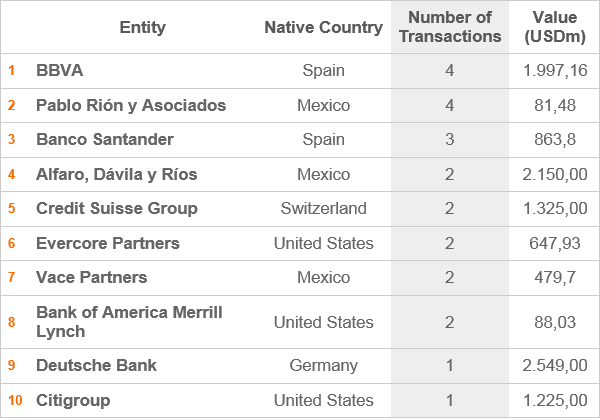
BBVA and Pablo Rión y Asociados are neck and neck at the top of TTR’s Mexico financial advisory ranking, in first and second place with four transactions apiece, together worth USD 2bn and USD 81m, respectively, insomuch as deal values have been disclosed. BBVA doubled its deal volume compared to its position a year ago when it placed sixth in the chart. Spanish rival Banco Santander holds third place in the chart, with three transactions together worth USD 864m, compared to one worth USD 1.3bn a year ago when it placed tenth. The fourth-to-eighth place investment banks advised on two transactions each, led by Alfaro, Dávila y Ríos whose pair of transactions is worth USD 2.2bn. Deutsche Bank and Citigroup hold the ninth- and tenth-place positions, with deals valued at USD 2.5bn and USD 1.2bn, respectively. Citigroup placed second and Deutsche Bank third in the corresponding period of 2014, with two deals worth USD 1.7bn together in the case of the former, and two worth USD 1.5bn in the latter.

Legal Advisory – Year to Date (YTD)
10

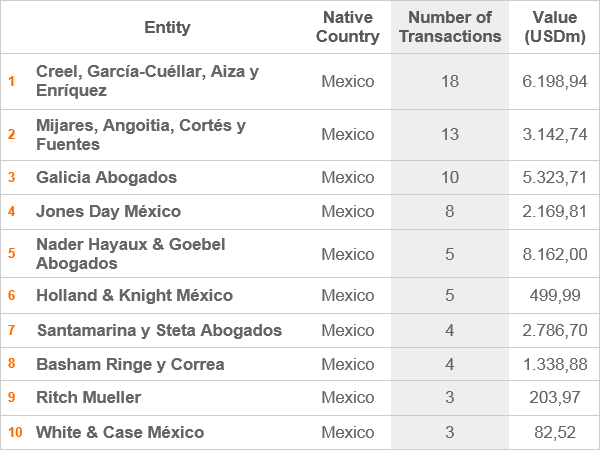
Creel, García-Cuéllar, Aiza y Enríquez have a comfortable lead in TTR’s Mexico legal advisory ranking, as the firm did in the first eight months of 2014. Creel leads despite a 10% decline in deal volume to 18 transactions YTD worth USD 6.2bn combined, and a 28% drop in aggregate value relative to its 20 deals worth USD 8.6bn at the close of August, 2014. Mijares, Angoitia, Cortés y Fuentes holds firm to second place in the ranking, with 13 deals together worth USD 3.1bn compared to the 12 worth USD 2.4bn that garnered it second place a year ago. Galicia Abogados rose three rungs from sixth to take third with 10 deals together worth USD 5.3bn compared to half that number worth 1bn at the close of August, 2014. Jones Day holds fourth place in the chart by deal volume with eight transactions and second by combined value of USD 5.3bn. The US-based firm didn’t place among the top 10 law firms practicing in Mexico in the first eight months of 2014. Nader Hayaux & Goebel Abogados, in fifth, and Holland & Knight, in sixth, have advised on five deals each YTD in 2015, the former leading the chart by combined deal value of USD 8.2bn, the latter lagging in the distance with USD 500m worth of transactions, in aggregate. Holland & Knight rose one spot in the ranking relative to its position at the end of August, 2014, while Nader Hayaux was not among the top 10 a year ago. Santamarina y Steta Abogados, at seventh, advised on four deals in the first eight months of the year, together worth USD 2.8bn, and is tied by volume with Basham Ringe y Correa, also with four transactions, in its case worth USD 1.3bn. Basham also ranked in eighth place for the January-August period in 2014. Ritch Mueller fell precipitously, from third to ninth with three deals YTD worth USD 204m, compared to eight a year ago worth USD 2.8bn, representing a 62.5% decline in volume and a 93% decline in aggregate value. White & Case, also with three transactions under its belt YTD, has met with a similar 50% decline in deal volume and an 88% decline in combined deal value to USD 83m, relative to its performance in the first eight months of 2014, when it’d advised on six deals together worth USD 686m.
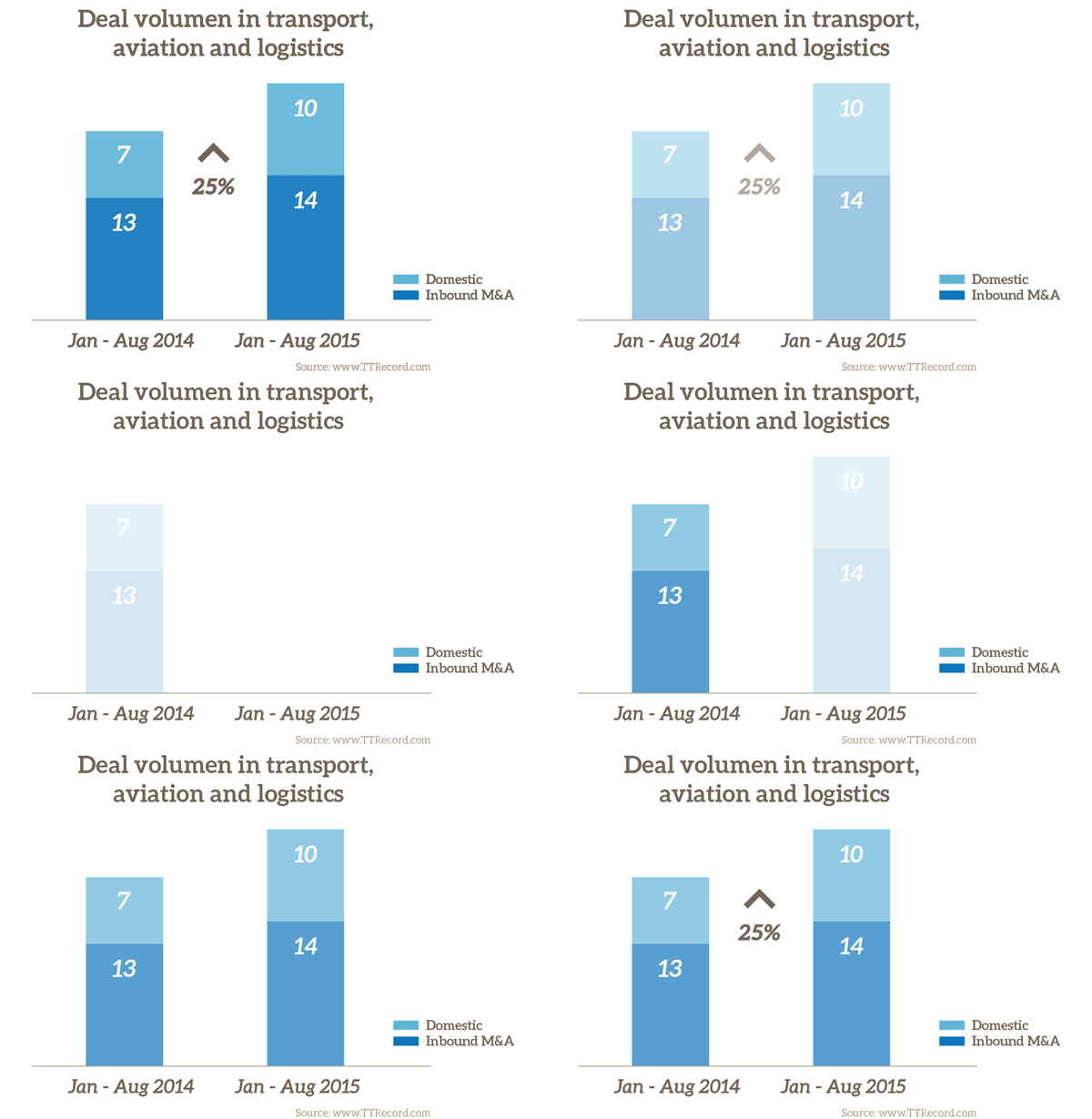
Transport & Logistics on the move in Brazil and Mexico

TTR-Deal-Tracker

Deal Tracker
www.TTRecord.com


LATIN AMERICA

BRAZIL: Transport, aviation and logistics dynamic in 2015

The transport and logistics sector is among the most dynamic in Brazil for the January to August period in 2015, with a 25% increase in transactional activity relative to the same period in 2014, according to TTR data (www.TTRecord.com). The number of international firms acquiring equity in Brazilian counterparts is considerable in both periods.

Brazil--Map-(GIF)---
Brazil-Graph


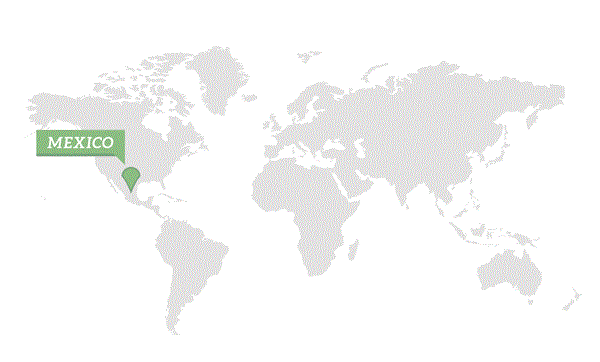
MEXICO:
Transport, aviation and logistics dealmaking keeps pace with Brazil

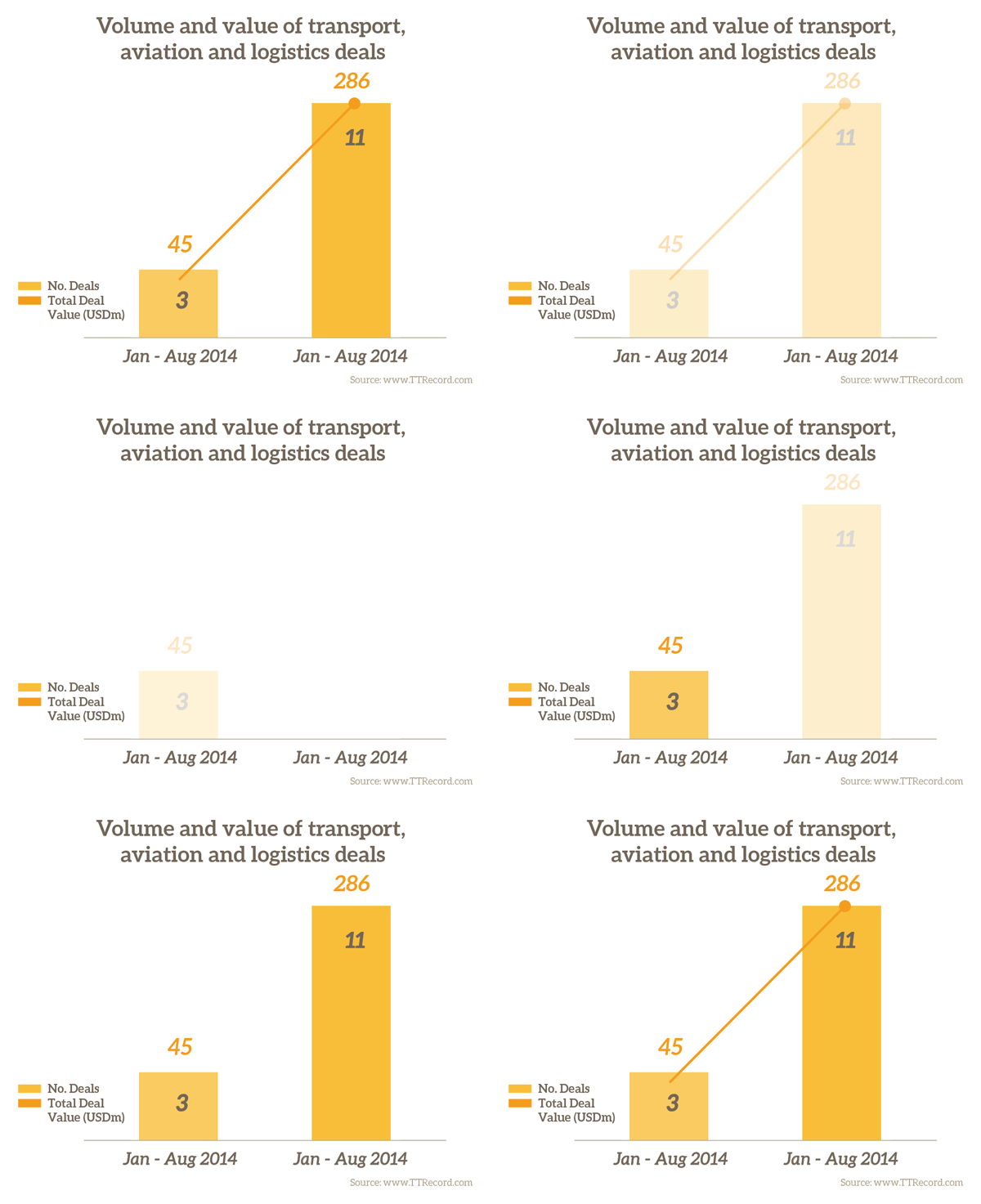
Dealmaking in the transport, aviation and logistics segment has skyrocketed in Mexico in the first seven-and-a-half months of 2015, with 11 deals in the sector together worth USD 286m, according to TTR data (www.TTRecord.com). This represents a 266.6% increase in deal volume and a 535.5% increase in aggregate value relative to the corresponding period in 2014. Mexico-Graph

Rankings / League Tables

Latin America Ranking – 2015

Financial Advisory – Year to Date (YTD)
1


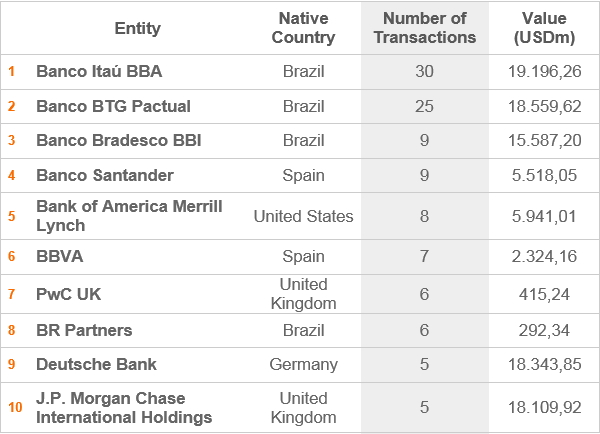
Banco Itaú BBA holds its lead by deal volume in TTR’s Latin America financial advisory ranking at mid-August, with 30 transactions worth nearly USD 19.2bn in aggregate. Its deal volume is down 33% compared to the first seven-and-a-half months of 2014, but it has almost tripled the combined value of its mandates. Banco BTG Pactual has advised on 25 transactions worth USD 18.5bn YTD, maintaining its second-place position in the ranking with one more deal under its belt compared to mid-August, 2014 and a 110% increase in the combined transaction value of its mandates. Banco Bradesco climbed two positions to take third in the chart relative to the comparable period in 2014, with nine transactions worth nearly USD 15.6bn, compared to 10 deals together worth nearly USD 4.7bn a year ago, when it placed fifth. Banco Santander follows, also with nine deals under its belt, in its case worth USD 5.5bn, to maintain the same fourth-place position it held in mid-August, 2014. BAML fell two spots from its third-place position at this point last year to take fifth, having advised on eight transactions together worth USD 5.9bn YTD compared to 11 worth USD 9.8bn a year ago. Spain’s BBVA, in sixth, has advised on seven deals worth USD 2.3bn in aggregate, YTD. It wasn’t among the top 10 a year ago. Nor was PwC, in seventh place with six deals together worth USD 415m, nor BR Partners, in eighth, also with six deals, worth USD 292m combined. Deutsche Bank fell one position to ninth, with five deals together worth USD 18.3bn, compared to eight worth USD 10.8bn a year ago. JPMorgan has knocked Citigroup, last year’s trailing bank at mid-August, from the top 10, to take up the rear with five deals worth USD 18.1bn combined.


Legal Advisory – Year to Date (YTD)
2


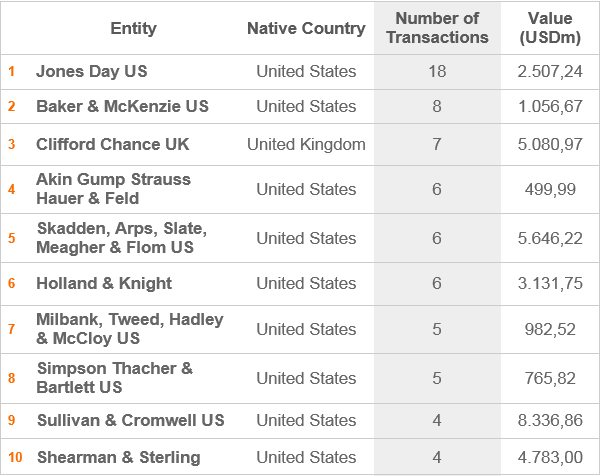
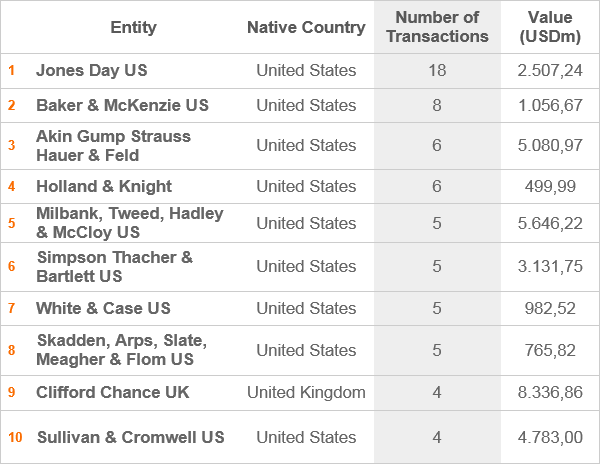
Jones Day maintains its safe lead in TTR’s Latin America legal advisory ranking at mid-August, with 18 advisory mandates under its belt, worth USD 2.5bn in aggregate. The firm climbed from fourth place in mid-August, 2014, when it’d advised on 11 deals worth USD 1.9bn combined. This more than doubles the deal volume of Baker & McKenzie, the number two firm in the chart, which has advised on eight transactions worth USD 1bn YTD, compared to 23 worth USD 8.8bn a year ago when it led the ranking. At third with seven deals together worth nearly USD 14bn, Clifford Chance wasn’t among the top 10 in mid-August, 2014 and today leads aggregate deal value by a long shot. Akin Gump Strauss Hauer & Feld, the fourth-ranked firm, was also absent from the top-10 at this point in 2014. This year it has advised on six deals worth USD 5bn thus far. Skadden, Arps, Slate, Meagher & Flom holds the fifth position with six deals worth USD 766m, a 100% increase in deal volume and a 130% increase in combined value compared to its performance to mid-August, 2014, when it too did not place among the top 10. Also with six mandates YTD, Holland & Knight rose from last in the top 10 to sixth, by adding just one transaction, despite an 84% decline in combined deal value from USD 3.1bn to USD 500m. Milbank, Tweed, Hadley & McCloy was also absent from the 10 leading legal advisors in Latin America in mid-August, 2014, and now ranks seventh with five transactions under its belt, together worth USD 5.6bn. Simpson Thacher & Bartlett fell from second in mid-August, 2014, when it’d advised on 13 deals worth USD 6.5bn, to rank eighth YTD in 2015 with its five mandates worth USD 3.1bn. Sullivan & Cromwell didn’t place among the top 10 in the first seven-and-a-half months of 2014 and today ranks ninth with four deals worth nearly USD 4.8bn in aggregate. Another newcomer to the top 10, Sherman & Sterling, brings up the rear with four advisory mandates worth USD 569m.


Brazil Ranking – 2015

Financial Advisory – Year to Date (YTD)
3


Banco Itaú BBA remains at the top of TTR’s Brazil financial advisory ranking at mid-August, the same position it held a year ago. It has advised on 28 transactions YTD together worth USD 19bn, compared to 35 in the January-to-mid-August period of 2014. This represents a 20% decline in advisory mandates and a 461% increase in the combined value of its deals. Banco BTG Pactual follows, with 16 transactions under its belt so far in 2015 compared to 20 in the corresponding period last year, representing a 20% decline in volume and a 130% increase in aggregate value. Banco Bradesco BBI rose one spot relative to last year to take third place with nine transactions worth nearly USD 15.6bn in total compared to its 10 deals worth just under USD 4.7bn a year ago. In Fourth, BAML has advised on six deals to tie by volume with the fifth-place investment bank, BR partners. It’s USD 5.8bn in combined deal value puts it far ahead of its closest rival’s USD 282m, meanwhile. BAML didn’t rank among the top 10 financial advisors in Brazil a year ago when BR Partners held the trailing position in the top 10 with four deals worth USD 487m in aggregate. JPMorgan, in sixth with five deals under its belt worth USD 18.1bn combined, representing a 400% increase in volume, was also absent from the top-10 a year ago, as was Deutsche Bank, ranked seventh with four deals together worth nearly USD 15.8bn. Rothschild climbed one spot to eighth with four deals worth almost USD 12.7bn, representing a 1,500% increase in deal value for the same number of transactions it’d advised on in the corresponding lapse of 2014. Deloitte and PwC hold the ninth and tenth positions, respectively, in the Brazil chart, also having advised on four deals. PwC placed eighth for the same period of 2014, also with four deals, then worth USD 834m compared to USD 60m YTD in 2015.


Legal Advisory – Year to Date (YTD)
4


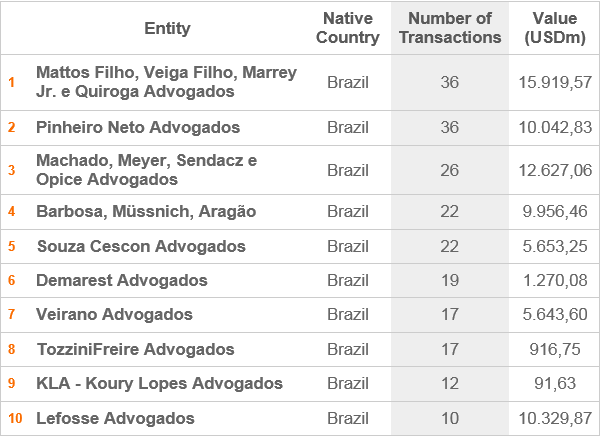
It’s a heated battle for dominance in TTR’s Brazil legal advisory ranking at mid-August, with Mattos Filho, Veiga Filho, Marrey Jr. e Quiroga Advogados maintaining a thin lead owing to the weighted value of the firm’s 36 deals together worth nearly USD 16bn, compared to competitor Pinheiro Neto Advogados’ 36 deals worth USD 10bn combined. Pinheiro Neto led by volume a year ago when it had advised on 38 transactions worth just under USD 6.5bn for Mattos Filho’s 35 worth some USD 7.5bn. Machado, Meyer, Sendacz e Opice Advogados maintains the third-place ranking it held a year ago with 26 deals together worth USD 12.6bn compared to 30 worth USD 2.2bn in mid-August, 2014. Barbosa, Müsnich, Aragão ranks fourth with 22 deals worth just under USD 10bn YTD, rising from eighth a year ago when it’d advised on 19 deals worth nearly USD 4.9bn combined for the corresponding period. Souza Cescon Advogados climbed two rungs from this time last year to take fifth with 22 transactions worth USD 5.6bn combined compared to 21 worth nearly USD 10.3bn a year ago, representing about a 5% increase in volume and a 45% decline in combined value. Demarest climbed from ninth to take sixth, with 19 deals worth just under USD 1.3bn compared to 19 worth USD 2bn a year ago. Veirano Advogados follows in seventh by volume, tied with TozziniFreire Advogados, in eighth, with USD 5.6bn and 917m in combined deal value, respectively, for their 17 advisory mandates. Veirano fell 26% in deal volume from sixth a year ago, TozziniFreire 19% from fifth a year ago. Koury Lopes Advogados climbed one spot to take ninth place compared to its tenth-place position a year ago, with 12 deals worth USD 92m today compared to 14 worth USD 1.4bn then. At the rear, Lefosse Advogados has advised on 10 deals YTD, worth USD 10.3bn. It didn’t place in the top 10 at mid-August, 2014.


Mexico Ranking – 2015

Financial Advisory – Year to Date (YTD)
5


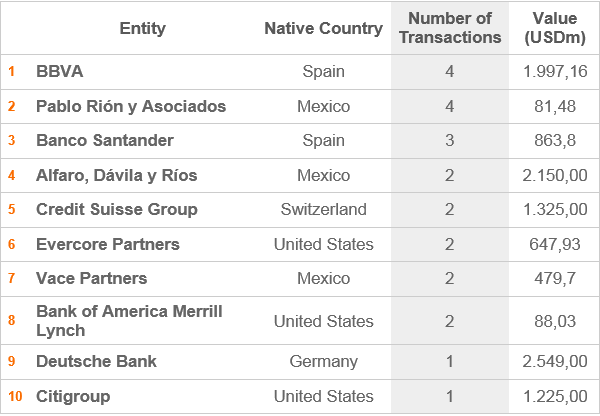
BBVA leads TTR’s Mexico financial advisory ranking at mid-August with four deals under its belt together worth just shy of USD 2bn. It rose from sixth a year ago, increasing deal volume by 100%. Pablo Rión y Asociados follows, also with four transactions YTD, together worth USD 81m, to the extent their values have been disclosed. Banco Santander ranks third, up from last place in the corresponding chart a year ago, with three transactions worth USD 864m in aggregate compared to one deal a year ago worth USD 1.3bn. Alfaro, Dávila y Ríos follows in fourth, with two deals under its belt, worth USD 2.1bn combined. Credit Suisse Group, Evercore Partners, Vace Partners and BAML have also advised on two transactions in Mexico YTD, and rank accordingly by relative combined transaction value. Of the financial advisors that have advised on two transactions YTD, only BAML made the top 10 in the corresponding period of 2014 when it’d also advised on two deals, then worth USD 634m compared to USD 88m today, representing an 86% decline in combined value. Deutsche Bank fell from third at mid-August 2014, to ninth for the corresponding period this year, advising on one deal worth USD 2.5bn compared to two last year worth nearly USD 1.8bn. Deutsche Bank ties the last place advisor in the top 10, Citigroup, which has also advised on one deal, in its case worth USD 1.2bn.


Legal Advisory – Year to Date (YTD)


6
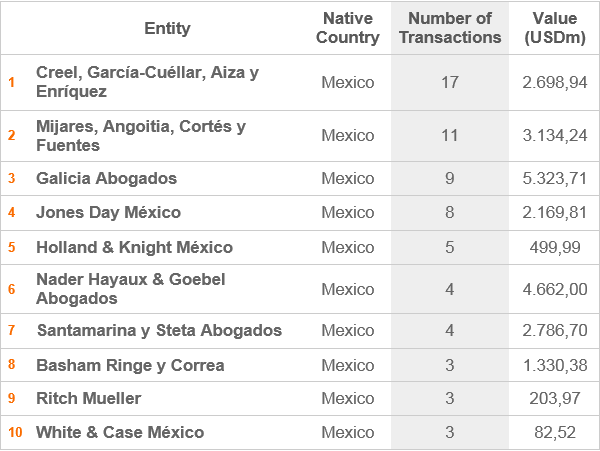
Creel, García-Cuéllar, Aiza y Enríquez holds a safe lead in TTR’s Mexico legal advisory ranking at mid-August with 17 deals together worth just under USD 2.7bn. The firm also led the chart a year ago when it’d advised on 20 deals worth nearly USD 8.6bn in aggregate. Mijares, Angoitia, Cortés y Fuentes has clinched the number two spot, as it did a year ago, with 11 deals worth USD 3.1bn, compared to 12 worth USD 2.4bn in mid-August, 2014. Galicia Abogados rose three rungs from sixth a year ago to take third, with nine deals together worth USD 5.3bn, compared to five worth USD 1bn for the corresponding period in 2014. Jones Day México, absent from the top 10 a year ago, ranks fourth, with eight advisory mandates YTD, worth some USD 2.2bn combined. Holland & Knight México, in fifth, has advised on five transactions thus far in 2015, worth USD 500m combined, compared to four in the corresponding period of 2014, worth nearly USD 2.3bn, when it’d placed seventh in the chart. Nader Hayaux & Goebel Abogados ranks sixth with its four deals worth nearly USD 4.7bn. The firm didn’t place among the top 10 at mid-August, 2014, nor did the seventh-place firm, Santamarina y Steta Abogados, also with four transactions under YTD, worth nearly USD 2.8bn. Basham Ringe y Correa holds firm to the eighth-place position it held in the chart in mid-August, 2014, with three deals worth a combined USD 1.3bn YTD, to tie by deal volume with the ninth- and tenth-placed firms, Ritch Mueller and White & Case. Both have also advised on three transactions so far this year, worth USD 204m and USD 83m, respectively. Ritch Mueller ranked third a year ago, when it’d advised on eight deals together worth USD 2.8bn, while White & Case then ranked fifth with six deals worth 686m combined.


F&B deals surge in Brazil

TTR-Deal-Tracker

Deal Tracker
www.TTRecord.com


LATIN AMERICA

BRAZIL: Food and beverage deals spike

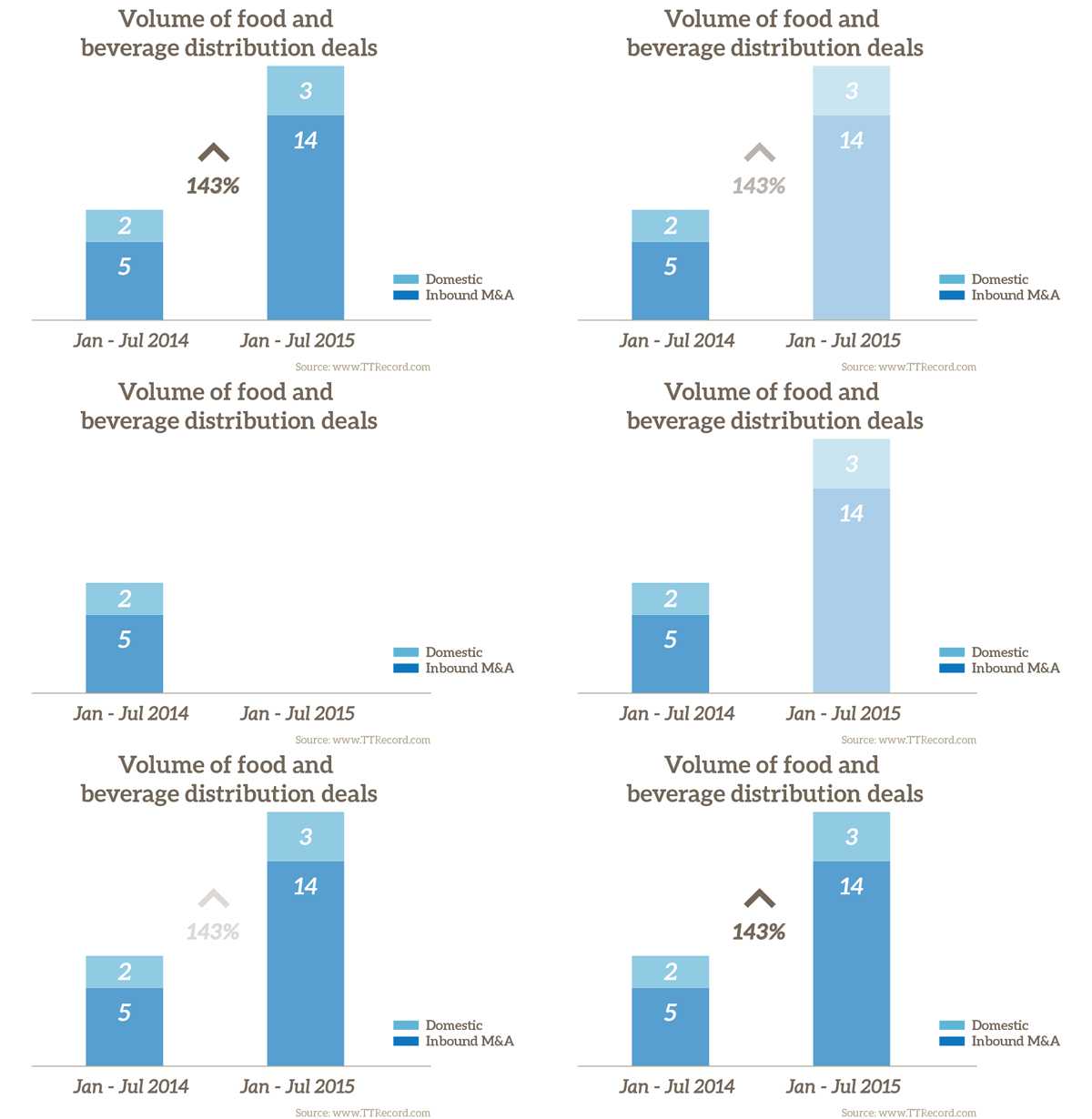
The number of food and beverage distribution deals in Brazil has increased by 143% YTD compared to the same period in 2014, according to TTR data (www.TTRecord.com). In both periods, transactions were mostly led by Brazilian buyers acquiring local peers.

Brazil--Map-(GIF)---Brazil-Graph-(GIF)-V2

 
COLOMBIA:
Domestic firms demonstrate appetite for acquisitions abroad

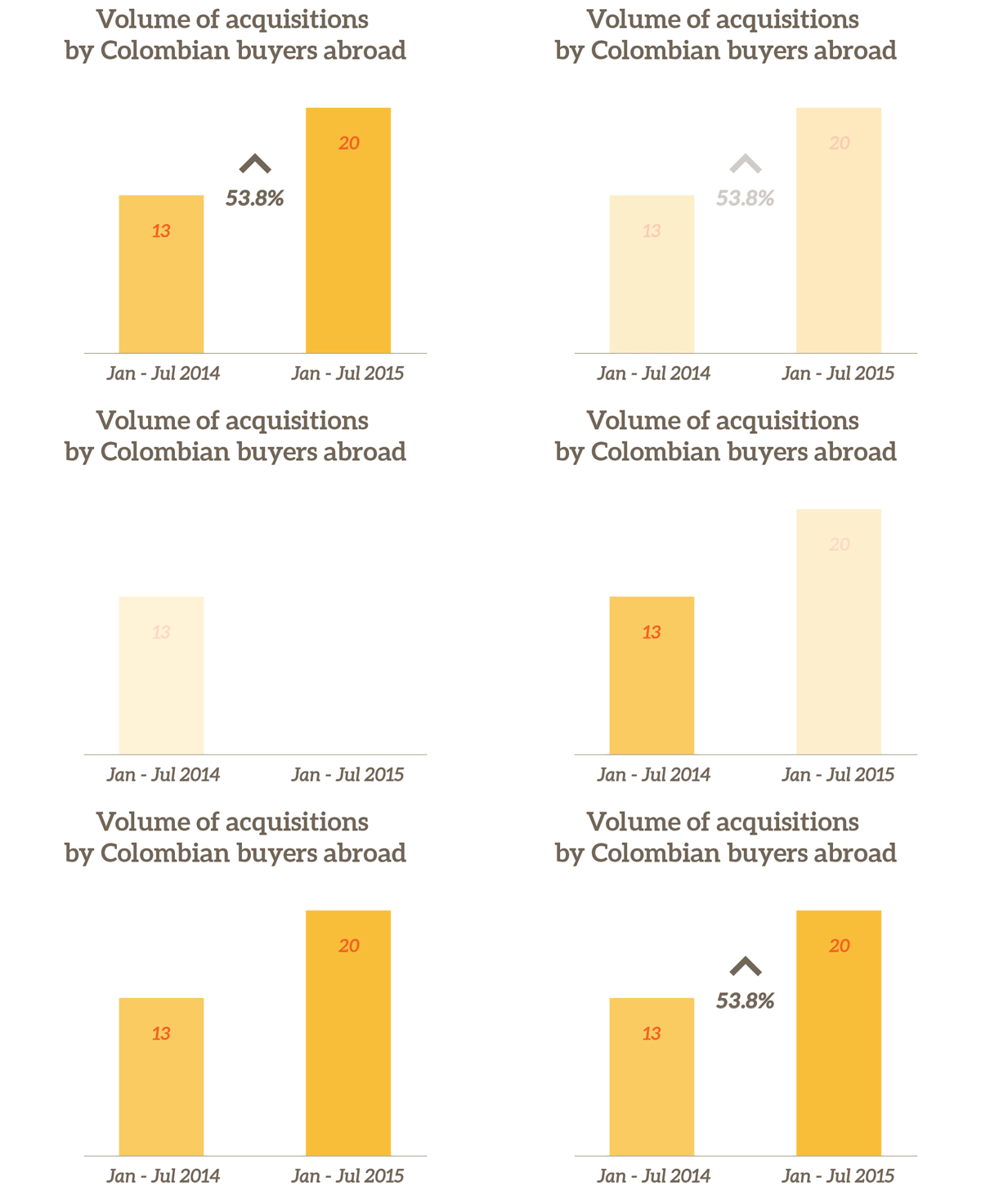
Colombian buyers have been increasingly looking abroad for growth with 20 acquisitions of foreign targets YTD in 2015 compared to 13 in the same period of 2014, according to TTR data (www.TTRecord.com). Among the most popular target markets for Colombian buyers are Chile, Panama, Brazil, and the US, with three acquisitions in each country, and two in Mexico, YTD. Colombia-Graph-(GIF)-

Rankings / League Tables

Latin America Ranking – 2015

Financial Advisory – Year to Date (YTD)
1


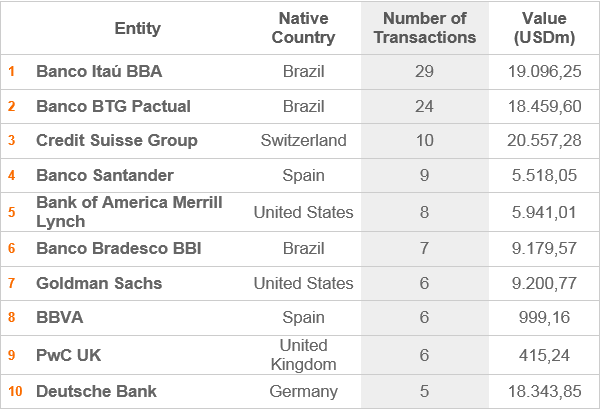
Banco Itaú’s lead on Banco BTG Pactual at the top of TTR’s Latin America financial advisory ranking narrowed as July drew to a close, compared to the rivals’ relative positions in the chart a year ago. By volume of deals Itaú is down 28%, with 29 transactions YTD compared to 40 a year ago. The aggregate value of Itaú’s mandates has nearly tripled, however, from USD 6.8bn to USD 19bn. Banco BTG Pactual actually had greater aggregate value a year ago than the leading bank with its 23 deals worth USD 8.3bn. Its volume is now up 4% compared to the first seven months of 2014 with 24 transactions that rival Itaú’s in combined value at USD 18.5bn. At third, Credit Suisse Group climbed one spot to displace BAML by number of deals with 10 transactions together valued at USD 20.6bn to lead the chart by value. A year ago it had advised on nine deals worth USD 7.2bn putting it in fourth place. Banco Santander climbed two rungs to take fourth with nine deals worth USD 5.5bn compared to its nine deals worth USD 2.4bn a year ago, which had put it in sixth place. At fifth in the ranking, BAML has advised on eight transactions YTD worth USD 5.9bn compared to its 10 deals worth USD 4bn at this time last year, which had put it in third place. Bradesco slipped one spot from fifth to sixth place by volume, but more than doubled aggregate value with nine deals worth 4.2bn at the end of July 2014 and seven deals worth USD 9.2bn YTD in 2015. Goldman Sachs, at seventh, rose two positions from ninth a year ago and grew its combined deal value from USD 7.8bn to USD 9.2bn, despite advising on six transactions YTD rather than seven in the first seven months of 2014. Also with six deals under their belts, BBVA and PwC were both absent from the top-10 at this point in 2014. Deutsche Bank maintains the same place at the rear it held at the end of July, 2014, while more than tripling aggregate deal value from USD 5bn a year ago to USD 18.3bn YTD in 2015, despite declining volume from seven to five deals.


Legal Advisory – Year to Date (YTD)
2


Jones Day leads TTR’s Latin America legal advisory ranking YTD by a long shot, with 18 deals under its belt together worth USD 2.5bn. This compares to its third-place ranking a year ago when it’d advised on 10 deals worth USD 1.9bn combined, representing an 80% increase in deal flow and a 31% increase in aggregate value. Baker & McKenzie follows, with eight transactions together worth USD 1bn in the region. It fell from its number one position at this point last year when it’d advised on 20 deals worth USD 2.3bn. Akin Gump Strauss Hauer & Feld is at third place with six deals together worth USD 5bn, putting it in third place by combined value as well. Akin Gump was not among the top 50 at this stage in 2014. Holland & Knight, with six transactions worth USD 500m combined, ranks fourth, compared to its seventh place in the ranking a year ago when it’d advised on five deals together worth USD 3.1bn. Milbank, Tweed, Hadley & McCloy has advised on five deals YTD, together worth USD 5.6bn to put it in fifth place by volume and second place by aggregate value, a notch above Simpson Thacher & Bartlett, with five deals worth USD 3.1bn putting the firm in sixth place. Simpson Thacher ranked second for the first seven months of 2014 with 13 deals worth USD 6.4bn combined. White & Case has also advised on five transactions, worth a combined USD 983m, YTD, compared to 10 worth USD 1bn a year ago. Skadden, Arps, Slate, Meagher & Flom, at sixth in the chart and absent from the top-10 a year ago, has also had five advisory mandates YTD, together worth USD 766m, to close the first seven months of 2015 at eighth. Clifford Chance follows at ninth by volume with four deals under its belt, together worth USD 8.3bn, to put it in the lead by combined deal value. Sullivan & Cromwell brings up the rear with four deals worth USD 4.8bn in aggregate.


Brazil Ranking – 2015

Financial Advisory – Year to Date (YTD)
3


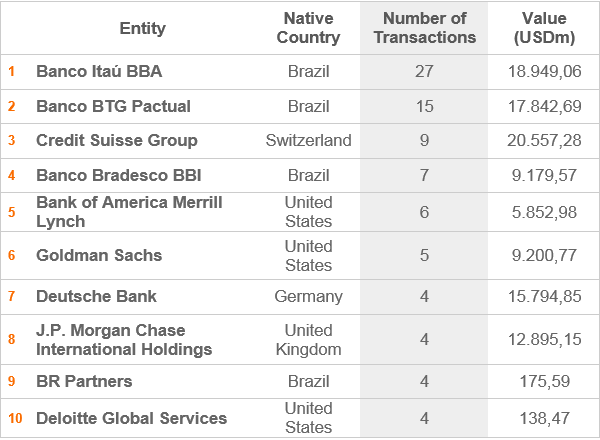
Banco Itaú BBA has a comfortable lead at the top of TTR’s Brazil financial advisory ranking at the start of August with 27 transactions together worth USD 18.9bn, with more than six times the combined value of its 32 transactions at this point in 2014. BTG rivals at second place by volume with just about USD 1bn less in combined deal value at USD 17.8bn for its 15 transactions. A year ago its 19 advisory mandates worth USD 7.3bn had also put it in second place by number of deals. Credit Suisse climbed two positions to take third in the ranking compared to its performance through 31 July, 2014, with nine deals together worth USD 20.6bn, putting it in the lead by value. Banco Bradesco BBI slipped one position to fourth compared to its run in 2014, with seven transactions together worth USD 9.2bn. BAML, in fifth, has advised on six transactions YTD in 2015 together worth USD 5.9bn. Goldman Sachs takes sixth place, with with five deals worth USD 9.2bn in aggregate. Deutsche Bank, at seventh, JPMorgan, at eighth, BR Partners in ninth, and Deloitte, in the tenth-place position, have all advised on four deals thus far in 2015. Deutsche Bank ranks fourth by combined value of USD 15.8bn, followed by JPMorgan with USD 12.9bn worth of combined deals. Both were absent from the top-10 in the first seven months of 2014, as was Goldman Sachs and BR Partners.


Legal Advisory – Year to Date (YTD)
4


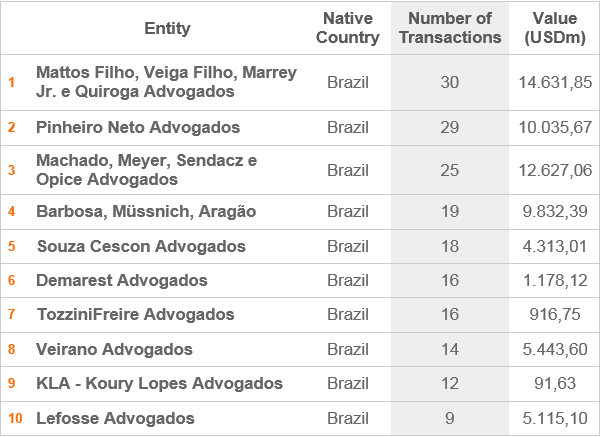
Mattos Filho, Veiga Filho, Marrey Jr. e Quiroga Advogados has overtaken Pinheiro Neto Advogados to lead TTR’s Brazil legal advisory ranking YTD in 2015 with 30 advisory mandates on deals worth USD 14.6bn combined giving it the lead also by aggregate value. It swapped positions with Pinheiro, which advised on 29 deals together worth USD 10bn for second place. At this time last year Pinheiro led with 34 advisory mandates worth USD 5.9bn combined, compared to Mattos Filho’s 31 deals worth USD 7.4bn combined. Machado, Meyer, Sendacz e Opice Advogados rose one spot in the ranking compared to the first seven months of 2014 to place third with 25 transactions worth USD 12.6bn combined, putting it about USD 2bn behind Mattos Filho by aggregate value. Barbosa, Müsnich, Aragão follows in fourth with its 19 deals together worth USD 9.8bn, compared to 14 worth USD 3.9bn at this time of year in 2014, which had put it at ninth place among the leading 10 firms. Souza Cescon Advogados is in fifth place with 18 deals worth USD 4.3bn, compared to its sixth place position at the end of July, 2014 when it had advised on 19 deals worth USD 10.3bn combined. Demarest Advogados climbed two positions in the ranking compared to last year to take sixth with 16 advisory mandates on transactions together worth USD 1.2bn. TozziniFreire Advogados has fallen two positions to seventh relative to its deal volume at this stage of 2014 with 16 advisory mandates on deals worth USD 917m combined YTD compared to 24 worth USD 3.3bn in the corresponding period of 2014. Veirano Advogados fell one position to eighth-place with 14 deals worth USD 5.4bn YTD compared to its 19 worth USD 987m at the end of July, 2014. Koury Lopes Advogados climbed one spot to ninth-place position by the end of July with 12 deals worth USD 92m this year compared to 13 worth USD 1.2bn last year when it’d placed tenth. Lefosse Advogados now brings up the rear with nine transactions together worth USD 5.1bn YTD. Lefosse did not place among the top-10 in the corresponding period of 2014.


Mexico Ranking – 2015

Financial Advisory – Year to Date (YTD)
5


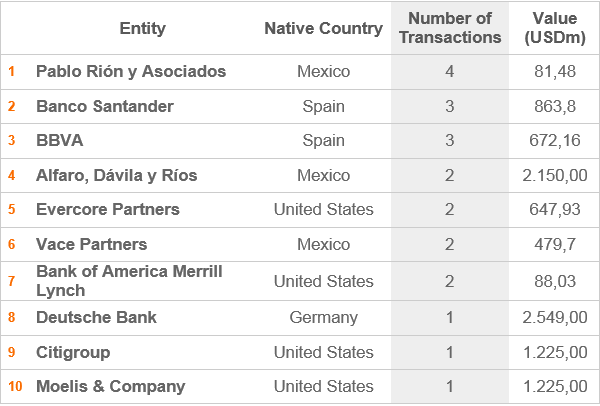
Pablo Rión y Asociados climbed to the top of TTR’s Mexico financial advisory ranking by the end of July with four transactions worth USD 81m in aggregate. Spain’s Banco Santander follows in second with three deals worth USD 864m combined, up from ninth place at the end of July, 2014 when it’d advised on one transaction worth USD 1.3bn. BBVA, at third, has also advised on three deals YTD, together worth USD 672m. Alfaro, Dávila y Ríos ranks fourth with two transactions worth USD 2.2bn. Evercore Partners and Vace Partners also have two deals apiece under their belts at fifth and sixth place positions, respectively, with USD 648m and USD 480m in combined deals, respectively. BAML also advised on two deals YTD, as it did in 1H14, worth USD 88m this year compared to USD 634m a year ago, putting it in seventh place by weighted volume. Deutsche Bank, at eighth, Citigroup at ninth, and Moelis & Company at tenth, have each advised on one deal YTD in 2015, in the case of Deutsche Bank, worth USD 2.5bn, putting it in the lead by aggregate value. Citigroup also advised on one transaction in the corresponding period of 2014, worth USD 1.7bn then, compared to this year’s worth USD 1.2bn.


Legal Advisory – Year to Date (YTD)


6
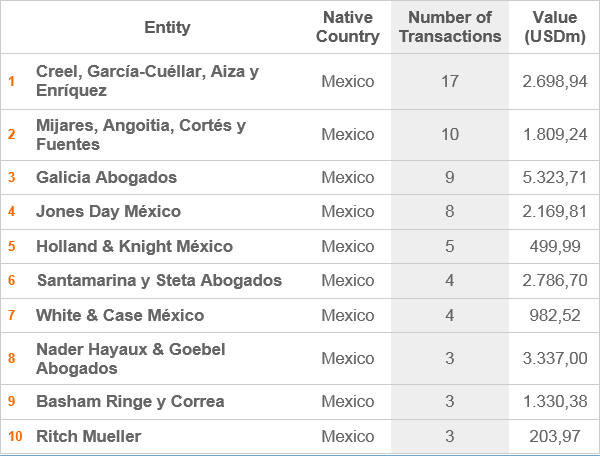
Creel, García-Cuéllar, Aiza y Enríquez maintains a solid lead over Mijares, Angoitia, Cortés y Fuentes, with 17 transactions worth USD 2.7bn combined, compared to its closest rival’s 10 deals together worth USD 1.8bn in TTR’s Mexico legal advisory ranking for the first seven months of 2015. Creel remains at number one despite dropping one deal by volume and 68% by aggregate value compared to its 18 deals worth USD 8.6bn at this time of the year in 2014. Galicia Abogados climbed four positions from its seventh place in the ranking at this point last year to take third with nine deals together worth USD 5.3bn. At this stage of 2014 Galicia had advised on four deals together worth USD 1bn. Jones Day México was not among the top 10 at the end of July in 2014 and now ranks fourth, with eight deals together worth USD 2.2bn. Holland & Knight follows with five deals worth USD 500m, compared to its four worth USD 2.3bn at the end of July, 2014, which had put it in sixth place. Santamarina y Steta Abogados holds sixth place, with four transactions worth USD 2.8bn combined. The firm was not among the top 10 in the first seven months of 2014. White & Case has also advised on four deals, but falls behind Santamarina in the chart owing to its lower combined value of USD 983m. By the end of July, 2014 it had advised on six transactions together worth USD 686m. Nader Hayaux & Goebel Abogados, in eighth, Basham, Ringe y Correa, in ninth and Ritch Mueller, bringing up the rear, have advised on three transactions each YTD, Nader’s worth USD 3.3bn combined, Basham’s USD 1.3bn and Ritch Mueller’s USD 204m. Neither Nader, Basham nor Ritch were among the top 10 in the first seven months of 2014.
 

TTR Dealmaker Q&A – Moshe Sendacz (Machado, Meyer, Sendacz e Opice Advogados)

TTR Dealmaker Q&A

July, 2015

Telefónica acquires GVT from Vivendi

EUR 7.5bn

Moshe Sendacz
Machado, Meyer, Sendacz e Opice Advogados

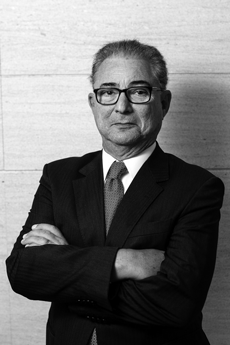
On 28 May, Spain’s Telefónica closed the acquisition of Curitiba, Brazil-based triple-play provider GVT from France-based Vivendi in a transaction worth EUR 7.5bn. Moshe Sendacz, a founding partner at one of Brazil’s leading M&A firms, led the team that advised the buyer on this monumental deal.
________________________________________________________________________________

Q: Why was your firm selected to act on behalf of Telefónica in this transaction?

A: It was a natural selection because we have been assisting the Telefónica Group since the privatization of Telebras in 1996-1997. We’ve been assisting Telefónica in all the transactions it carries out in Brazil, including when it competed for GVT and lost to Vivendi in 2009.

Q: What expertise did Machado, Meyer, Sendacz e Opice bring to the table?

A: The deal required expertise in various areas, with one of the most challenging being regulatory. Our capital markets practice played an important role in a follow-on issuance involved in the GVT deal in the amount of USD 5bn in shares, which was entirely subscribed. This was an overwhelming success at a difficult time in Brazil’s capital market. It was a very complex deal for the firm’s M&A practice, as Vivendi received part of the purchase price in cash, and part in shares of Telefônica Brasil through the merger of GVT’s shares into Telefônica Brasil; a portion of Telefônica Brasil shares thus received by Vivendi were subsequently exchanged by Vivendi with Telefónica for shares held by Telefónica in Telecom Italia, thus allowing Telefónica to begin exiting its investment in Telecom Italia and its indirect ownership in TIM Brasil. Our tax team also played an important role in solving, in an efficient manner, several tax issues faced in all aspects of the deal. The simultaneous closing in São Paulo, Paris, Milan and Madrid contributed to the complexity of the deal.

“It was a very complex deal for the firm’s M&A practice, as Vivendi received part of the purchase price in cash, and part in shares of Telefônica Brasil through the merger of GVT’s shares into Telefônica Brasil”

Q: What concerns did the regulators raise?

A: The Brazilian regulators forced Telefónica to exit its stake in Telecom Italia because of the condition barring it from indirectly holding shares in two competing operators in Brazil, namely Telecom Italia’s subsidiary TIM Brasil, the country’s number two player in mobile with 27.1% market share, and Telefônica Brasil, the market leader with 28.5% market share in mobile services. The Brazilian regulators were also concerned about that portion of the deal that would result in Vivendi receiving, as part of the GVT purchase price, shares of Telefônica Brasil, thus becoming a direct shareholder in Telefônica Brasil and an indirect shareholder in TIM Brasil as a result of the swap of shares between Telefónica and Vivendi. These two main issues required a complex negotiation with Brazilian antitrust authorities and telecom regulator, Anatel.

Q: How long did the negotiations with regulators take to conclude?

A: We started to approach the local authorities immediately after the execution of the SPA in September, 2014, and before making any required filings. Negotiations with the regulators commenced in October, 2014 and concluded in March, 2015.

Q: Telefónica had been the expected buyer of GVT in 2009. What went wrong then?

A: The seller decided to accept Vivendi’s offer for the controlling shares, and Telefónica gave up on the public tender offer it had launched to acquire GVT. In 2014 Vivendi manifested its desire to exit Brazil and Telefónica decided to present an offer for GVT. Vivendi also received an offer from Telecom Italia for the same asset. Telefónica’s offer conditions were much more attractive, and Vivendi decided to proceed with Telefónica. The purchase agreement was negotiated in record time in just two weeks: one week in São Paulo and one week in Paris, concluding with the signing on 18 September, 2014.

“The purchase agreement was negotiated in record time in just two weeks: one week in São Paulo and one week in Paris”

Q: What prompted Vivendi to sell GVT?

A: Telecom is a very capital-intensive business; it needs investment all the time. Vivendi was small relative to other players in the market to compete effectively and the company required more capital to grow the business.

Q: Apart from being extremely profitable, what made this asset so attractive for Telefónica?

A: It would complement geographically and also GVT is very strong in broadband. It has a very attractive fiber network and a strong presence in the corporate market.

Q: Why is GVT so profitable?

A: It was very well structured and managed by its CEO, Amos Genish, one of the founding shareholders of GVT. He’s now the top telecom guy in Brazil and has accepted the position of CEO at Telefônica Brasil. He is the leading executive at Telefónica Group in the country, which GVT is now part of.

Q: How was a multiple of 14.86x on 2013 EBITDA arrived at?

A: The telecom market is undergoing consolidation in Brazil. GVT was at the point where it would start to lose market share, but it represented synergies for the buyer. It was one of the few assets in play in a consolidated market; there’s a price in that. There was virtually no geographical overlap. The regulatory issue was in the crossed ownership of Telefónica and Telecom Italia and Vivendi and Telefônica Brasil. The antitrust and telecom authorities approved the merger of operations with no relevant objections, and more importantly, the price paid by Telefônica Brasil to Vivendi was supported by appraisals and opinions prepared by investment banks by using criteria typically adopted in deals of this nature.

Q: What does this transaction represent for the telecom sector in Brazil?

A: Telefônica has now improved its offering mainly in Internet and data services thanks to GVT’s strong fiber network. It’s a strong and solid company. It was already the largest telecom operator in Brasil. GVT was not a competitor. In fact, one of the issues raised during the negotiations with the regulatory authorities was that it could become a good competitor, because it was growing, but it was not the intent of Vivendi to invest heavily to realize that growth, so essentially the competitive landscape remains the same after the deal. The telecom market is dominated by Telefônica, TIM Brasil, Claro and Oi, which together control around 95% of the market. I believe there is no room for more operators. The transaction won’t impact pricing for consumers, but Telefônica can now compete in areas where it was not a major player previously.

Q: What made this transaction unique among deals your firm has advised on?

A: First, for the consideration involved. This was the biggest M&A transaction in Brazil, in terms of price, of the past 35 years. Secondly, owing to the complexity of the transaction, it was important for the firm to be involved. It was very important for the firm to strengthen its professional relationship with Telefónica and build on the confidence the country’s largest telecom has in us so that we can continue assisting the company in the years ahead.

“This was the biggest M&A transaction in Brazil, in terms of price, of the past 35 years”

Q: How did the firm celebrate the closing?

A: With a lot of Champagne. Simultaneous parties were held to celebrate at Telefónica’s country headquarters in Madrid and here in São Paulo.

See-Full-Transactions-Details


Download PDF

Mexico’s revision of maritime regulatory framework brings clarity in wake of energy reform

torres-medina

By Benjamin Torres and Hector Medina

Baker & McKenzie México 

Mexico is restructuring its entire regulatory framework governing the energy sector, and hasn’t neglected the need to address ambiguities hindering private sector participation in linked industries governed by maritime law.

The first step in the country’s sweeping energy reform was taken by the Mexican government on 20 December, 2013, with landmark amendments to certain key articles of the Mexican Constitution related to the energy sector, including hydrocarbons and power generation. Those amendments are the legal foundation for broader participation by private entities in several activities that were previously reserved for Mexican nationals or the Mexican state.

Mexico has made several attempts to stimulate the development of its energy sector over the years, including the so-called “Energy Reform” spearheaded by former president Felipe Calderon in 2008. The truth is, none of the previous attempts had the desired effect, since any real change required a revision of the fundamental legal framework governing the energy sector in Mexico: the Constitution.

The recent constitutional reforms have led to the enactment of a new set of energy laws and regulations as well as substantive amendments to other laws and regulations to align them with the new energy reform framework. The intention is clear: to allow greater private participation in the entire Mexican energy sector, downstream, midstream and upstream, whether hydrocarbons or power.

The reform is still in its implementation phase and there are several regulations, administrative guidelines and other regulatory provisions yet to be issued. However, over the last year, the reform has achieved measurable results, particularly in the hydrocarbons sector with the publication of tenders for offshore shallow-water exploration and production and production enhancement under the Round One bidding procedure, which were published by the recently strengthened Mexican National Hydrocarbons Commission (CNH). The call for tenders has been well received by many of the relevant players in the domestic and international energy industry. Several well-known companies in the upstream sector are participating in different stages of the tender process.

There are other sectors of activity that have been realigned with the new energy policies introduced by the Mexican government as a result of the constitutional reforms. The maritime sector, which has a very close connection to the oil and gas industry in offshore exploration and production operations, is governed by the Navigation and Maritime Commerce Law enacted in June 2006 (the NMC law).

The NMC law governs the operation of vessels and other naval artifacts in Mexican waters as well as the most important agreements related to such activities including charter parties and purchase and sale agreements, among others. A naval artifact is defined as any fixed or floating structure not designed or built for navigation but that is capable of being moved on the water by itself or by another vessel, or built on the water.

Regulations for the NMC Law were published in the Federal Official Gazette on 4 March, 2015 and became effective on 4 April, 2015.

Prior to the enactment of the NMC law, two previous versions of navigation laws coexisted and remained in force: a Navigation Law enacted in 1994 as well as another Navigation Law and Maritime Commerce Law enacted in 1963. Both were repealed by the new NMC law except for certain regulations under the Navigation Law of 1994, which remained in effect. Those regulations have now been furnished by the new regulation published on 4 March, 2015, which offer new guidelines for private sector business opportunities.

Prior to the new regulations of the NMC Law, the legal standing of foreign vessels in Mexican waters operated by foreign navigation companies was not entirely clear and according to some interpretations, only Mexican navigation companies could operate foreign-flagged vessels in Mexico by securing a temporary navigation permit limited to a maximum of two years. These permits are granted for a period of three months and can be renewed up to seven times. If the vessel stays more than two years in Mexican waters, it has to be flagged as Mexican, but certain exceptions may apply for highly specialized vessels, including those dedicated to oil and gas activities.

It was, however, possible for foreign navigation companies to operate foreign-flagged naval artifacts, such as drilling rigs and production platforms under temporary authorizations. This confusing legal structure led foreigners to implement complex corporate and tax structures involving incorporation of Mexican navigation companies to hold permits to operate foreign-flagged vessels and still comply with restrictions on foreign investment provided by the law.

The new regulations to the NMC law provide a much clearer process to allow foreign entities to secure permits to operate foreign-flagged vessels and naval artifacts, such as rigs and production platforms. Although foreign navigation companies will continue to face some restrictions, these will not represent a significant obstacle to their business activities. Moreover, the new regulations provide specific treatment for vessels and naval artifacts dedicated to oil and gas activities, including its regulation of navigation and permanency in Mexican waters, safety and inspection, crew training, and prevention of pollution caused by hydrocarbons, among other matters critically important to prepare an efficient business plan.

Article 40 of the NMC law provides that “the operation and exploitation of vessels in interior and coastal navigation is reserved to Mexican navigation companies with Mexican vessels”. However, an exception is provided in case of the lack of existence of available Mexican vessels in equal technical conditions or in case of public interest, where it is possible to grant temporary permits for coastal navigation in favor of Mexican navigation companies with foreign vessels.

Moreover, Article 41 of the NMC law provides that “having conducted the bidding process with the preference provided under items I and II of the above Article, a permit may be granted for a new procedure including foreign navigation companies with foreign vessels.” It is important to mention that prior the enactment of the new regulations to the NMC law, there was no clear procedure provided to include foreign navigation companies with foreign vessels and therefore to issue temporary navigation permits in favor of foreign navigation companies with foreign vessels, as provided under Article 41.

Now, the new regulations to the NMC law, provide under Article 226 that, “the foreign navigation companies, in order to exploit and operate foreign vessels in coastal navigation, will require a temporary navigation permit according to Article 41 of the NMC law…”.

In light of the above, the possibility for a foreign navigation company to apply for a temporary navigation permit to operate foreign vessels in coastal Mexican waters has greater clarity than under the previous regulation. It is provided, however, that the Maritime Transportation Industrial Chamber must be notified as to the application of any permit, such that the chamber may indicate the availability of a Mexican vessel with the same technical capabilities. A general notice must be served to Mexican navigation companies so they can exercise their preferential right granted under Article 40 of the NMC law, as outlined above.

In conclusion, if a foreign navigation company applies for a temporary navigation permit to operate a foreign vessel in Mexican coastal waters, the procedure described above shall be conducted and all the conditions under Article 41 of the NMC law and under Article 226 of its new regulations must be complied with, so the corresponding authority can issue a navigation permit, even if it is a foreign navigation company with a foreign vessel.

OTHER OPPORTUNITIES IN MEXICO’S MARITIME SECTOR

Another important activity that is expected to be further developed in Mexico is ship building. This is also reflected in the new regulations to the NMC law, which added specific provisions and standards for such activities, including the granting of authorizations for shipyards to operate in Mexico.

The Mexican government’s effort to harmonize all sectors involved or related with the new energy industry has been remarkable, and the maritime sector constitutes clear evidence of this.

In addition to the enactment of the regulations to the NMC law, the federal government aims to foster and promote the sector. Last year, it announced a plan to update the applicable regulatory framework to increase the legal certainty in connection with the merchant marine; extend and modernize port infrastructure; and modernize the maritime fleet, focused on highly specialized equipment for the oil and gas sector. The plan also includes substantial investment.

Companies interested in participating in maritime business opportunities in Mexico will need to fully understand and be well advised of the Mexican maritime regulatory framework, including its recent developments, in order to carry out an effective business plan and implement the most efficient corporate and tax structures.

________________________________________________________________________________

About the authors

Benjamin Torres is a partner at Baker & McKenzie and head of the firm’s energy, mining and infrastructure practice in Mexico.

Hector Medina is an associate in the firm’s real estate group, and a member of the mining, energy and infrastructure practice group.